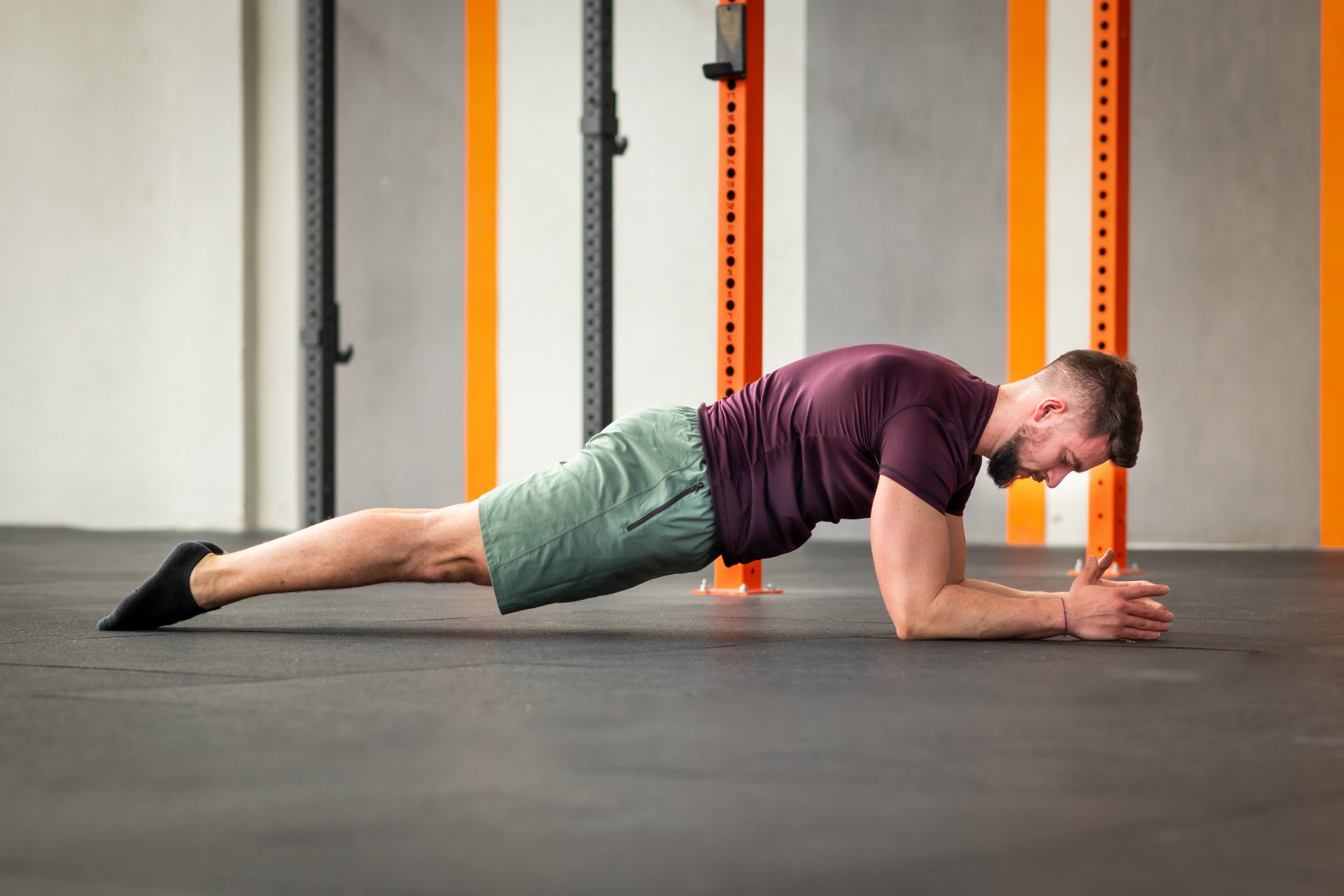
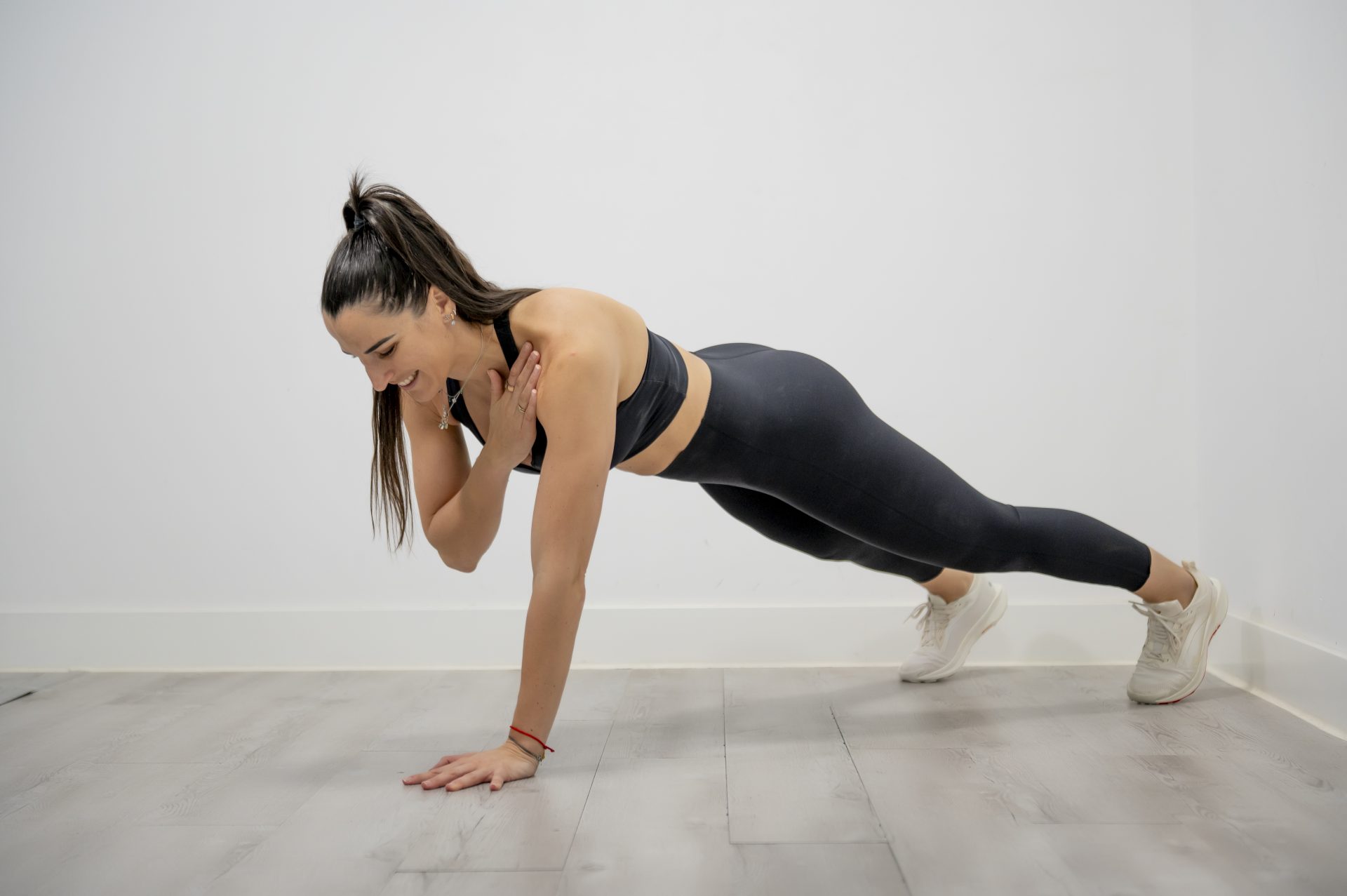
Shoulder taps exercises are a compound bodyweight movement performed in a high-plank position — hands directly under shoulders, body in a straight line from head to heels, core braced — where one hand at a time lifts off the floor and taps the opposite shoulder before returning to the supporting position. Despite the simple description, shoulder taps are deceptively demanding because the moment one hand leaves the floor, the body’s natural tendency is to rotate or sway sideways. Resisting that rotation is exactly what makes shoulder taps valuable: this is anti-rotation core training, the same training quality used by every athletic movement that requires keeping the spine stable while the limbs do work. The exercise category also goes by other names — the “plank for shoulders” search term reflects this dual-purpose nature, since shoulder taps train shoulder stability AND plank-position core simultaneously.
The mechanism is what makes shoulder taps uniquely effective. Most ab exercises (crunches, sit ups, leg raises) train the core in flexion or extension. Shoulder taps train the core in anti-rotation — preventing the spine from twisting when one side of the body unloads. This is the function the core actually performs in real-world movement: walking with a heavy bag in one hand, picking up a child on one side, swinging a racket. Shoulder taps simultaneously train the deltoids and triceps (which stabilise the supporting arm), the serratus anterior (which keeps the shoulder blade locked against the ribcage), and the entire posterior chain. For variations like the shoulder tap biceps curl that progress the move with added resistance, the broader programme covers the full progression sequence including loaded variations.
Builds Anti-Rotation Core Strength (The Most Functional Ab Quality)
The core has four primary functions: anti-flexion, anti-extension, anti-rotation, and anti-lateral-flexion. Shoulder taps are one of the highest-yield anti-rotation exercises in the bodyweight toolkit. EMG research on abdominal exercises (Escamilla et al., 2010, Journal of Orthopaedic & Sports Physical Therapy) shows shoulder-tap-style anti-rotation work produces significantly higher oblique and transverse abdominis activation than standard plank holds because the constantly shifting load forces continuous core firing.
Strengthens Shoulder Stability and Rotator Cuff Endurance
The supporting arm’s shoulder works isometrically throughout shoulder taps — holding body weight while resisting the pull of the lifted arm. Daily practice strengthens the rotator cuff, serratus anterior and deltoids in a way that translates directly into better push-up performance, longer overhead carries, and reduced shoulder injury risk during heavier work.
Improves Plank Endurance and Core Integration
Shoulder taps are essentially a moving plank with added challenge. Members who incorporate shoulder taps into daily core work consistently report improved plank hold times — often jumping from 60-second plank max to 90+ seconds within 4–6 weeks. The training transfers directly because the underlying demand is the same.
Time-Efficient — Trains Multiple Muscle Groups Simultaneously
3 sets of 30-second shoulder taps deliver core, shoulder, triceps and chest training in a single movement. For working professionals with limited training time, this multi-muscle efficiency makes shoulder taps one of the most valuable bodyweight exercises in any home routine.
Exercise 1: Standard Shoulder Taps — Anti-Rotation Core + Shoulder Stability — 3 sets × 30 seconds
Begin in high plank position — hands directly under shoulders, body in a straight line, core braced, feet hip-width apart. Lift the right hand off the floor and tap the left shoulder, return; lift the left hand and tap the right shoulder, return. Continue alternating at a controlled pace for 30 seconds. 3 sets total. Keep the hips as still as possible — minimal sway is the goal. Modification: widen the feet to a slightly wider stance for more stability; reduce duration to 20 seconds initially and build up.
Exercise 2: Knee-Plank Shoulder Taps — Beginner Plank for Shoulders — 3 sets × 30 seconds
Begin in modified plank — hands under shoulders, knees on the floor (rather than feet), body in a straight line from knees to head. Perform shoulder taps from this reduced-load position. 3 sets × 30 seconds. The plank-for-shoulders entry-level variation — designed for those building core strength from zero, anyone with wrist sensitivity, or postpartum recovery training. Build to standard shoulder taps over 3–4 weeks once form is locked. Modification: place a folded towel under the knees for joint padding.
Exercise 3: Shoulder Tap Biceps Curl — Loaded Anti-Rotation + Bicep — 3 sets × 12 reps each side
Set up in a high plank position with a light dumbbell (1–3 kg) in each hand on the floor. Lift the right hand with the dumbbell, perform a slow biceps curl while balancing on the left arm, lower the dumbbell back to the floor. Switch sides. 3 sets × 12 reps each side. The shoulder tap biceps curl variation — an advanced progression that adds bicep loading on top of the anti-rotation core demand. Save for week 6+ once standard shoulder taps are clean. Modification: use lighter weight (1 kg or no weight) initially; progress only after form stays clean throughout the set.
Mistake 1: Letting the Hips Sway Side to Side — Correction: Brace Glutes and Core, Widen Stance
The most common shoulder taps error: as one hand lifts, the hips rotate or sway sideways to compensate, completely defeating the anti-rotation purpose. The exercise becomes a moving plank with no real training stimulus. What to do instead: consciously brace the glutes (squeeze tight) and core before each rep. Widen the feet to a slightly wider stance — the wider base reduces the rotational tendency. Watch your hips in a mirror or video — they should stay level throughout. Form first; pace second.
Mistake 2: Going Too Fast With Sloppy Form — Correction: 1 Tap Per Second With Control
Speed-doing shoulder taps by quickly slapping at the shoulders trains nothing — momentum and rapid weight-shifts mask the core demand. What to do instead: moderate, deliberate pace — roughly 1 tap per second. Each tap should feel solid, with the hips staying level throughout. 25 controlled taps per 30 seconds beat 50 sloppy ones for both core development and shoulder safety. The deep-dive reinforces this controlled-tempo principle for all shoulder-loaded work.
Mistake 3: Sagging Hips or Piking Hips — Correction: Maintain Straight-Line Plank Position
If the hips drop low (sagging) or rise high (piking) during shoulder taps, the core disengages and the lower back takes load it shouldn’t. What to do instead: set up like a strict push-up — body straight from heels to crown of head — and maintain that line throughout. The moment the hips sag or pike, stop, reset, and continue at a slower pace. Better to do 3 sets of 20 seconds with perfect form than 1 set of 60 seconds with broken form.
Anti-Rotation Programming, Not Just Crunches and Planks
Most online ab routines completely ignore anti-rotation training. Habuild’s daily sessions explicitly programme shoulder taps, dead bugs and pallof press variations alongside crunches and planks, ensuring all four core training functions (anti-flexion, anti-extension, anti-rotation, anti-lateral-flexion) develop together — the foundation of real functional core strength.
Live Daily Sessions With Real-Time Form Correction
The hip-sway error, the speed-tap error, the sagging-hip error — all corrected within seconds on the live call. Shoulder taps done badly are useless; shoulder taps done well are highly effective compound movements. The difference is form, and form requires live coaching.
Progressive Overload Built Into Every Session
Week 1: knee-plank shoulder taps, 20 seconds. Week 4: standard shoulder taps at 30-second sets. Week 6: shoulder tap biceps curl introduced. Week 10: longer sets with combined sequences. Members don’t programme this — duration, complexity and load build progressively within the live class flow.
Accountability, Streaks and Community
Anti-rotation core strength shows up in real-world movement — improved walking, lifting, sport — but the visible body change is subtle. Daily streak tracking, the WhatsApp community and live morning sessions keep members on the mat through the slow window where the deep core is rebuilding silently before performance benefits show.
Complete Beginners Starting from Zero
Shoulder taps begin in a push-up plank position with no equipment. The movement is scaled by widening the feet (reduces rotation challenge) and moving the tapping hand slowly. Even those new to plank-based exercises can begin here. The only requirement is showing up consistently — strength and technique follow from that.
Intermediate Trainees Looking to Fill a Gap
Shoulder taps build the anti-rotation core stability that planks alone cannot develop — the ability to resist twisting forces while maintaining spinal alignment. This is exactly the kind of stability that protects the spine during daily activities and sport, making shoulder taps one of the most functional core exercises available. Adding shoulder taps exercises to an existing routine addresses a specific conditioning gap that most general workouts miss.
Those Building Anti-Rotation Core Stability and Plank Progressions
Shoulder taps build the anti-rotation core stability that planks alone cannot develop — the ability to resist twisting forces while maintaining spinal alignment. This is exactly the kind of stability that protects the spine during daily activities and sport, making shoulder taps one of the most functional core exercises available.
Senior Citizens and Older Adults (50+)
Shoulder Taps Exercises can be adapted for older adults by controlling tempo, reducing range of motion, and using supported variations. Habuild’s live instructors modify exercises in real time for different fitness levels and physical conditions in the same session.
Is Shoulder Taps Exercises Good for Beginners?
Yes — absolutely. Shoulder Taps Exercises begin at very low intensity with fully accessible entry-level variations. Habuild’s live instructor adapts the session in real time so beginners and experienced trainees can train together without either being left behind.
How Often to Do Shoulder Taps Exercises — Frequency Guide
Train shoulder taps exercises 3–4 times per week. This frequency gives the muscle and nervous system adequate stimulus without outpacing recovery. Consistency matters more than intensity in the early weeks — showing up regularly produces better results than infrequent all-out sessions.
When in Your Workout to Do Shoulder Taps Exercises
Place shoulder taps exercises in the core or upper-body session, typically after push-ups and planks as a stability-focused finisher. Sequencing exercises correctly ensures you bring maximum quality to shoulder taps exercises rather than performing them under accumulated fatigue from earlier work.
What to Pair Shoulder Taps Exercises With
Combine shoulder taps exercises with planks, push-ups, and dead bugs for a complete anti-rotation and core stability programme. This combination develops complementary muscle groups in the same session and builds the balanced strength that prevents compensation and injury.
How to Progress Shoulder Taps Exercises Over Time
Once the base movement feels controlled and repeatable, narrow the foot width, increase the pace of the tap, add light wrist weights, or progress to alternating shoulder tap push-ups for combined strength and stability demand. Progress only when form is consistent — adding difficulty before mastering the base movement reinforces poor mechanics and stalls long-term results.
Habuild is India’s First Habit Building Program — and through its strength and fitness sessions, it brings the same habit-based philosophy to targeted exercise training. Every session is structured around your specific goal, not a one-size-fits-all class.
Goal-Specific Programming — Not a Generic Fitness Class
Every exercise, rep range, and rest period in Habuild’s shoulder taps exercises sessions is chosen because it produces results for shoulder taps exercises specifically. Habuild does not run the same session for every goal — the programme is structured to drive your specific outcome with every session, not general fitness that happens to include shoulder taps exercises.
Live Daily Sessions with Real-Time Form Correction
Unlike pre-recorded videos, Habuild’s live daily sessions allow the instructor to see and correct your form in real time — the specific errors that limit shoulder taps exercises results and increase injury risk. This live correction is the difference between training that works and training that wastes effort and creates bad habits.
Progressive Overload Built into Every Session
Members do not need to design their own progressive overload for shoulder taps exercises — it is built into the programme structure. Each week, sessions are deliberately more challenging than the last, ensuring the body never fully adapts and results continue coming rather than stalling.
Accountability, Streaks, and Community
The most common reason people stop exercising is not effort — it is missing sessions until the habit breaks. Habuild’s streak system, live session accountability, and community of members training the same goal alongside you resolves this directly. Members who join with a specific goal like shoulder taps exercises and stay consistent for 30 days almost universally report that showing up has become automatic.
"120-day streak. Daily Habuild shoulder taps plus standard plank work — plank max more than doubled in 7 weeks. The anti-rotation transfer was the secret. Could feel the deep core firing during regular planks differently after just 3 weeks of shoulder tap practice."
"180-day streak. I'd been stuck at 6 push-ups for months. Five months of daily Habuild work including shoulder taps and shoulder tap biceps curl — clean 18 push-ups last week. The shoulder stability transfer was significant."


Practice Strong Everyday with Trishala Bothra, an IIT-B and London School of Business alumni
Trishala is focused on making movement feel lighter, more engaging, and something you actually look forward to.
In just 3 years, over 50,000 people began their strength journey, and 10,000+ join every week to keep getting stronger.