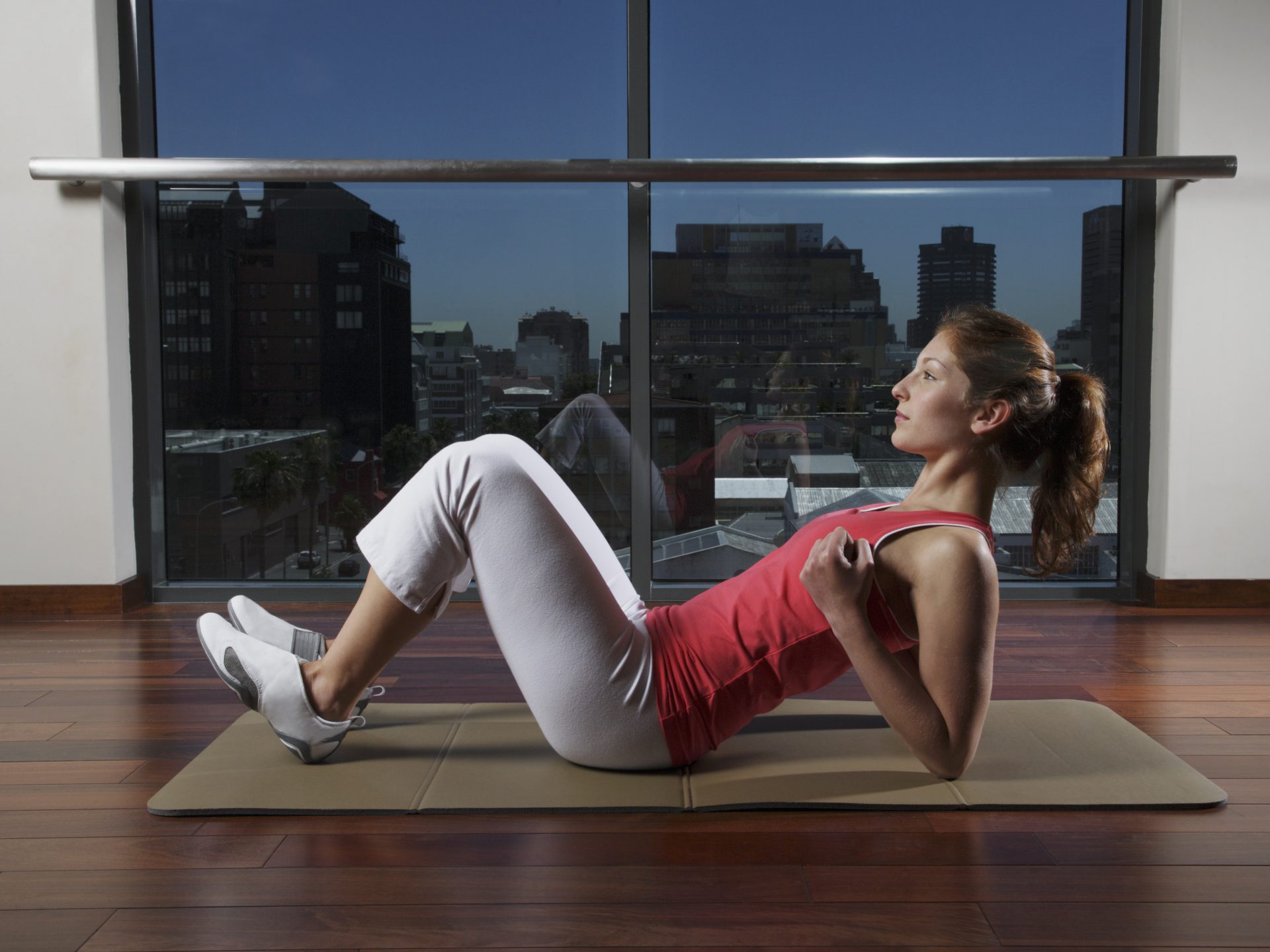
An obliques workout is a focused training session that targets the side abdominal muscles — specifically the internal and external obliques — through both isolation and anti-rotation movements. The obliques run diagonally along the sides of the torso, from the lower ribs to the pelvis. They are responsible for waist definition (when developed and lean), rotational power (in sports, lifting, and daily movement), and lateral spine stability. Most home core routines completely neglect them, leading to a flat-front-but-undefined-sides core that looks half-built. A dedicated obliques workout fixes this gap directly.
The mechanism varies by movement type. Isolation exercises (side crunches, Russian twists, side bends) flex and rotate the spine under load, contracting the obliques concentrically and producing hypertrophy and strength. Anti-rotation exercises (pallof press, side planks, anti-rotation chops) train the obliques to resist rotation — a critical function for spine health, lifting safety, and athletic stability. The most complete oblique muscle exercise programme uses both: isolation for visible definition, anti-rotation for stability and injury prevention. Train obliques 4 days a week alongside the rest of the core, and visible side ab definition typically appears within 6–10 weeks — body fat permitting.
Sharper Waist Definition and Visible Side Abs
Targeted oblique muscle exercises produce the side-of-torso definition that abdominal training alone doesn’t reach. Combined with a moderate calorie deficit, 8–10 weeks of consistent oblique training visibly sharpens the waistline.
Stronger Rotational Power for Sports and Daily Movement
The obliques generate the torque used in throwing, swinging, lifting, and turning. Research on targeted oblique training has shown meaningful improvements in rotational power output over 12-week training cycles — directly improving athletic performance.
Reduced Lower Back Pain and Better Spine Stability
Strong obliques distribute load away from the lumbar spine during bending, lifting, and twisting. Research on core training consistently shows meaningful reductions in low back pain frequency, often in the range of 50–75% when daily core work is added to standard care.
Better Posture and Side-to-Side Symmetry
Most people are stronger on one side of their core than the other — visible as slight tilts in standing, walking, and lifting. A symmetrical obliques workout reveals and corrects this imbalance.
Exercise 1: Side Crunch — Internal and External Obliques — 3 sets × 15 reps each side
How to perform: Lie on your right side, knees bent, left hand behind your head. Curl your left shoulder toward your left hip, contracting the side of the torso. Lower with control. Why it suits this goal: Direct isolation of the obliques with maximum oblique-only contraction. The single best beginner side ab workout movement. Modification: Press the bottom hand into the floor for assistance and reduce reps to 10 per side.
Exercise 2: Russian Twist — Obliques, Transverse Abdominis — 3 sets × 20 reps total (10 each side)
How to perform: Sit with knees bent, lean back to a 45-degree angle, hold a weight (or no weight) at chest level. Rotate the torso side to side, touching the weight to the floor on each side. Why it suits this goal: Combines flexion and rotation under load — full oblique recruitment. Modification: Bodyweight only, slower tempo, feet on the floor for stability. Note: keep tempo controlled and range moderate — fast, large-range Russian twists with heavy weight can strain the lumbar spine. Bodyweight or light load is plenty for most home trainers.
Exercise 3: Side Plank — Obliques, Quadratus Lumborum, Glute Medius — 3 sets × 30–45 seconds each side
How to perform: Lie on your side, prop yourself on your forearm with your elbow under your shoulder. Lift the hips off the floor, body in a straight line. Hold. Why it suits this goal: Anti-rotation and isometric oblique training. Complements isolation work by training the obliques in their stabilising function. Modification: Side plank from the knees instead of the feet for beginners.
Mistake 1: Training Only the Front Abs and Skipping the Sides — Correction: 50% of Core Time on Obliques
What it is + why it undermines results: Most home core routines spend 90% of the time on crunches and planks (rectus abdominis), leaving the obliques underdeveloped. What to do instead: Allocate at least 40–50% of core training time to oblique-specific work — side crunches, Russian twists, side planks.
Mistake 2: Rushing Reps Using Momentum — Correction: 2 Seconds Up, 2 Seconds Down
What it is + why it undermines results: Fast oblique reps use momentum, not muscle, and produce minimal hypertrophy. What to do instead: Use a 2-second concentric, 1-second hold, 2-second eccentric tempo. Half the reps, double the result.
Mistake 3: Doing the Same Side Ab Workout Every Session — Correction: Rotate Between Isolation and Anti-Rotation
What it is + why it undermines results: Adaptation plateaus when the same exercises are repeated indefinitely. The obliques have multiple functions — train all of them. What to do instead: Alternate sessions: one session focused on isolation (crunches, twists), the next on anti-rotation (planks, pallof press). In a live Habuild class, the coach catches the asymmetric reps most home trainers don’t notice — the dominant side quietly does 12 reps while the weaker side does 9, deepening the imbalance the obliques workout was meant to fix.
Oblique-First Core Programming
Habuild’s core sessions deliberately program oblique work first — when the abs are freshest. Most home routines do crunches first, fatigue the rectus abdominis, and reach the obliques tired. Reversing the order produces measurably better oblique development.
Live Daily Sessions With Real-Time Form Correction
The three invisible oblique-workout failures — neck pulling, momentum, asymmetric reps — are caught immediately by a live coach. Without correction, most home trainers don’t realise the form has degraded.
Progressive Overload Built Into Every Session
Members progress from bodyweight to weighted to advanced anti-rotation variations on a structured schedule. The progression is built in.
Accountability, Streaks, and Community
Visible side ab definition takes 8–10 weeks of consistent oblique-focused work. Daily streaks and live cohort timing keep members showing up across the long timeline.
Complete Beginners Starting from Zero
Oblique exercises begin with simple side-lying movements and slow bicycle crunches on the floor — no equipment required. The pace and range of rotation are fully self-controlled, making these appropriate for any fitness level. The only requirement is showing up consistently — strength and technique follow from that.
Intermediate Trainees Looking to Fill a Gap
The obliques are the muscles responsible for the defined waist and V-shape that abdominal training is typically aimed at — but they are systematically neglected by programmes that focus only on crunches and planks. A dedicated obliques workout develops both the internal and external obliques, creating the rotational strength that protects the spine and the definition that straight-line ab work cannot produce. Adding obliques workout to an existing routine addresses a specific conditioning gap that most general workouts miss.
Those Training for Waist Definition and Rotational Core Strength
The obliques are the muscles responsible for the defined waist and V-shape that abdominal training is typically aimed at — but they are systematically neglected by programmes that focus only on crunches and planks. A dedicated obliques workout develops both the internal and external obliques, creating the rotational strength that protects the spine and the definition that straight-line ab work cannot produce.
Senior Citizens and Older Adults (50+)
Obliques Workout can be adapted for older adults by controlling tempo, reducing range of motion, and using supported variations. Habuild’s live instructors modify exercises in real time for different fitness levels and physical conditions in the same session.
Is Obliques Workout Good for Beginners?
Yes — absolutely. Obliques Workout begin at very low intensity with fully accessible entry-level variations. Habuild’s live instructor adapts the session in real time so beginners and experienced trainees can train together without either being left behind.
How Often to Do Obliques Workout — Frequency Guide
Train obliques workout 4–5 times per week. This frequency gives the muscle and nervous system adequate stimulus without outpacing recovery. Consistency matters more than intensity in the early weeks — showing up regularly produces better results than infrequent all-out sessions.
When in Your Workout to Do Obliques Workout
Place obliques workout in the core block, after straight-line ab exercises (crunches, planks), as the rotational component of a complete core programme. Sequencing exercises correctly ensures you bring maximum quality to obliques workout rather than performing them under accumulated fatigue from earlier work.
What to Pair Obliques Workout With
Combine obliques workout with planks, crunches, and reverse crunches for a complete core programme covering all planes of movement. This combination develops complementary muscle groups in the same session and builds the balanced strength that prevents compensation and injury.
How to Progress Obliques Workout Over Time
Once the base movement feels controlled and repeatable, add a dumbbell or medicine ball, increase rotation speed, and progress to cable woodchops and standing rotation exercises for external resistance. Progress only when form is consistent — adding difficulty before mastering the base movement reinforces poor mechanics and stalls long-term results.
Habuild is India’s First Habit Building Program — and through its strength and fitness sessions, it brings the same habit-based philosophy to targeted exercise training. Every session is structured around your specific goal, not a one-size-fits-all class.
Goal-Specific Programming — Not a Generic Fitness Class
Every exercise, rep range, and rest period in Habuild’s obliques workout sessions is chosen because it produces results for obliques workout specifically. Habuild does not run the same session for every goal — the programme is structured to drive your specific outcome with every session, not general fitness that happens to include obliques workout.
Live Daily Sessions with Real-Time Form Correction
Unlike pre-recorded videos, Habuild’s live daily sessions allow the instructor to see and correct your form in real time — the specific errors that limit obliques workout results and increase injury risk. This live correction is the difference between training that works and training that wastes effort and creates bad habits.
Progressive Overload Built into Every Session
Members do not need to design their own progressive overload for obliques workout — it is built into the programme structure. Each week, sessions are deliberately more challenging than the last, ensuring the body never fully adapts and results continue coming rather than stalling.
Accountability, Streaks, and Community
The most common reason people stop exercising is not effort — it is missing sessions until the habit breaks. Habuild’s streak system, live session accountability, and community of members training the same goal alongside you resolves this directly. Members who join with a specific goal like obliques workout and stay consistent for 30 days almost universally report that showing up has become automatic.
I have been with Habuild for 1,050 days. My energy has increased and I don't feel drained by work anymore. My patience has grown — things that used to stress me out don't affect me the same way. My kids at home have also picked up the yoga habit. Most importantly, my knowledge about breathing and how it affects the entire body has transformed. My nervous system feels calmer, my digestion is better, and there is a steadiness in my body and mind that I had never experienced before.

My homeopathy doctor suggested yoga and I found Habuild. In the free 14 days, I already felt changes. The biggest surprise: I used to be unable to get down from a pavement by myself. Now I can jump. My core and lower body strength have rebuilt themselves through consistent practice. Habuild is a complete package — it strengthens everything, not just flexibility.


Practice Strong Everyday with Trishala Bothra, an IIT-B and London School of Business alumni
Trishala is focused on making movement feel lighter, more engaging, and something you actually look forward to.
In just 3 years, over 50,000 people began their strength journey, and 10,000+ join every week to keep getting stronger.