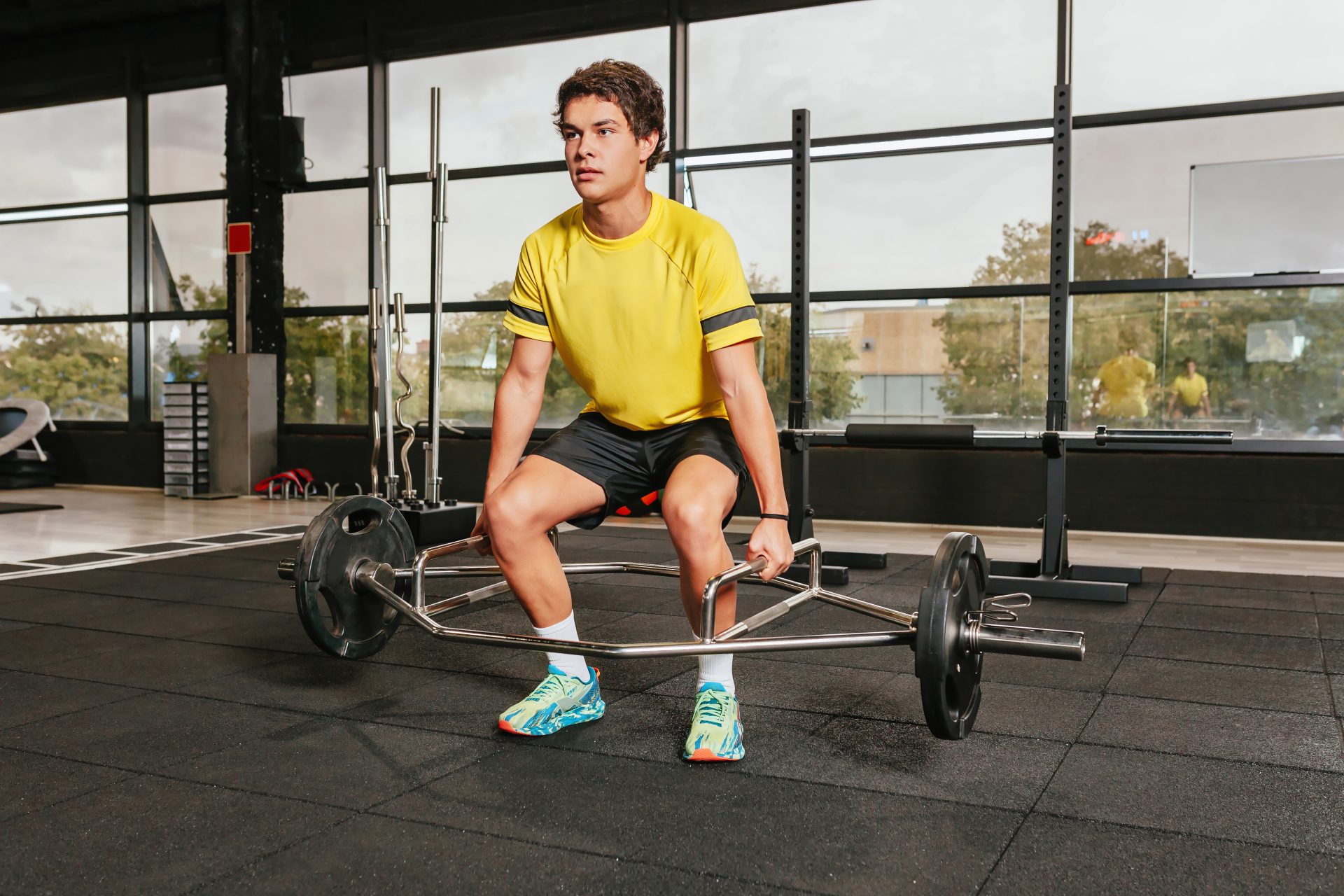
Nordic curl exercises are an advanced bodyweight hamstring movement that trains the hamstrings through powerful eccentric loading — the lowering portion of a contraction where the muscle lengthens under load. The classic Nordic curl is performed by kneeling on a padded surface with the feet anchored under a heavy object (a low couch, a Nordic curl bench, or held by a training partner), torso upright, and slowly lowering the entire body forward toward the floor while resisting the descent purely with the hamstrings. The hamstrings work eccentrically the entire way down — the harder they fight the fall, the slower the descent. At the bottom, the hands catch the body before face-planting, and the lifter pushes back up to start. Nordic curls at home variations replace the Nordic curl bench with anchored feet under a couch or heavy door; nordic curl beginner progressions use partial range and hand-assisted return to make the move accessible to those building hamstring strength from zero.
The mechanism is what makes Nordic curls one of the most-respected exercises in modern strength and sports science. Most lower-body exercises (squats, deadlifts, lunges) train the hamstrings primarily as hip extensors. The Nordic curl trains them as knee flexors, AND under heavy eccentric load — the exact movement pattern and contraction type that fails when sprinters pull a hamstring at full speed. The famous “nordic hamstring curl for speed” research (Petersen et al, 2011, plus follow-up studies) shows hamstring injury rates drop by approximately 51% in football and sprint athletes who add Nordic curls to their training programmes. The exercise also produces significant hamstring hypertrophy and strength gains. Combined with broader lower-body programming, Nordic curls deliver elite-level posterior chain development that few other bodyweight exercises can match. For comprehensive hamstring and glute work that pairs with Nordic curls, the programme covers the full lower-body progression.
Reduces Hamstring Injury Risk by Up to 51% (Documented in Athletes)
The most well-documented benefit. Multiple peer-reviewed studies on football, rugby and sprint athletes show 51% reduction in hamstring injury rates when Nordic curls are added to the training programme — making them the single most effective hamstring-injury-prevention exercise that exists. Particularly valuable for runners, footballers, sprinters and any athlete whose sport involves explosive deceleration.
Builds Eccentric Hamstring Strength (The Quality That Matters Most)
Nordic curls train hamstrings under the longest, hardest eccentric load of any common exercise. Eccentric strength is the quality that fails during sprint pulls, sudden direction changes, and any rapid deceleration. Stat: research on Nordic hamstring training (Mjølsnes et al, plus follow-up Bourne et al studies on eccentric hamstring loading) shows consistent practice produces meaningful eccentric hamstring strength gains over 8–12 week protocols — a magnitude no other bodyweight exercise comes close to.
Improves Sprint Speed and Athletic Performance
The nordic hamstring curl for speed connection is real. Athletes who add Nordic curls report improved 40-yard dash times, faster acceleration off the line, and better top-end speed — all driven by stronger hamstrings that can produce more force during ground contact. For recreational runners, even modest strength gains translate into measurable pace improvements.
Builds Visible Hamstring Hypertrophy Without Weights
The eccentric loading from Nordic curls produces significant hamstring muscle growth — visible in the back of the legs as the underdeveloped “back of the thigh” fills out. For those who can’t access a gym for weighted hamstring curls, Nordic curls deliver gym-comparable hypertrophy with zero equipment beyond an anchor point.
Exercise 1: Hand-Assisted Nordic Curl (Beginner) — Eccentric Hamstring Entry — 3 sets × 5 reps
Kneel on a folded mat or towel, feet anchored under a heavy couch or low door (or held by a partner). Body upright, core braced. Slowly lower the upper body forward by extending the knees, controlling the descent purely with the hamstrings — aim for 3–4 seconds to lower as far as possible while maintaining control. Catch yourself with the hands at the bottom, push back up to start using hand pressure. 3 sets × 5 reps. The nordic curl beginner variation. Modification: reduce the descent depth — lower only halfway initially; use a wall or chair for hand catch.
Exercise 2: Standard Nordic Curl — Full Eccentric + Concentric — 3 sets × 6 reps
Same setup. This time, lower the body forward through full range (4–5 seconds to lower), catch lightly with the hands at the bottom, and use the hamstrings (not arms) to return to start — this is the harder version. 3 sets × 6 reps. The standard variation that produces the documented 51% injury reduction in athletes. Modification: if hamstring strength isn’t yet sufficient for the full hamstring-driven return, push back up with light hand assistance and progressively reduce the assistance over weeks.
Exercise 3: Nordic Hamstring Curl for Speed (Athletic Variation) — Explosive Concentric — 3 sets × 5 reps
Same setup as standard Nordic curl. Lower with full control over 4–5 seconds (eccentric phase), then return to upright as explosively as possible — driving up through the hamstrings with maximum power, hands assisting only minimally. 3 sets × 5 reps. The nordic hamstring curl for speed variant — the version sprint athletes and footballers use specifically for speed gains and injury prevention. Reserve for week 6+ once standard Nordic curl form is locked. Modification: if explosive return isn’t yet possible, focus on faster intent — try to return quickly even if the actual movement remains slow. Speed will catch up with strength.
Mistake 1: Starting With Full-Range Without Building Up — Correction: Use Hand-Assisted Beginner Version First
The most common Nordic curl error: attempting full-range standard Nordic curls on day one with untrained hamstrings, resulting in face-plants, severe DOMS for a week, or hamstring strains. Untrained hamstrings cannot handle the eccentric load of a full Nordic curl. What to do instead: spend 2–4 weeks on the hand-assisted beginner version (partial range, hand-supported return) before progressing to standard Nordic curls. Build the eccentric strength first; the rep volume comes later. Patience here prevents injury.
Mistake 2: Bending at the Hips Instead of the Knees — Correction: Keep Hips Locked, Lower From Knees
If the body bends at the hips (folding forward like a hinge) instead of keeping the body in a straight line and lowering by extending the knees, the hamstrings disengage and the move becomes a glute bridge variant. What to do instead: consciously squeeze the glutes throughout to lock the hip position. The body should descend as a rigid plank — head, shoulders, hips, knees moving together as a unit. Only the knees change angle.
Mistake 3: Anchoring Feet Insufficiently — Correction: Use Truly Heavy Object or Partner
If the anchor isn’t heavy enough (a light couch, an unattached chair), the feet lift off the floor as you descend, the move collapses, and you get face-planted. Insufficient anchoring is the #1 cause of failed Nordic curls at home attempts. What to do instead: use a heavy sofa with multiple cushions on it, a low door with feet wedged under, a Nordic curl bench, or a training partner kneeling on your ankles. Test the anchor by pulling lightly before starting your first rep. The programme reinforces proper setup principles for all anchor-required lower-body work.
Posterior-Chain-Specific Programming, Not Just Quad-Dominant Work
Most home workouts overemphasise quad-dominant movements (squats, lunges) and underdevelop the posterior chain (hamstrings, glutes, lower back). Habuild’s daily sessions explicitly programme Nordic curls, glute bridges, deadlift patterns and posterior-chain mobility in a balanced ratio with quad work — addressing the muscle imbalance that drives knee pain, lower-back strain and slow sprint speed.
Live Daily Sessions With Real-Time Form Correction
The hip-bend error, the inadequate-anchor error, the too-fast-progression error — all corrected within seconds on the live call. Nordic curls done badly cause hamstring strain or DOMS that derails training for a week; Nordic curls done well are elite-level injury-prevention work. The difference is form, and form requires live coaching.
Progressive Overload Built Into Every Session
Week 1–4: hand-assisted beginner version with partial range. Week 5–8: progressive depth with reduced hand assistance. Week 9–12: standard Nordic curl at full range. Week 13+: nordic hamstring curl for speed variation for athletes seeking speed transfer. Members don’t programme this — depth, range and intensity build progressively within the live class flow.
Accountability, Streaks and Community
Nordic curls are humbling — even fit adults struggle with full range initially. Daily streak tracking, the WhatsApp community and live morning sessions keep members on the mat through the early weeks where the hamstring eccentric strength is rebuilding before noticeable performance benefits show.
Complete Beginners Starting from Zero
Nordic curls begin with an assisted version — hands reaching forward to catch your weight, or using a resistance band for support. No gym equipment is needed: a sofa and a partner to hold the ankles, or a secure low bar, are all that is required. The only requirement is showing up consistently — strength and technique follow from that.
Intermediate Trainees Looking to Fill a Gap
Nordic curls are the gold-standard hamstring exercise for injury prevention — research shows they reduce hamstring strain injury risk by up to 51% in athletes. They are essential for runners, footballers, and anyone whose sport involves sprinting, because they specifically strengthen the hamstring at its most vulnerable point during the running stride. Adding nordic curl exercises to an existing routine addresses a specific conditioning gap that most general workouts miss.
Runners, Athletes, and Those Preventing Hamstring Injuries
Nordic curls are the gold-standard hamstring exercise for injury prevention — research shows they reduce hamstring strain injury risk by up to 51% in athletes. They are essential for runners, footballers, and anyone whose sport involves sprinting, because they specifically strengthen the hamstring at its most vulnerable point during the running stride.
Senior Citizens and Older Adults (50+)
Nordic Curl Exercises can be adapted for older adults by controlling tempo, reducing range of motion, and using supported variations. Habuild’s live instructors modify exercises in real time for different fitness levels and physical conditions in the same session.
Is Nordic Curl Exercises Good for Beginners?
Yes — absolutely. Nordic Curl Exercises begin at very low intensity with fully accessible entry-level variations. Habuild’s live instructor adapts the session in real time so beginners and experienced trainees can train together without either being left behind.
How Often to Do Nordic Curl Exercises — Frequency Guide
Train nordic curl exercises 2–3 times per week. This frequency gives the muscle and nervous system adequate stimulus without outpacing recovery. Consistency matters more than intensity in the early weeks — showing up regularly produces better results than infrequent all-out sessions.
When in Your Workout to Do Nordic Curl Exercises
Place nordic curl exercises early in a lower-body session when the hamstrings are fresh — never as a fatigued finisher. Sequencing exercises correctly ensures you bring maximum quality to nordic curl exercises rather than performing them under accumulated fatigue from earlier work.
What to Pair Nordic Curl Exercises With
Combine nordic curl exercises with Romanian deadlifts, glute bridges, and calf raises for a complete posterior chain programme that protects the knee and hip under load. This combination develops complementary muscle groups in the same session and builds the balanced strength that prevents compensation and injury.
How to Progress Nordic Curl Exercises Over Time
Once the base movement feels controlled and repeatable, reduce band assistance progressively, then work toward full bodyweight Nordic curls, and finally add a slow eccentric tempo (5-second lower) for maximum hamstring strength development. Progress only when form is consistent — adding difficulty before mastering the base movement reinforces poor mechanics and stalls long-term results.
Habuild is India’s First Habit Building Program — and through its strength and fitness sessions, it brings the same habit-based philosophy to targeted exercise training. Every session is structured around your specific goal, not a one-size-fits-all class.
Goal-Specific Programming — Not a Generic Fitness Class
Every exercise, rep range, and rest period in Habuild’s nordic curl exercises sessions is chosen because it produces results for nordic curl exercises specifically. Habuild does not run the same session for every goal — the programme is structured to drive your specific outcome with every session, not general fitness that happens to include nordic curl exercises.
Live Daily Sessions with Real-Time Form Correction
Unlike pre-recorded videos, Habuild’s live daily sessions allow the instructor to see and correct your form in real time — the specific errors that limit nordic curl exercises results and increase injury risk. This live correction is the difference between training that works and training that wastes effort and creates bad habits.
Progressive Overload Built into Every Session
Members do not need to design their own progressive overload for nordic curl exercises — it is built into the programme structure. Each week, sessions are deliberately more challenging than the last, ensuring the body never fully adapts and results continue coming rather than stalling.
Accountability, Streaks, and Community
The most common reason people stop exercising is not effort — it is missing sessions until the habit breaks. Habuild’s streak system, live session accountability, and community of members training the same goal alongside you resolves this directly. Members who join with a specific goal like nordic curl exercises and stay consistent for 30 days almost universally report that showing up has become automatic.
"120-day streak. Three years of recurring hamstring tightness from running. Eight weeks of progressive Nordic curls (started hand-assisted) and the chronic tightness completely resolved. Training partner could feel the muscle quality change."

"180-day streak. Recreational runner. Six months of daily Habuild posterior-chain work including Nordic curls — 5K time dropped 45 seconds. The eccentric strength transferred directly into longer stride and stronger ground contact."



Practice Strong Everyday with Trishala Bothra, an IIT-B and London School of Business alumni
Trishala is focused on making movement feel lighter, more engaging, and something you actually look forward to.
In just 3 years, over 50,000 people began their strength journey, and 10,000+ join every week to keep getting stronger.