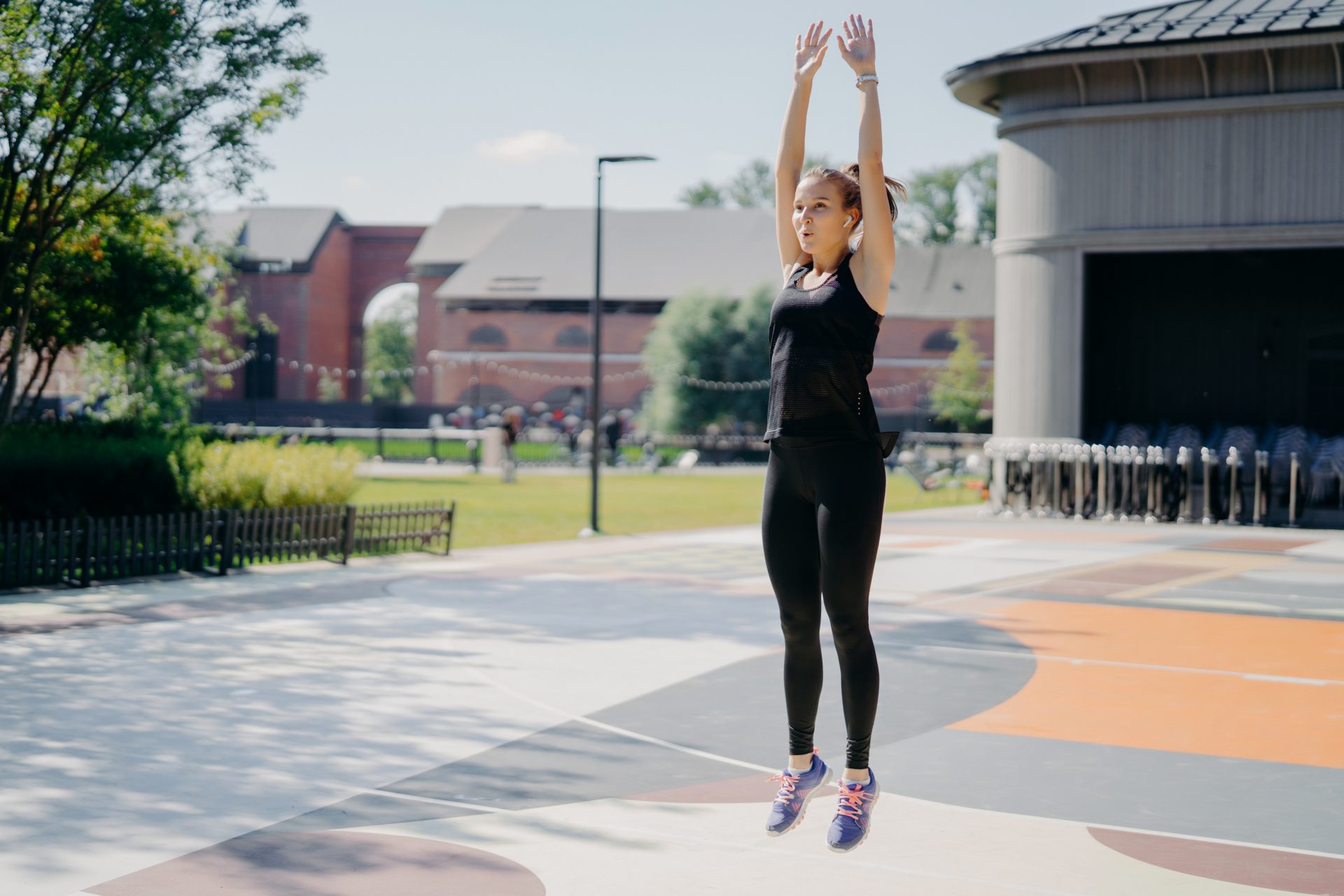
Jumping jacks exercises are a full-body bodyweight cardio movement performed by simultaneously jumping both feet out wider than shoulder-width while swinging both arms overhead, then jumping the feet back together while bringing arms back to the sides. The exercise is so simple that virtually every primary-school child has done them, yet the metabolic and cardiovascular demand is comparable to many gym-based cardio machines. Variations expand the toolkit: beginner jumping jacks (the step-out-step-in version with no jumping) make the movement accessible to those with knee issues, joint sensitivity or low fitness levels; high-knee jumping jacks intensify the cardio demand significantly; cross-jumping jacks add rotational complexity. Each variation hits the same primary muscle groups while shifting intensity.
The mechanism is what makes jumping jacks remarkably efficient. The movement engages the calves and quads (jumping out and in), the shoulders and lats (overhead arm swing), the hip abductors (lateral leg movement), and the core (stabilising the torso during dynamic motion) — all simultaneously. The cardiovascular demand kicks in fast: heart rate climbs into the 140–160 bpm zone within 30 seconds for most adults, placing the body firmly in cardio training territory. This is why jumping jacks are the cornerstone of many home HIIT and warm-up routines — they deliver maximum heart-rate elevation with zero equipment in minimal floor space. Searches for “before and after jumping jacks” capture this exact appeal: real visible transformation results from a humble bodyweight move. For maximum fat-loss benefit, jumping jacks pair best with strength work, as documented in our deep-dive.
Burns 8–14 Calories Per Minute (High for a Bodyweight Move)
Jumping jacks are among the highest-calorie-burn bodyweight exercises that exist — typical burn is 8–10 calories per minute at moderate pace, and 12–14 at fast pace. A 5-minute jumping jacks finisher at the end of a workout adds ~50–60 calories of additional burn while elevating heart rate into the cardio training zone.
Raises Heart Rate Fast — Excellent Warm-Up or HIIT Component
Unlike steady-state cardio that takes 5–8 minutes to fully elevate heart rate, jumping jacks push heart rate into the cardio training zone within 30–45 seconds. This makes them an unbeatable warm-up before strength training, or as the cardio component of HIIT intervals. Stat: HIIT meta-analyses (e.g., Milanović et al., Sports Medicine, 2015) show 15–20% VO2 max improvements over 8-week protocols including movements like jumping jacks.
Trains Coordination, Balance and Cross-Body Movement
The simultaneous arm-leg coordination required by jumping jacks trains neuromuscular coordination — the brain-body connection that determines athletic performance, balance, and fall prevention as we age. Daily practice meaningfully improves this coordination within 2–4 weeks, especially in beginners or older adults.
Highly Time-Efficient and Equipment-Free
One of the most equipment-free, no-learning-curve exercises that exists. 3 minutes of jumping jacks daily provides measurable cardio and metabolic benefit — no gym, no fancy machines, no skill development. Stat: research on light-to-moderate physical activity and mortality (Stamatakis et al., JAMA Internal Medicine) shows meaningful all-cause mortality reductions even with brief daily activity in sedentary adults.
Below are 3 fully detailed variations; cross-jumping jacks and combined jumping-jack circuit options round out the 5-variation set, covered in the progressive overload schedule below and built into Habuild’s daily live sessions.
Exercise 1: Standard Jumping Jacks — Cardio + Full Body — 3 sets × 30–45 seconds
Stand with feet together, arms by your sides. Jump both feet out wider than shoulder-width while raising arms overhead in a wide arc. Jump back to start (feet together, arms down). 3 sets × 30–45 seconds with 30-second rest between sets. The foundational variation — the cleanest single-exercise full-body cardio in any home routine. Modification: reduce pace; use less aggressive arm swing if shoulder mobility is limited.
Exercise 2: Beginner Jumping Jacks (Step-Out, No Jump) — Low-Impact Cardio — 3 sets × 45 seconds
Same movement pattern, but instead of jumping, alternately step the right foot out and back, then the left foot, while sweeping the arms overhead and back. 3 sets × 45 seconds. The beginner jumping jacks variant — designed for those with knee issues, ankle sensitivity, low fitness, or those returning from injury. Gets the heart rate up without the joint impact. Modification: reduce arm range — only sweep arms to shoulder height — if shoulders feel strained.
Exercise 3: High-Knee Jumping Jacks — Cardio + Hip Flexors — 3 sets × 30 seconds
Standard jumping jacks pattern, but as you jump out, drive one knee up toward your chest in alternation (right knee up, then left knee up on the next out-jump). The arm pattern stays the same. 3 sets × 30 seconds. Significantly intensifies the cardio demand and adds direct hip flexor engagement. Save for week 4+ once standard jumping jacks feel easy. Modification: reduce knee height initially; build to chest-high knee drive over 2–3 weeks.
Mistake 1: Doing 10,000 Jumping Jacks a Day With No Strength Work — Correction: Pair Cardio With Strength
The “10000 jumping jacks a day” challenge that circulates on social media misses the mark badly. Doing 10,000 reps daily produces overuse injuries, doesn’t build muscle, doesn’t address strength deficits, and frequently destroys ankle and knee joints over 3–6 months. What to do instead: 5–10 minutes of jumping jacks combined with strength work in a 30-minute session. The cardio gets covered, the strength gets built, and joints stay healthy. Programmes like integrate this combination so cardio and strength advance together.
Mistake 2: Landing With Locked Knees and Heels — Correction: Soft Knee, Land on Mid-Foot
Speed-doing jumping jacks while landing with stiff legs and slamming heels into the floor creates jarring impact through the knees, ankles and lower back. Repeated daily, this leads to shin splints, knee pain or stress fractures. What to do instead: land with a soft knee bend (small but visible), absorb impact through the mid-foot rather than the heel, and keep the core braced throughout to prevent the spine from absorbing impact.
Mistake 3: Skipping the Warm-Up Before Jumping Straight In — Correction: 90 Seconds of Easy Movement First
Jumping jacks elevate heart rate fast, but they also load cold muscles and joints fast. Going from sedentary to full-pace jumping jacks within 10 seconds is a common cause of calf cramps, ankle tweaks and lower-back stiffness. What to do instead: 90 seconds of easy walking, ankle rolls, and shoulder rolls first to warm up tissue. Then start with beginner jumping jacks for 30 seconds, build to standard pace from there.
Cardio-Plus-Strength Programming, Not Just Endless Jumping Jacks
Most home HIIT routines hammer cardio (jumping jacks, burpees, mountain climbers) without addressing strength. Members lose initial fat then plateau because resting metabolic rate doesn’t rise. Habuild’s daily sessions integrate jumping jacks as one of multiple cardio components alongside strength work — the combination produces sustained fat loss past the initial 6-week plateau.
Live Daily Sessions With Real-Time Form Correction
The locked-knee landing, the speed-rep, the shoulder-shrug arm pattern — all corrected within seconds on the live call. Jumping jacks performed badly are cardio at the cost of joint health; performed well, they’re a sustainable cornerstone of home fitness. The difference is form, and form requires live coaching.
Progressive Overload Built Into Every Session
Week 1: beginner jumping jacks at moderate pace, 30-second intervals. Week 4: standard jumping jacks at fast pace, 30-second intervals. Week 8: high-knee jumping jacks introduced. Week 12: combined jumping jack circuits with longer intervals. Members don’t programme this — duration, complexity and pace build progressively within the live class flow.
Accountability, Streaks and Community
Cardio progress requires consistency more than intensity. Daily streak tracking, the WhatsApp community and live morning sessions get members through the first 4 weeks where the cardiovascular adaptation happens — after which jumping jacks transition from feeling demanding to feeling energising.
Complete Beginners Starting from Zero
Jumping jacks begin at a pace slow enough for anyone — even the step jack variation (stepping one foot at a time instead of jumping) eliminates impact entirely while maintaining the arm and leg pattern. The only requirement is showing up consistently — strength and technique follow from that.
Intermediate Trainees Looking to Fill a Gap
Jumping jacks are one of the most accessible full-body cardio exercises available — they require no equipment, no space beyond a body-width, and can be done by almost anyone regardless of fitness level. They are ideal as both a warm-up and a standalone cardio session for those building an exercise habit from scratch. Adding jumping jacks exercises to an existing routine addresses a specific conditioning gap that most general workouts miss.
Cardio Beginners and Those Building Aerobic Base Without Equipment
Jumping jacks are one of the most accessible full-body cardio exercises available — they require no equipment, no space beyond a body-width, and can be done by almost anyone regardless of fitness level. They are ideal as both a warm-up and a standalone cardio session for those building an exercise habit from scratch.
Senior Citizens and Older Adults (50+)
Jumping Jacks Exercises can be adapted for older adults by controlling tempo, reducing range of motion, and using supported variations. Habuild’s live instructors modify exercises in real time for different fitness levels and physical conditions in the same session.
Is Jumping Jacks Exercises Good for Beginners?
Yes — absolutely. Jumping Jacks Exercises begin at very low intensity with fully accessible entry-level variations. Habuild’s live instructor adapts the session in real time so beginners and experienced trainees can train together without either being left behind.
How Often to Do Jumping Jacks Exercises — Frequency Guide
Train jumping jacks exercises daily or 5 times per week. This frequency gives the muscle and nervous system adequate stimulus without outpacing recovery. Consistency matters more than intensity in the early weeks — showing up regularly produces better results than infrequent all-out sessions.
When in Your Workout to Do Jumping Jacks Exercises
Place jumping jacks exercises at the start of a session as a warm-up, or in intervals (30 seconds on, 15 seconds rest) for a cardio workout. Sequencing exercises correctly ensures you bring maximum quality to jumping jacks exercises rather than performing them under accumulated fatigue from earlier work.
What to Pair Jumping Jacks Exercises With
Combine jumping jacks exercises with butt kicks, high knees, and mountain climbers for a complete no-equipment cardio circuit. This combination develops complementary muscle groups in the same session and builds the balanced strength that prevents compensation and injury.
How to Progress Jumping Jacks Exercises Over Time
Once the base movement feels controlled and repeatable, increase pace, extend continuous duration, add overhead arm presses during the jack, or progress to star jumps for greater explosive demand. Progress only when form is consistent — adding difficulty before mastering the base movement reinforces poor mechanics and stalls long-term results.
Habuild is India’s First Habit Building Program — and through its strength and fitness sessions, it brings the same habit-based philosophy to targeted exercise training. Every session is structured around your specific goal, not a one-size-fits-all class.
Goal-Specific Programming — Not a Generic Fitness Class
Every exercise, rep range, and rest period in Habuild’s jumping jacks exercises sessions is chosen because it produces results for jumping jacks exercises specifically. Habuild does not run the same session for every goal — the programme is structured to drive your specific outcome with every session, not general fitness that happens to include jumping jacks exercises.
Live Daily Sessions with Real-Time Form Correction
Unlike pre-recorded videos, Habuild’s live daily sessions allow the instructor to see and correct your form in real time — the specific errors that limit jumping jacks exercises results and increase injury risk. This live correction is the difference between training that works and training that wastes effort and creates bad habits.
Progressive Overload Built into Every Session
Members do not need to design their own progressive overload for jumping jacks exercises — it is built into the programme structure. Each week, sessions are deliberately more challenging than the last, ensuring the body never fully adapts and results continue coming rather than stalling.
Accountability, Streaks, and Community
The most common reason people stop exercising is not effort — it is missing sessions until the habit breaks. Habuild’s streak system, live session accountability, and community of members training the same goal alongside you resolves this directly. Members who join with a specific goal like jumping jacks exercises and stay consistent for 30 days almost universally report that showing up has become automatic.
"120-day streak. I'd been doing only walks for cardio. Adding 5 minutes of jumping jacks to my Habuild morning session — 5 kg gone in 10 weeks. The calorie burn jumped, and the cardio fitness obviously improved as a side benefit."
"180-day streak. My resting heart rate had been stuck around 78 for years. Six months of Habuild's jumping-jack-inclusive routine and it's now 64 bpm — measurably better cardiovascular health that I can see on my fitness tracker every morning."


Practice Strong Everyday with Trishala Bothra, an IIT-B and London School of Business alumni
Trishala is focused on making movement feel lighter, more engaging, and something you actually look forward to.
In just 3 years, over 50,000 people began their strength journey, and 10,000+ join every week to keep getting stronger.