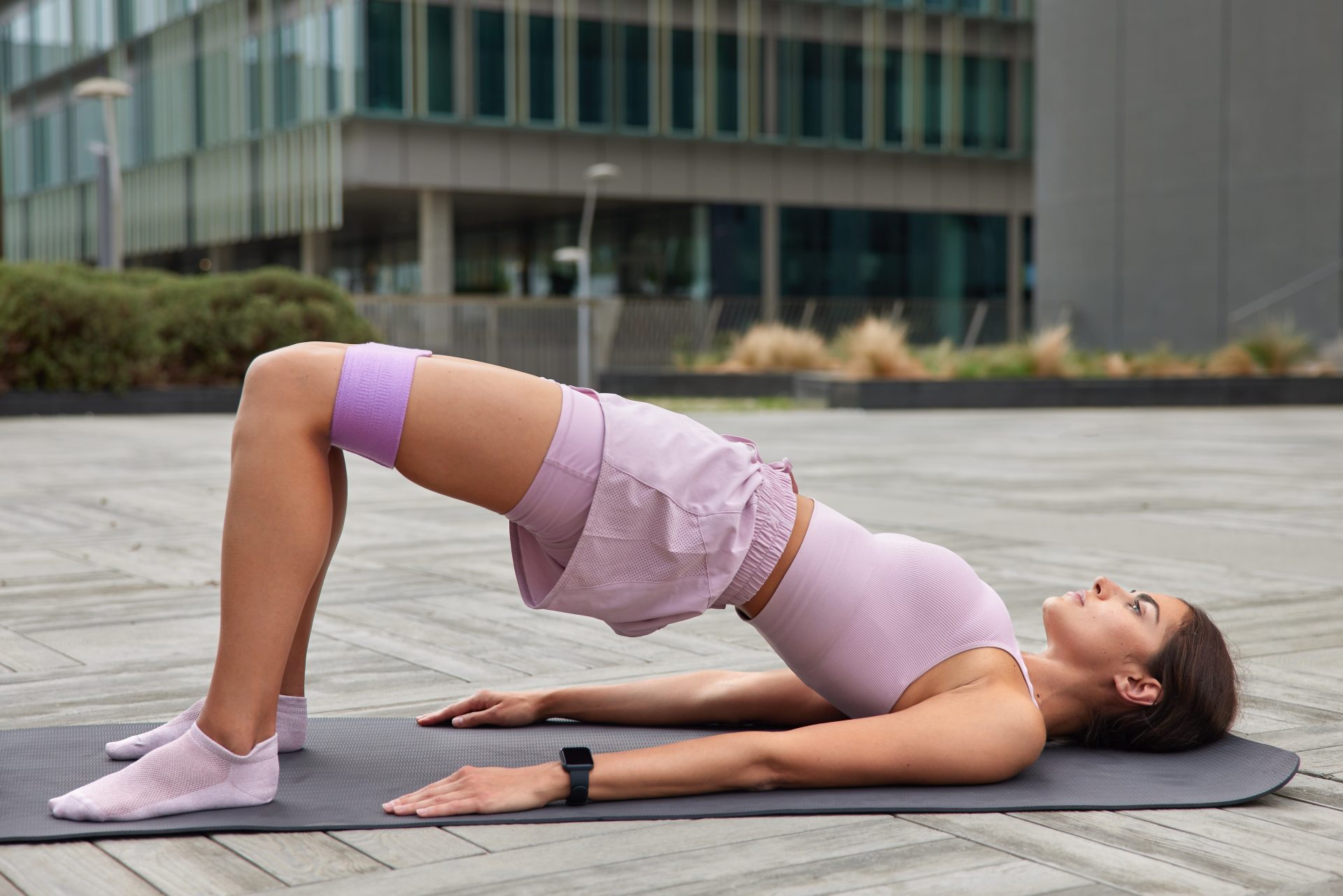
Glute bridge exercises are floor-based movements specifically designed to strengthen the posterior chain — the muscles along the back of your body including the gluteus maximus, gluteus medius, hamstrings, and lumbar extensors. Unlike general leg exercises that prioritise the quads or calves, glute bridges isolate the hip extension pattern that most people neglect during a working day of prolonged sitting. This makes them uniquely effective for rebuilding the strength and activation that sedentary habits tend to switch off. The mechanics are straightforward but powerful. When you press your feet into the floor and drive your hips toward the ceiling, you create hip extension — the primary movement your glutes were built to perform. Holding at the top activates the posterior chain isometrically, while lowering slowly adds an eccentric load that builds both strength and hamstring control. This push-hold-lower sequence demands your glutes do the work rather than borrowing from your quads or lower back.
Stronger Glutes That Support Every Movement You Make
Your glutes are the largest and most powerful muscle group in your body. When they are strong, every movement — walking, climbing stairs, carrying groceries — becomes more stable and efficient. Weak glutes force your lower back, knees, and hip flexors to compensate, which is a recognised contributor to chronic pain patterns across the posterior chain.
Research consistently shows that hip extension exercises like the glute bridge produce higher gluteus maximus activation levels than squats alone — making them an essential complement to any lower-body programme rather than an optional add-on.
Reduced Lower Back and Hip Discomfort With Consistent Practice
Most people searching for glute bridge benefits are managing a dull lower back ache, tight hips, or a sense of weakness when they stand after hours at a desk. Targeted movements like the standard glute bridge, the single leg glute bridge, and the hamstring glute raise directly counteract glute inhibition and anterior pelvic tilt that prolonged sitting produces.
With consistent practice, many people notice a gradual easing of background tension in the lower back and hips. These hip strength exercises complement glute bridges for full posterior chain support across the sitting-to-standing transition.
Better Posture and Pelvic Alignment Over Time
Weak glutes are closely linked to anterior pelvic tilt — where the pelvis tips forward and the lower back curves excessively. Consistent glute bridge training retrains the hips to hold a more neutral position. This shift reduces lumbar strain, improves walking mechanics, and supports better posture during both seated and standing tasks.
The WHO recommends at least 150 minutes of moderate-intensity muscle-strengthening activity per week. Glute bridges performed five days per week at 3 sets each contribute meaningfully toward that threshold without requiring equipment or a gym.
Improved Core Stability, Energy, and Everyday Resilience
A strong posterior chain is inseparable from core stability. When your glutes engage correctly during a bridge, your deep abdominal muscles co-activate to maintain spinal alignment — meaning every session also builds core endurance. That endurance translates into less fatigue during long days on your feet, better balance as you age, and a general physical confidence that carries into daily activity.
These core strength exercises pair well with hip bridge training to build the full anterior-posterior stability that the spine depends on.
What you eat directly determines how fast you recover, how much you progress, and how consistently you can train. Here is what your nutrition plan should look like to support your glute bridge training effectively.
Protein — The Foundation of Strength Gains
For strength-focused training, aim for 1.6–2.0 g of protein per kg of body weight daily. This higher intake supports muscle protein synthesis and repair after resistance sessions. Indian sources like eggs, paneer, dal, chicken, and moong work excellently here.
Calcium and Vitamin D — Joint and Bone Health
Strong bones provide the structural foundation for all movement — include calcium-rich foods like milk, curd, paneer, ragi, and sesame seeds (til) daily. Vitamin D is essential for calcium absorption; aim for 15–20 minutes of morning sunlight alongside dietary sources like eggs and fatty fish. Deficiency in either nutrient accelerates joint wear over time.
Anti-Inflammatory Foods — Faster Recovery
Recovery speed is directly influenced by your body’s inflammatory status. Turmeric with black pepper (curcumin + piperine), fresh ginger, and omega-3 fatty acids from flaxseeds, walnuts, and fatty fish all actively reduce exercise-induced inflammation. Include these consistently rather than only on hard training days.
Hydration — Performance and Joint Lubrication
Adequate hydration supports joint lubrication, muscle function, and nutrient transport — aim for 2.5–3 L of water daily. Drink at least 500 ml before your morning exercise session to prime circulation and joint mobility. Herbal teas and coconut water count toward your fluid intake and provide additional micronutrients.
Magnesium — Muscle Function and Sleep Quality
Magnesium governs over 300 enzymatic reactions including muscle contraction and relaxation — making it essential for any movement-based training. Include pumpkin seeds, bananas, dark chocolate (70%+), spinach, and whole grains in your daily diet. Many Indians are mildly deficient; if you experience frequent muscle cramps or poor sleep quality, a magnesium glycinate supplement may help.
Starting a new training programme is often the hardest part. Here is a clear, week-by-week plan to begin your glute bridge training without injury or overwhelm.
Before You Begin — Setting Your Baseline
Before your first session, assess where you currently stand: can you perform 10 bodyweight squats with good form? Hold a plank for 30 seconds? These simple benchmarks tell you whether to start at the absolute beginner level or move slightly ahead. Set a concrete, measurable goal — for example, performing 3 sets of 15 controlled reps of your target movement within 8 weeks.
Week 1–2: Foundation
Prioritise form above all else — a slow, controlled rep with full range of motion builds more real strength than 20 sloppy ones. Expect some delayed onset muscle soreness (DOMS) 24–48 hours after your first two or three sessions; this is normal and will reduce as your body adapts. Keep sessions to 20–30 minutes and use 3 sets of 8–10 reps per exercise, resting 60–90 seconds between sets.
Week 3–4: Building Consistency
Once you can complete all sets comfortably with good form, begin adding volume — either one extra set per exercise or an additional exercise. Training at the same time each morning dramatically improves adherence; your body begins priming itself hormonally before you even start. Track each session with a simple log — even just noting reps completed — so you can see tangible progress week over week.
Week 5–8: Progression
Around weeks 4–6, most people notice their first meaningful strength gains — movements that felt hard now feel manageable, and posture often improves noticeably. Begin introducing progressive overload: increase resistance, slow the tempo, or add a pause at the hardest point of each rep. Your recovery capacity also improves in this phase, so you may be able to handle 4–5 sessions per week if your schedule permits.
In strength training, consistency across weeks matters far more than any single intense session.
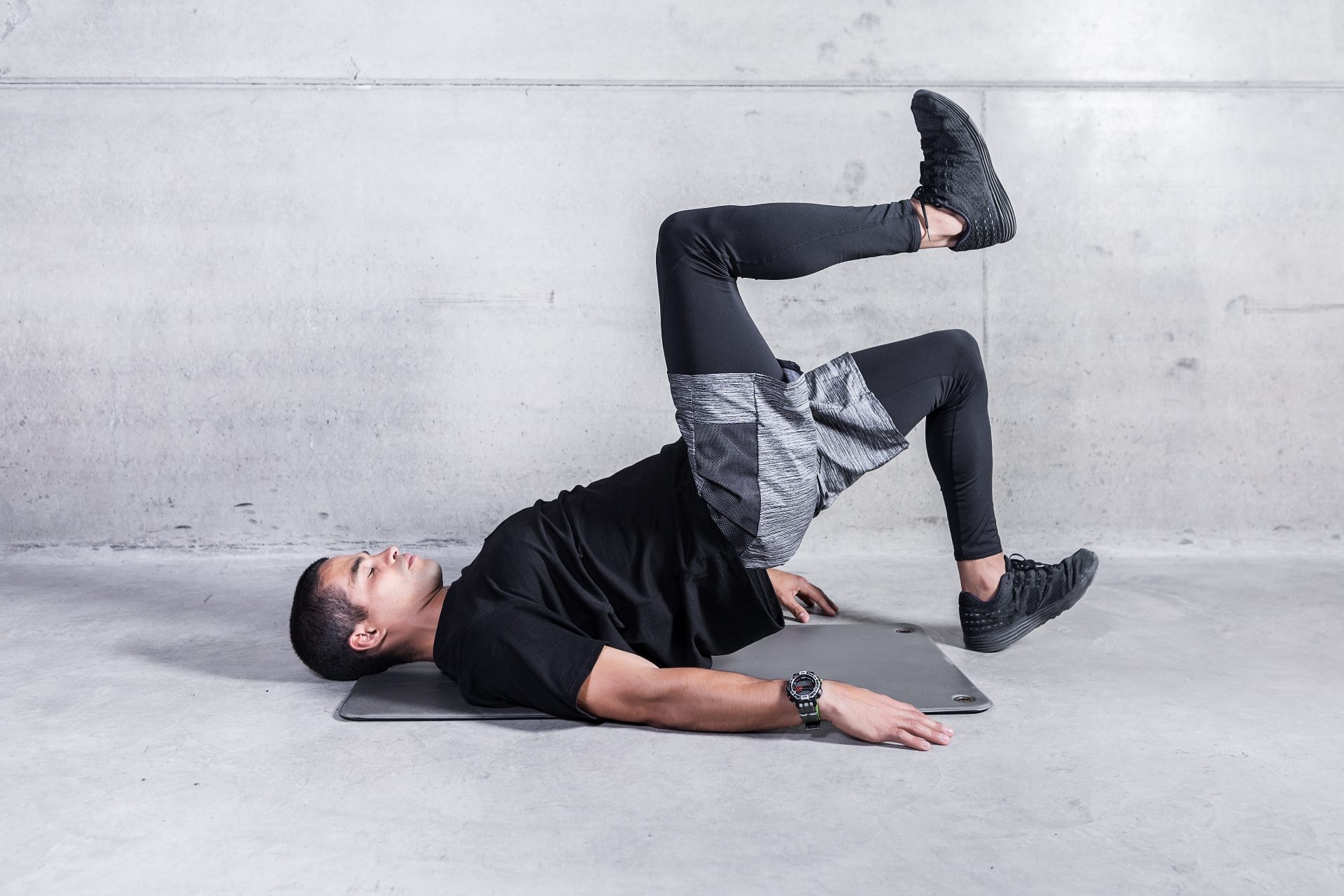
Standard Glute Bridge — Full Posterior Chain — 3 × 15 Reps
What it does: The foundational movement. Lying on your back with knees bent and feet flat, you drive through your heels to lift your hips until your body forms a straight line from shoulders to knees. This places the gluteus maximus under full load at the top position and teaches correct hip extension mechanics without stressing the knees or spine.
Dosage: 3 sets × 15 repetitions, 5 days per week. Hold the top position for 2 seconds on each rep.
Beginner modification: Reduce range of motion — lift hips only to a comfortable height rather than a full bridge. Place a folded towel under your lower back for support during the learning phase.
Single Leg Glute Bridge — Unilateral Strength and Balance — 3 × 10 Each Side
What it does: The single leg glute bridge removes the support of the second leg, forcing each glute to work independently. This exposes and corrects strength imbalances between sides — a common hidden contributor to lower back and hip problems — and increases hamstring demand, making it an effective progression from the standard bridge.
Dosage: 3 sets × 10 reps per side. Rest 30 seconds between sides.
Beginner modification: Keep the non-working foot lightly touching the floor for balance rather than holding it raised. Progress to a full lift once you can complete 10 reps with steady hips. These leg strength exercises build on the same unilateral movement patterns to develop balanced lower-body power.
Hamstring Glute Raise (Hip Thrust with Feet Elevated) — Hamstrings and Glutes — 3 × 12 Reps
What it does: Placing your feet on a low surface — a step or rolled yoga mat — increases the range of hip extension and shifts more load onto the hamstrings and lower glutes. This variation challenges the posterior chain through a longer lever arm, building strength that carries directly into running, stair climbing, and explosive movements.
Dosage: 3 sets × 12 reps. Elevate feet 15–25 cm. Control the descent over 3 seconds.
Beginner modification: Begin with feet flat on the floor as a standard bridge before adding elevation. Introduce the raised surface only when you can complete 15 reps with a steady, level pelvis.
Mistake 1 — Overarching the Lower Back at the Top — Correction: Drive from Your Glutes, Not Your Spine
What it is: Many people push their hips so high that they hyperextend at the lumbar spine rather than fully engaging the glutes. This shifts the load away from the target muscles and compresses the lumbar vertebrae — the opposite of what you want from a glute bridge session.
What to do instead: At the top of every rep, your body should form a straight diagonal line from knees to shoulders. Squeeze your glutes firmly rather than forcing extra height. If you feel the effort in your lower back more than your glutes, drop the height by 3–5 cm and focus entirely on the squeeze.
Mistake 2 — Using Too Much Quad Drive and Not Enough Heel Press — Correction: Shift Weight to Your Heels
What it is: When feet are placed too close to the hips, the knee angle decreases and the quads take over the lift. The glutes barely fire, and the exercise fails to achieve its purpose. This is extremely common in beginners and in people with a quad-dominant movement pattern from prolonged sitting.
What to do instead: Walk your feet forward until there is a 90-degree angle at the knee or slightly greater. Press consciously through your heels — you should be able to wiggle your toes at the top of the bridge. If your quads are burning more than your glutes, your feet are too close to your body.
Mistake 3 — Rushing the Repetitions Without a Hold — Correction: Pause for 2 Seconds at the Top
What it is: Moving through reps quickly turns the glute bridge into a momentum drill rather than a strength exercise. The glutes are not held under tension long enough to build meaningful strength, and the hamstrings and lower back compensate for the lack of control. People who train this way for weeks often notice little change in posterior chain strength or appearance.
What to do instead: At the top of every rep, pause and hold for a 2-second count with glutes fully contracted. Lower slowly over 2–3 seconds. This adds time under tension — the primary driver of glute hypertrophy and strength gains — without requiring extra reps or added load.
Glute Bridge training is not a one-size-fits-all programme — but it is far more broadly accessible than most people assume. Here is who benefits most.
Complete Beginners Starting from Zero
You do not need any prior fitness experience to begin glute bridge exercises. Every movement in a well-structured programme comes with easier modifications — for example, performing the exercise seated, with a reduced range of motion, or using a wall or chair for support. The only requirement is willingness to show up consistently; the strength and technique will follow.
People With Weak Glutes Leading to Knee or Back Pain
This training is especially valuable for people managing Weak Glutes Leading to Knee or Back Pain. Glute Bridge exercises specifically target the muscular imbalances and movement patterns that drive these conditions. Always begin at a reduced intensity and range, and increase gradually as your body adapts.
Office Workers and Sedentary Adults
Sedentary adults who spend 6–8 hours sitting daily experience progressive losses in glute bridge capacity — this training directly reverses that trend. A 20–30 minute morning session creates a positive hormonal and metabolic shift that persists throughout the working day. Even three sessions per week produce measurable improvements in energy levels, concentration, and posture.
Active Adults and Athletes
Experienced gym-goers and recreational athletes use glute bridge training to address specific movement gaps and build functional capacity. This style of training bridges the gap between general fitness and sport-specific performance, reducing injury risk in the process. It works well as a primary programme or as targeted supplementary work alongside your existing routine.
Seniors Maintaining Functional Independence
Sarcopenia — the age-related loss of muscle mass — begins in the mid-30s and accelerates after 60 if not countered with resistance training. Glute Bridge exercises are one of the most effective tools for preserving muscle mass, bone density, and functional independence in older adults. Progressive bodyweight and resistance training is safe, evidence-based, and highly effective for this group.
Glute-Specific Programming — Not a Generic Fitness Class
Every exercise selection, sequencing decision, and rest period in Habuild’s strength sessions is chosen for posterior chain benefit. Sessions open with activation drills — clamshells and hip circles — to wake up the gluteus medius before loading it. They close with isometric holds in the bridge position to build end-range glute strength, the zone where most weakness actually lives. Activating before loading means your glutes fire correctly rather than letting your lower back quietly take over the work.
Members specifically focused on building glute strength can explore the structured path offered through Habuild’s strength training for glutes programme — progressing from foundational bridges to more demanding loading patterns over weeks.
Live Daily Sessions with Real-Time Form Correction
Habuild sessions are live — not pre-recorded. When your hips drop to one side during a single leg glute bridge, your instructor sees it and corrects it before it becomes a habit. This real-time feedback loop prevents the common form errors that stall progress and cause the minor aches that make people abandon training programmes.
Progressive Overload Built into Every Session
You do not need to self-programme your progression. Over successive weeks, Habuild builds in increasing hold durations, more complex unilateral variations, and greater movement demands — systematically. Members move from standard bridges to single-leg work to elevated hip thrusts without needing to determine the when or how themselves.
Accountability, Streaks and Community
Glute strength takes 6–10 weeks of consistent practice to produce meaningful change. Habuild’s streak tracking, daily live schedule, and WhatsApp community provide the accountability structures that make that consistency achievable. Members show up because a live class is starting — and the streak keeps them returning the following morning.
My homeopathy doctor suggested yoga and I found Habuild. In the free 14 days, I already felt changes. The biggest surprise: I used to be unable to get down from a pavement by myself. Now I can jump. My core and lower body strength have rebuilt themselves through consistent practice. Habuild is a complete package — it strengthens everything, not just flexibility.
I have been with Habuild for 1,050 days. My energy has increased and I don't feel drained by work anymore. My patience has grown — things that used to stress me out don't affect me the same way. My kids at home have also picked up the yoga habit. Most importantly, my knowledge about breathing and how it affects the entire body has transformed. My nervous system feels calmer, my digestion is better, and there is a steadiness in my body and mind that I had never experienced before.



Practice Strong Everyday with Trishala Bothra, an IIT-B and London School of Business alumni
Trishala is focused on making movement feel lighter, more engaging, and something you actually look forward to.
In just 3 years, over 50,000 people began their strength journey, and 10,000+ join every week to keep getting stronger.