Exercises for the quadriceps target the four-muscle group on the front of the thigh: the rectus femoris, vastus lateralis, vastus medialis, and vastus intermedius. Together, these muscles handle knee extension, walking, running, jumping, and standing up from a chair. They are the largest muscle group in the body and respond strongly to training. Strong quads improve athletic performance, daily mobility, and visible leg shape — the same fundamentals covered across generally. They also protect the knees by providing stability and shock absorption during impact movements like running and jumping.
The mechanism of quad development is mechanical tension across full range of motion. Squats, lunges, and step-ups all involve deep knee flexion followed by powerful extension, which loads the quads through their primary function. Different exercises bias different muscles within the group. Wide-stance squats bias the inner-thigh vastus medialis. Front squats and Bulgarian split squats bias the rectus femoris. Step-ups bias the vastus lateralis. Best quad exercises rotate through these patterns for complete development. The 3-exercise routine below covers every angle the quads can be loaded from with no equipment beyond optionally a single dumbbell.
Builds Visible Thigh Strength and Shape
Direct quad training produces measurable thigh-circumference change in most adults within 8 to 12 weeks of consistent practice — the same hypertrophy timeline that drives across other major muscle groups.
Protects the Knees From Injury
Strong quads stabilise the knee joint and absorb impact force. Research on neuromuscular training and ACL injury prevention (Markovic 2007 and follow-up work) consistently shows meaningful reductions in knee-injury risk after structured 8-week quad and balance protocols in athletes and recreational lifters.
Improves Daily Mobility and Functional Movement
Standing up from a chair, climbing stairs, getting out of a car, and squatting to pick something up all rely on quad strength. Quadricep exercises for seniors are particularly valuable here — pair them with broader for complete lower-body support. Always consult a doctor first if knee or hip arthritis is present.
Boosts Metabolism Through Large Muscle Mass
The quads are the largest muscle group in the body. Training them burns more calories per session than training any other single area. The full lower-body progression sits inside a broader framework that addresses quads, hamstrings, glutes, and calves together.
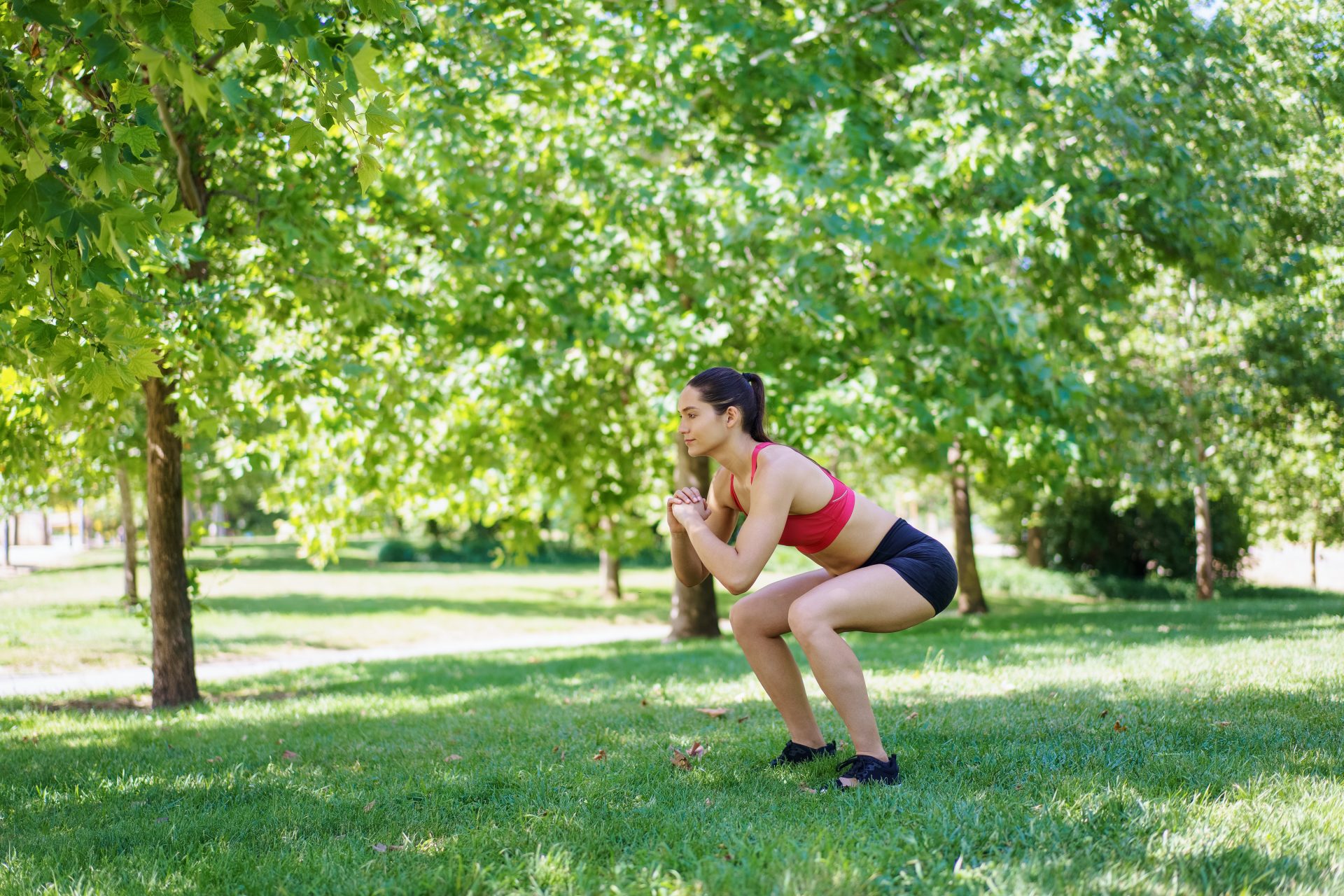
Exercise 1: Bodyweight Squat — Quads, Glutes, Core — 3 sets of 15 reps
How to perform: Stand with feet shoulder-width apart. Lower your hips back and down as if sitting in a chair. Keep your chest up and knees tracking over your toes. Drive through your heels to return to standing. Why it suits this goal: This is the foundation lower-body exercise. Master 15 clean reps before adding load. Modification: Sit back to a chair on each rep for the box-squat variation.
Exercise 2: Forward Lunge — Quads, Glutes, Single-Leg Strength — 3 sets of 10 reps each side
How to perform: Step one leg forward into a long stride. Lower until both knees form 90-degree angles. Drive through the front heel to return to standing. Why it suits this goal: This adds single-leg loading that bilateral squats miss. Excellent for fixing left-right strength imbalances. Modification: Use a wall for balance and step only halfway forward initially.
Exercise 3: Step-Up — Vastus Lateralis, Glutes — 3 sets of 10 reps each side
How to perform: Stand in front of a sturdy bench, chair, or step. Place one foot fully on the surface. Drive through that heel to lift your body up onto the step. Lower with control. Why it suits this goal: This biases the outer quad and works the unilateral pattern at full range of motion. Excellent for quad exercises at home. Modification: Use a low step (15 to 20 cm) initially. Build height over weeks.
Mistake 1: Knees Caving Inward — Correction: Drive Knees Out Toward Pinky Toes
What it is and why it undermines results: Knee valgus during squats and lunges shuts down the glutes and transfers strain to the knee joint. Over reps, this is a leading cause of knee pain. What to do instead: Actively push the knees outward throughout the movement. Imagine spreading the floor apart with your feet.
Mistake 2: Not Going Deep Enough — Correction: Thigh Parallel to Floor or Lower
What it is and why it undermines results: Half-squats remove most of the quad and glute engagement. The exercise becomes a quarter-rep that builds nothing. What to do instead: Lower until your thighs are at least parallel to the floor. Below parallel is even better for quad development if knee health allows.
Mistake 3: Quads-Only Training, Skipping Hamstrings — Correction: Balance Front and Back of Thigh
What it is and why it undermines results: Training only the quads creates muscle imbalance with the hamstrings, increasing knee injury risk. What to do instead: Pair every quad session with hamstring work (Romanian deadlifts, glute bridges, hamstring curls). Balance is what protects the knees. In a live Habuild class, knee-cave gets called out the moment it starts — that’s the cue most self-trainers miss for years and that quietly stalls leg development.
50,000+ members already training with Habuild every morning
Live daily sessions · Expert instructor · Cancel anytime
Lower-Body-Specific Programming, Not Random Leg Day
Habuild’s lower-body sessions follow a structured progression: bilateral squats, single-leg work, then accessory variations.
Live Daily Sessions With Real-Time Form Correction
The two invisible quad-training failures (knee cave and shallow depth) are caught immediately by a live coach. Most home trainers cave their knees within 4 reps without realising it.
Progressive Overload Built Into Every Session
Members progress from bodyweight to dumbbell to Bulgarian split squat variations on a structured schedule based on rep benchmarks.
Accountability, Streaks, and Community
Visible quad development takes 8 to 12 weeks of consistent training. Daily streaks and live cohort timing close the consistency gap.
Complete Beginners Starting from Zero
Quadricep exercises begin with bodyweight squats and seated leg raises — no equipment required. Every movement has a modified version for those with limited knee range or existing discomfort. The only requirement is showing up consistently — strength and technique follow from that.
Intermediate Trainees Looking to Fill a Gap
The quadriceps are the primary shock-absorbers of the lower body and the main engine of knee extension — making them critical for running performance, stair climbing, and knee joint health. Targeted quad work reduces injury risk and improves performance in almost every athletic activity. Adding quadricep exercises to an existing routine addresses a specific conditioning gap that most general workouts miss.
Runners, Cyclists, and Those with Knee or Lower-Body Goals
The quadriceps are the primary shock-absorbers of the lower body and the main engine of knee extension — making them critical for running performance, stair climbing, and knee joint health. Targeted quad work reduces injury risk and improves performance in almost every athletic activity.
Senior Citizens and Older Adults (50+)
Exercises for Quadriceps can be adapted for older adults by controlling tempo, reducing range of motion, and using supported variations. Habuild’s live instructors modify exercises in real time for different fitness levels and physical conditions in the same session.
Is Exercises for Quadriceps Good for Beginners?
Yes — absolutely. Exercises for Quadriceps begin at very low intensity with fully accessible entry-level variations. Habuild’s live instructor adapts the session in real time so beginners and experienced trainees can train together without either being left behind.
How Often to Do Exercises for Quadriceps — Frequency Guide
Train quadricep exercises 3 times per week. This frequency gives the muscle and nervous system adequate stimulus without outpacing recovery. Consistency matters more than intensity in the early weeks — showing up regularly produces better results than infrequent all-out sessions.
When in Your Workout to Do Exercises for Quadriceps
Place quadricep exercises early in a lower-body session, as a primary compound movement before isolation exercises. Sequencing exercises correctly ensures you bring maximum quality to quadricep exercises rather than performing them under accumulated fatigue from earlier work.
What to Pair Exercises for Quadriceps With
Combine quadricep exercises with hamstring curls, glute bridges, and calf raises for balanced lower-body development that protects the knee joint. This combination develops complementary muscle groups in the same session and builds the balanced strength that prevents compensation and injury.
How to Progress Exercises for Quadriceps Over Time
Once the base movement feels controlled and repeatable, add resistance progressively from bodyweight to light dumbbells to barbell squats, and introduce single-leg variations (Bulgarian split squats, pistol squat progressions) as strength develops. Progress only when form is consistent — adding difficulty before mastering the base movement reinforces poor mechanics and stalls long-term results.
Habuild is India’s First Habit Building Program — and through its strength and fitness sessions, it brings the same habit-based philosophy to targeted exercise training. Every session is structured around your specific goal, not a one-size-fits-all class.
Goal-Specific Programming — Not a Generic Fitness Class
Every exercise, rep range, and rest period in Habuild’s quadricep exercises sessions is chosen because it produces results for quadricep exercises specifically. Habuild does not run the same session for every goal — the programme is structured to drive your specific outcome with every session, not general fitness that happens to include quadricep exercises.
Live Daily Sessions with Real-Time Form Correction
Unlike pre-recorded videos, Habuild’s live daily sessions allow the instructor to see and correct your form in real time — the specific errors that limit quadricep exercises results and increase injury risk. This live correction is the difference between training that works and training that wastes effort and creates bad habits.
Progressive Overload Built into Every Session
Members do not need to design their own progressive overload for quadricep exercises — it is built into the programme structure. Each week, sessions are deliberately more challenging than the last, ensuring the body never fully adapts and results continue coming rather than stalling.
Accountability, Streaks, and Community
The most common reason people stop exercising is not effort — it is missing sessions until the habit breaks. Habuild’s streak system, live session accountability, and community of members training the same goal alongside you resolves this directly. Members who join with a specific goal like quadricep exercises and stay consistent for 30 days almost universally report that showing up has become automatic.
100-day streak. "Bodyweight squats to weighted to Bulgarian split squats over 4 months. Squat strength up significantly. Knees stronger than they have been in years."
150-day streak. "Wanted toned thighs, not bulky. Daily moderate-load quad work plus clean eating gave me exactly the look I wanted in 4 months."



Practice Strong Everyday with Trishala Bothra, an IIT-B and London School of Business alumni
Trishala is focused on making movement feel lighter, more engaging, and something you actually look forward to.
In just 3 years, over 50,000 people began their strength journey, and 10,000+ join every week to keep getting stronger.