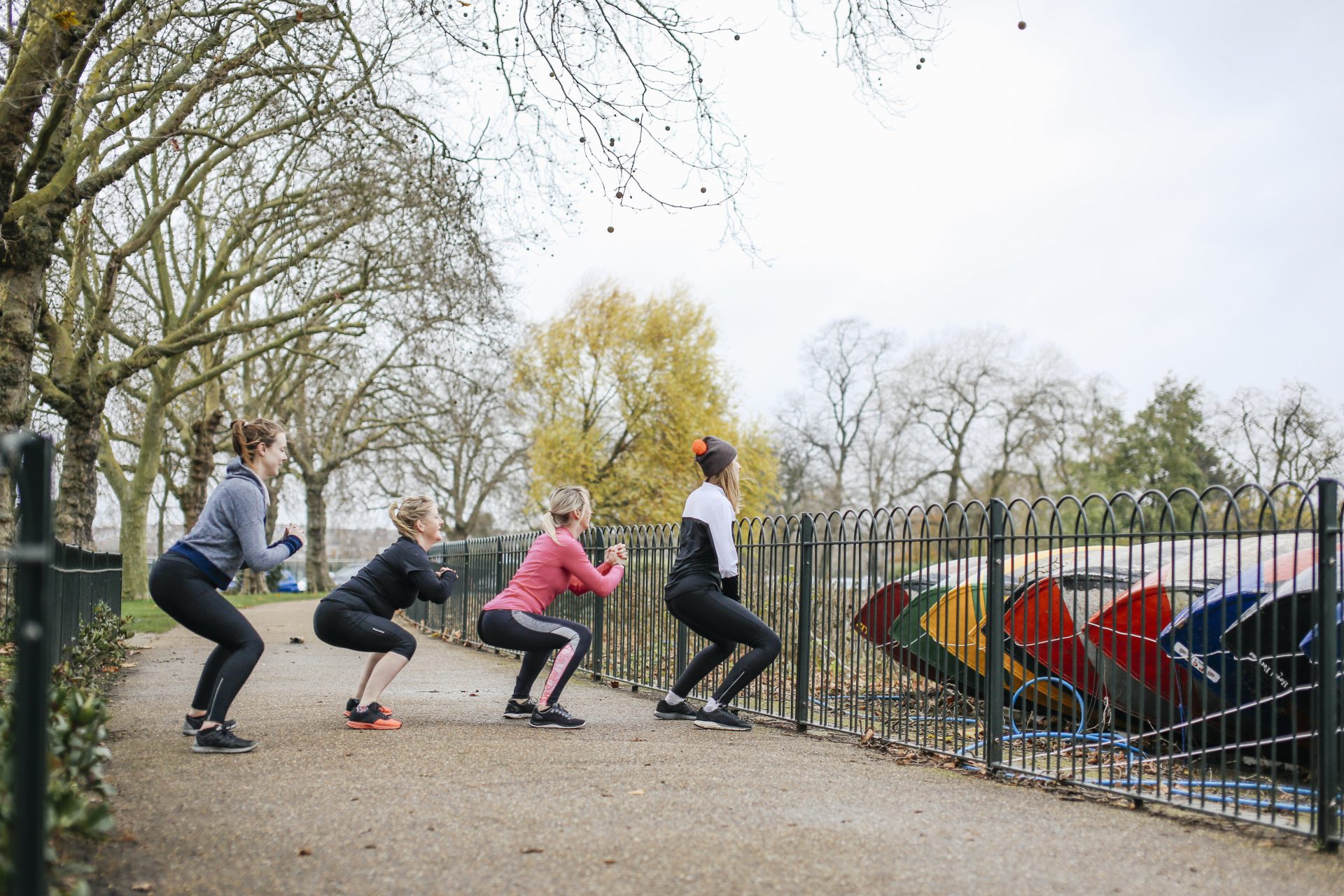
Duck walk exercises are locomotion-based strength movements where you maintain a deep squat position — hips below parallel, chest upright, knees tracking over toes — and walk forward (or backward) while holding that position throughout. Unlike standard squats or lunges, which are stationary repetitions, the duck walk turns the squat into a moving challenge. This forces your stabiliser muscles to work continuously rather than in brief bursts, making it fundamentally different from general lower-body exercise. The training stimulus comes from three overlapping movement demands: continuous eccentric loading of the quads as you stay low, sustained glute and hip-abductor activation to prevent the knees from caving, and constant ankle dorsiflexion to keep your heels grounded. Together, these mechanisms create time-under-tension that is difficult to replicate with isolated machine exercises, while simultaneously training the neuromuscular coordination that makes your lower body perform better in real-world movement. If you want to explore broader lower-body programming alongside duck walk training, structured leg-focused sessions accelerate these same adaptations.
Benefit 1 — Deep Quad and Glute Strength That Transfers to Real Life
The most direct outcome of regular duck walk training is functional strength in the muscles you rely on for stairs, hills, carrying loads, and getting up from low seats. Because the movement keeps you below parallel for the entire duration, the quads work through a longer range of motion than conventional squats allow.
Research published in the Journal of Strength and Conditioning Research found that deep-squat-based movements recruit up to 25% more quadriceps muscle fibre than parallel squats — meaning every step of a duck walk is doing substantially more work per rep than a standard squat at the same tempo.
Benefit 2 — Relief from Knee Stiffness and Hip Tightness
Many people searching for lower-body exercises are dealing with nagging knee stiffness or tight hips from long hours of sitting. The duck walk gently mobilises the knee joint through full flexion under load, promoting synovial fluid circulation and gradually easing morning stiffness with consistent practice.
Movements like the wide-stance duck walk, the heel-down variation, and the lateral duck walk specifically counteract the hip-flexor shortening that desk work creates — making them particularly useful for people whose main complaint is tightness rather than acute pain. Yoga for knee pain complements this approach by adding restorative mobility work between strength sessions.
Benefit 3 — Long-Term Joint Resilience Through Functional Range of Motion
Over weeks of consistent practice, the duck walk builds a specific kind of joint resilience that isolated exercises cannot replicate — because it demands stability and strength at the same time. The ankles, knees, and hips all learn to handle load in a compromised, end-range position.
The WHO recommends at least 150 minutes of moderate-intensity muscle-strengthening activity per week for healthy adults. A daily 10-minute duck walk session contributes meaningfully to that target while specifically improving functional range of motion in a way that most moderate-intensity cardio does not.
Benefit 4 — Improved Posture, Energy, and Mental Focus
A secondary but significant benefit of the duck walk is the postural demand it places on your trunk. Staying upright in a deep squat while moving requires constant core bracing, which over time reinforces an upright thoracic spine and reduces the forward rounding that accumulates from sedentary habits.
Members consistently report that energy levels and mid-afternoon focus improve after a few weeks of consistent lower-body training — the combination of better posture, improved circulation, and daily morning movement creates a compounding quality-of-life effect that extends well beyond the training session itself.
What you eat directly determines how fast you recover, how much you progress, and how consistently you can train. Here is what your nutrition plan should look like to support your duck walk training effectively.
Protein — Preventing Muscle Loss During Cardio
Cardio training breaks down muscle over time if protein intake is insufficient — aim for 1.4–1.8 g/kg/day. Prioritise fast-digesting sources like eggs or whey post-session, and slower sources like dal and paneer at other meals. Chicken, tofu, and low-fat curd are convenient everyday options.
Calcium and Vitamin D — Joint and Bone Health
Strong bones provide the structural foundation for all movement — include calcium-rich foods like milk, curd, paneer, ragi, and sesame seeds (til) daily. Vitamin D is essential for calcium absorption; aim for 15–20 minutes of morning sunlight alongside dietary sources like eggs and fatty fish. Deficiency in either nutrient accelerates joint wear over time.
Anti-Inflammatory Foods — Faster Recovery
Recovery speed is directly influenced by your body’s inflammatory status. Turmeric with black pepper (curcumin + piperine), fresh ginger, and omega-3 fatty acids from flaxseeds, walnuts, and fatty fish all actively reduce exercise-induced inflammation. Include these consistently rather than only on hard training days.
Hydration — Performance and Joint Lubrication
Cardio sessions drive significant fluid and electrolyte loss through sweat. Target 3–3.5 L of water daily, with at least 500 ml consumed before your morning session. On days exceeding 45 minutes of continuous cardio, consider adding a small pinch of rock salt and lemon to water to replace lost sodium and potassium.
Magnesium — Muscle Function and Sleep Quality
Magnesium governs over 300 enzymatic reactions including muscle contraction and relaxation — making it essential for any movement-based training. Include pumpkin seeds, bananas, dark chocolate (70%+), spinach, and whole grains in your daily diet. Many Indians are mildly deficient; if you experience frequent muscle cramps or poor sleep quality, a magnesium glycinate supplement may help.
Starting a new training programme is often the hardest part. Here is a clear, week-by-week plan to begin your duck walk training without injury or overwhelm.
Before You Begin — Setting Your Baseline
Assess your current baseline with a simple test: walk briskly for 10 minutes and note your heart rate and breathlessness level. If you can hold a conversation throughout, your starting fitness is reasonable; if not, begin at a very gentle pace. Set a concrete goal — completing a 30-minute continuous session at moderate intensity — as your 8-week target.
Week 1–2: Foundation
Begin with 15–20 minute sessions at low-to-moderate intensity where you can still hold a full conversation. Focus on establishing a rhythm and learning to breathe through your nose during the easier portions. Do not worry about speed or distance in this phase — showing up consistently matters most.
Week 3–4: Building Consistency
Increase session duration by 5 minutes every week once you can complete your current duration without excessive fatigue. Commit to exercising at the same time each morning; your cardiovascular system responds strongly to consistent circadian-timed training. You should begin to notice better energy levels and lower resting heart rate around week 3.
Week 5–8: Progression
By weeks 5–8, you are ready to introduce interval-style work: 30 seconds at higher intensity followed by 60–90 seconds of easy pace. Most people see their first significant endurance milestone — completing a full session without stopping — somewhere between weeks 4 and 6. Track your progress by how you feel at the same intensity, not just by time or distance.
With cardio training, showing up every morning consistently matters infinitely more than occasional high-intensity efforts.

Exercise 1 — Classic Forward Duck Walk — Quads, Glutes, Ankles — 3 × 15 Metres
What it does: The foundational version. You lower into a deep squat, keep your chest tall, and walk forward one foot at a time without rising out of the squat. This builds continuous quad time-under-tension and trains the glutes to stabilise the pelvis during forward locomotion — a pattern that directly transfers to athletic performance and injury prevention.
Dosage: 3 sets of 15 metres (approximately 20 steps), 3–4 times per week. Rest 60 seconds between sets.
Beginner modification: Use a slightly higher squat position — just above parallel — and reduce the set distance to 8 metres. Focus on keeping heels flat and knees tracking over the second toe before adding depth.
Exercise 2 — Lateral Duck Walk — Hip Abductors, Glute Medius, Inner Knee Stabilisers — 3 × 10 Steps Each Side
What it does: From the same deep squat position, you step sideways rather than forward. This recruits the hip abductors and glute medius — the muscles most responsible for preventing knee valgus collapse — in a way that forward locomotion misses. Strong hip abductors are directly linked to reduced knee pain risk and better pelvic alignment during everyday activities.
Dosage: 3 sets of 10 lateral steps in each direction, 3 times per week. Add a light resistance band just above the knees once the bodyweight version feels manageable.
Beginner modification: Reduce to 6 steps per side and pause for one second between each step to rebuild balance before the next movement.
Exercise 3 — Backward Duck Walk — Hamstrings, VMO, Hip Flexors — 3 × 10 Metres
What it does: Walking backward in a squat shifts the loading pattern to the hamstrings and the vastus medialis oblique (VMO) — the teardrop-shaped quad muscle critical for knee tracking. This variation is particularly useful for people rebuilding knee confidence after a period of inactivity, as it reduces anterior shear force on the knee compared to forward walking. It also opens the hip flexors more aggressively, which benefits anyone with sitting-related tightness.
Dosage: 3 sets of 10 metres backward, 3 times per week. Perform after the forward duck walk when the joints are already warm.
Beginner modification: Perform alongside a wall for tactile balance feedback. Start with 5 metres per set and build gradually.
Mistake 1 — Heels Rising Off the Floor — Correction: Build Ankle Mobility First
What it is: The most common duck walk error is allowing the heels to lift as you walk, which shifts load forward onto the knees and removes the glute and hamstring co-activation that makes the exercise productive. Heel rise usually signals limited ankle dorsiflexion — the ankle cannot flex far enough to keep the heel grounded at depth.
What to do instead: Spend 2 minutes daily on seated ankle circles and calf stretches before your duck walk sets. Place a 5mm wedge or a folded mat under your heels temporarily while you build ankle range of motion over 4–6 weeks.
Mistake 2 — Letting the Knees Cave Inward — Correction: Cue External Rotation Before Each Set
What it is: Knee valgus (inward collapse) during the duck walk is both a strength gap and a form failure. When the hip abductors are not actively engaged, the knees drift inward under load, creating shearing stress on the medial knee structures that undermines the joint resilience the exercise is meant to build.
What to do instead: Before each set, stand in a deep squat and actively push your knees outward against an imaginary resistance. Hold this cue consciously for the first 3–4 steps of every set until it becomes automatic. A light resistance band above the knees makes the cue tactile and significantly more effective.
Mistake 3 — Progressing Distance Before Depth Is Stable — Correction: Prioritise Quality Over Metres Covered
What it is: Many people treat the duck walk as a conditioning drill and immediately try to cover maximum ground, rising out of the squat whenever fatigue sets in. This turns a strength movement into a half-measure that delivers neither the mobility benefit nor the strength stimulus the exercise is designed for.
What to do instead: Set a depth standard — hips clearly below parallel, chest tall, heels flat — and stop the set the moment form breaks, regardless of how far you have walked. Over 3–4 weeks, your sustainable distance at full depth will increase naturally. Fewer metres with better mechanics will always outperform more metres with compromised form.
Duck Walk training is not a one-size-fits-all programme — but it is far more broadly accessible than most people assume. Here is who benefits most.
Complete Beginners Starting from Zero
You do not need any prior fitness experience to begin duck walk exercises. Every movement in a well-structured programme comes with easier modifications — for example, performing the exercise seated, with a reduced range of motion, or using a wall or chair for support. The only requirement is willingness to show up consistently; the strength and technique will follow.
People With Low Cardiovascular Fitness or High Resting Heart Rate
This training is especially valuable for people managing Low Cardiovascular Fitness or High Resting Heart Rate. Duck Walk exercises specifically target the muscular imbalances and movement patterns that drive these conditions. Always begin at a reduced intensity and range, and increase gradually as your body adapts.
Office Workers and Sedentary Adults
Sedentary desk-based work dramatically reduces daily energy expenditure and cardiovascular fitness. A structured morning cardio routine provides the cardiovascular stimulus that the workday eliminates, improving energy, mood, and metabolic health. Studies consistently show that morning exercisers maintain better adherence than those who train in the evening.
Active Adults and Athletes
Experienced gym-goers and recreational athletes use duck walk training to address specific movement gaps and build functional capacity. This style of training bridges the gap between general fitness and sport-specific performance, reducing injury risk in the process. It works well as a primary programme or as targeted supplementary work alongside your existing routine.
Seniors Maintaining Functional Independence
Cardiovascular fitness declines with age but responds strongly to consistent training at any age. Low-to-moderate intensity duck walk sessions maintain heart health, improve circulation, and sustain the energy levels needed for an active daily life. The key for seniors is maintaining consistency over years, not pushing intensity — steady daily movement produces compounding benefits.
Lower-Body-Specific Programming — Not a Generic Fitness Class
Every movement selection, sequencing decision, and rest interval in Habuild’s strength sessions is chosen for functional lower-body benefit. Sessions open with hip-mobility and ankle-preparation drills — precisely the prerequisites that prevent heel-rise and knee-cave errors — before progressing into loaded movements like the duck walk. Sessions close with targeted glute and posterior-chain work so the muscles that stabilise the knee are trained alongside the quads, not at the expense of them.
Live Daily Sessions with Real-Time Form Correction
The specific errors that prevent duck walk progress — heels rising, knees caving, depth not maintained — are almost impossible to self-correct from a video. In Habuild’s live daily sessions, instructors observe members in real time and call out corrections before a compensation pattern becomes a habit. Pre-recorded content cannot do this. The live format is not a feature; it is the reason members actually improve.
Progressive Overload Built into Every Session
Members do not need to self-programme their own progression. Habuild’s sessions systematically increase movement complexity, time-under-tension, and intensity week by week. In the first weeks, the focus is on depth and ankle stability. By weeks 5–8, lateral and backward duck walk variations are introduced. By month 3, resistance is added through bands or load. Members who follow the programme do not plateau because progression is built in — not left to chance.
Accountability, Streaks and Community
The single biggest predictor of whether the duck walk actually improves your lower-body strength is not technique — it is consistency over 8–12 weeks. Habuild’s streak-tracking system, daily session reminders, and WhatsApp community create the social and structural conditions that make daily training feel normal rather than effortful. Members regularly share streak milestones and support each other through the early weeks when motivation alone is not enough.
I am 82 years old. I have arthritis with worn-out knees and cannot sit cross-legged. I also have water in my lungs. My orthopaedic doctor, after seeing my X-ray, said I would be in a wheelchair for the rest of my years. Today, 99% of my knee pain is gone. I do only 25% of the movements Saurabh Sir teaches, but I do them consistently. I am now visiting old temples and climbing the steps to enter them — holding support, but climbing. Leg exercises have strengthened my muscles enough to support my joints. I am walking with confidence.
I joined Habuild in January 2025 as a school teacher. I can now do Yoga Mudra and Nataraj Asana — things I couldn't manage before. Earlier I couldn't even touch my leg; now I do it with complete ease. My mental peace has become strong. I finished the Tata Marathon (6 km) and want to do 21 km. I also walk alone now — something I used to be afraid of. I get all this strength from Habuild.


Practice Strong Everyday with Trishala Bothra, an IIT-B and London School of Business alumni
Trishala is focused on making movement feel lighter, more engaging, and something you actually look forward to.
In just 3 years, over 50,000 people began their strength journey, and 10,000+ join every week to keep getting stronger.