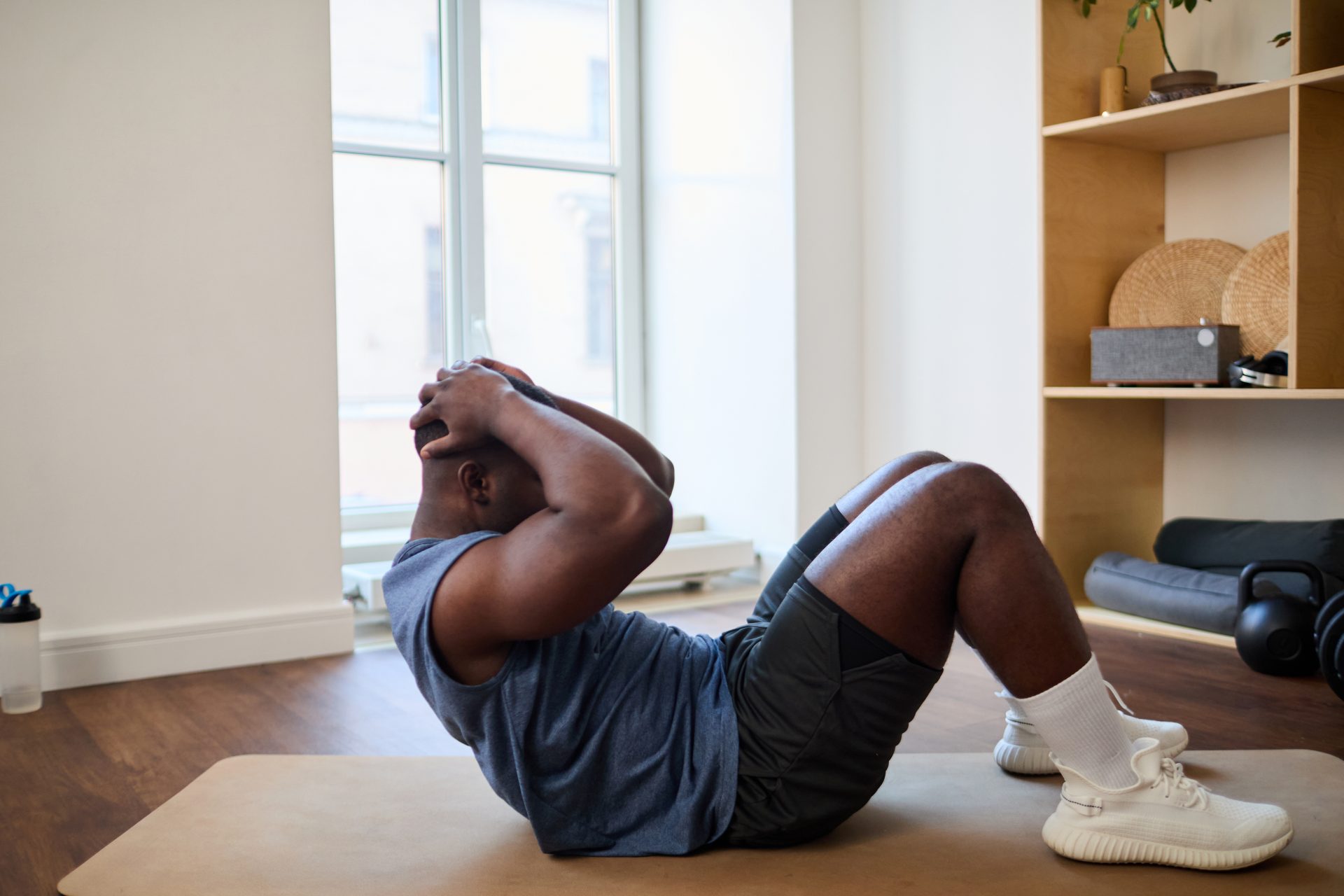
Dead bug exercises get their unusual name from the position they begin in — lying on your back with arms extended toward the ceiling and knees bent at 90° over the hips, looking, well, like a bug on its back. From this starting position, you slowly lower one arm behind your head AND the opposite leg toward the floor simultaneously, then return to start, and repeat with the other side. Throughout the movement, the lower back must stay pressed firmly into the floor — that is the entire point of the exercise. Dead bug core exercises are classified as “anti-extension” core training: the abs work to PREVENT the lower back from arching as gravity pulls the limbs downward.
The mechanism is what makes dead bugs uniquely valuable. Most ab exercises (crunches, sit-ups) train spinal flexion — the abs contract to bend the spine forward. The dead bug exercise for ab muscles trains the OPPOSITE skill — the abs holding a neutral spine against limb movement. This is exactly the function the core performs in daily life and athletics: keeping the spine stable while the limbs do work. Athletes use dead bugs for force-transfer training; rehab clinicians use them for lower-back patients because the exercise builds core strength without spinal flexion that aggravates disc issues. The benefit of dead bug exercise extends well beyond ab aesthetics — it’s the foundation of safe, functional core integration. For a complete progression including dead bugs, our programme covers anti-extension work alongside other movement patterns.
Builds Deep Core Stability Without Lower Back Stress
Dead bugs activate the transverse abdominis, internal obliques and pelvic floor — the deep core muscles responsible for spinal stability — without flexing the lumbar spine. This makes them safe for people with disc bulges, sciatica or chronic lower back pain who cannot tolerate crunches. Stat: clinical research building on Stuart McGill’s spinal-stability literature shows dead-bug-style anti-extension protocols reduce lower-back pain by approximately 30–40% in patients with non-specific chronic LBP after 8 weeks of consistent practice.
Improves Coordination and Cross-Body Movement Patterns
The contralateral (opposite arm and leg) movement pattern of dead bugs trains the same neurological coordination used in walking, running and most athletic movement. This builds the brain-body connection that simple crunches cannot — improving athletic performance and reducing injury risk in generally.
Strengthens the Anti-Extension Function of the Core
The core has four primary functions: anti-flexion (preventing rounding), anti-extension (preventing arching), anti-rotation, and anti-lateral-flexion. Dead bugs are the gold-standard anti-extension exercise. Most ab routines completely neglect this function, which is why they fail to translate into real-world strength.
Beginner-Friendly and Universally Scalable
Dead bugs are one of the safest core exercises in the entire fitness toolkit. They have multiple regression and progression options, work for complete beginners on day one, work for elite athletes with weighted variations, and work for postpartum or rehab populations who need core strength without spinal load.
Below are 3 of the 5 progressions covered in detail; bird dog (the same anti-extension principle on hands and knees) and pallof press (the anti-rotation cousin) round out the 5-variation set — introduced in Habuild’s daily live sessions and discussed in the FAQ below.
Exercise 1: Standard Dead Bug — Anti-Extension Core — 3 sets × 10 reps each side
Lie on your back, arms extended straight up toward the ceiling, knees bent 90° over hips. Slowly lower right arm overhead AND left leg toward the floor (without touching), keeping lower back pressed flat. Return to start, switch sides. 3 sets × 10 reps each side. The foundational variation. Modification: if the lower back lifts, reduce the range — just lower the arm or just lower the leg, not both, until core strength catches up.
Exercise 2: Dead Bug With Heel Tap — Lower Ab Bias — 3 sets × 12 reps each side
Same starting position, but lower only the LEG (heel taps the floor lightly), then return — arms stay up. Switch legs. 3 sets × 12 reps each side. Easier than standard dead bug because only one limb is moving; great progression entry point. Trains lower abs and hip flexor control specifically. Modification: reduce the range so the heel doesn’t quite touch the floor if lower back lifts.
Exercise 3: Weighted Dead Bug — Loaded Anti-Extension — 3 sets × 8 reps each side
Hold a light dumbbell (1–3 kg) or water bottle in each hand. Same dead bug movement pattern. The added load forces deeper transverse abdominis engagement and significantly increases anti-extension demand. 3 sets × 8 reps each side. Save this for week 6+ once standard dead bug form is locked. Modification: use a single dumbbell held in both hands above the chest if individual weights are not available.
Mistake 1: Letting the Lower Back Arch Off the Floor — Correction: Press Lower Back Flat Throughout
The single most common dead bug error: as the arm and leg lower, the lower back arches and lifts off the floor. The exercise becomes a hip flexor and quad drill — the core completely disengages. What to do instead: place one hand under your lower back as a tactile cue, and only lower the limbs as far as you can go while the back stays pressed firmly against your hand. Form first; range second. The benefit of dead bug exercise comes from the maintained neutral spine, not the depth of limb lowering.
Mistake 2: Going Too Fast — Correction: 3 Seconds Down, 1 Second Pause, 3 Seconds Up
Speed-doing dead bugs at 30 reps per minute removes the entire stability challenge. The core is barely loaded; the exercise becomes pointless. What to do instead: deliberate tempo. 3-second slow lower, 1-second pause at the bottom (longest core engagement), 3-second slow return. 8 controlled reps beat 30 fast ones for both core development and lower-back protection.
Mistake 3: Holding the Breath — Correction: Exhale on the Lower, Inhale on the Return
Holding breath during dead bugs spikes intra-abdominal pressure and reduces transverse abdominis activation — the exact muscle the exercise is meant to train. What to do instead: exhale slowly as you lower the limbs (which actively engages the deep core), inhale as you return to start. Coordinated breath increases core activation by roughly 25% in the same rep.
Anti-Extension Programming, Not Just Crunches
Most online ab routines completely ignore anti-extension training — which is why members who do “core work” daily still suffer from lower-back pain and weak athletic core function. Habuild’s daily sessions explicitly programme dead bugs alongside crunches and planks in a balanced 30/30/40 anti-extension/flexion/anti-rotation split.
Live Daily Sessions With Real-Time Form Correction
The arching-back error, the speed-rep error, the held-breath error — all corrected within seconds on the live call. Dead bugs done badly do nothing for the core; dead bugs done well are some of the most effective core training that exists. The difference is form, and form requires live coaching.
Progressive Overload Built Into Every Session
Week 1: dead bug heel tap (one limb at a time). Week 3: standard dead bug. Week 6: dead bug with held position at the bottom. Week 10: weighted dead bug. Members don’t need to programme this — duration, complexity and load build progressively within the live class flow.
Accountability, Streaks and Community
Core stability is invisible until you suddenly notice your lower back stops aching, you’re stronger in every movement, and your posture has improved. Daily streak tracking, the WhatsApp community and live morning sessions keep members on the mat through the 6–8 week window where the deep core is rebuilding silently.
Complete Beginners Starting from Zero
Dead bugs are done lying on your back with no equipment — the starting position itself is comfortable for most people, including those with active back pain. The difficulty is controlled entirely by how far you lower your limbs. The only requirement is showing up consistently — strength and technique follow from that.
Intermediate Trainees Looking to Fill a Gap
Dead bug exercises are among the most effective exercises for building the deep core stability that prevents and resolves lower back pain. Unlike crunches, which train the superficial abs, the dead bug trains the transverse abdominis — the deep stabilising muscle that supports the lumbar spine during movement. Adding dead bug exercises to an existing routine addresses a specific conditioning gap that most general workouts miss.
Those with Lower Back Pain and Anyone Building True Core Stability
Dead bug exercises are among the most effective exercises for building the deep core stability that prevents and resolves lower back pain. Unlike crunches, which train the superficial abs, the dead bug trains the transverse abdominis — the deep stabilising muscle that supports the lumbar spine during movement.
Senior Citizens and Older Adults (50+)
Dead Bug Exercises can be adapted for older adults by controlling tempo, reducing range of motion, and using supported variations. Habuild’s live instructors modify exercises in real time for different fitness levels and physical conditions in the same session.
Is Dead Bug Exercises Good for Beginners?
Yes — absolutely. Dead Bug Exercises begin at very low intensity with fully accessible entry-level variations. Habuild’s live instructor adapts the session in real time so beginners and experienced trainees can train together without either being left behind.
How Often to Do Dead Bug Exercises — Frequency Guide
Train dead bug exercises 4–5 times per week. This frequency gives the muscle and nervous system adequate stimulus without outpacing recovery. Consistency matters more than intensity in the early weeks — showing up regularly produces better results than infrequent all-out sessions.
When in Your Workout to Do Dead Bug Exercises
Place dead bug exercises at the start of a core session as an activation movement, or as a warm-up for any lower-body or back training day. Sequencing exercises correctly ensures you bring maximum quality to dead bug exercises rather than performing them under accumulated fatigue from earlier work.
What to Pair Dead Bug Exercises With
Combine dead bug exercises with bird dogs, planks, and glute bridges for a complete lower-back-safe core stability programme. This combination develops complementary muscle groups in the same session and builds the balanced strength that prevents compensation and injury.
How to Progress Dead Bug Exercises Over Time
Once the base movement feels controlled and repeatable, increase the range of motion (lower limbs closer to the floor), add a pause at the lowest position, then add a resistance band between hands and feet for increased tension. Progress only when form is consistent — adding difficulty before mastering the base movement reinforces poor mechanics and stalls long-term results.
Habuild is India’s First Habit Building Program — and through its strength and fitness sessions, it brings the same habit-based philosophy to targeted exercise training. Every session is structured around your specific goal, not a one-size-fits-all class.
Goal-Specific Programming — Not a Generic Fitness Class
Every exercise, rep range, and rest period in Habuild’s dead bug exercises sessions is chosen because it produces results for dead bug exercises specifically. Habuild does not run the same session for every goal — the programme is structured to drive your specific outcome with every session, not general fitness that happens to include dead bug exercises.
Live Daily Sessions with Real-Time Form Correction
Unlike pre-recorded videos, Habuild’s live daily sessions allow the instructor to see and correct your form in real time — the specific errors that limit dead bug exercises results and increase injury risk. This live correction is the difference between training that works and training that wastes effort and creates bad habits.
Progressive Overload Built into Every Session
Members do not need to design their own progressive overload for dead bug exercises — it is built into the programme structure. Each week, sessions are deliberately more challenging than the last, ensuring the body never fully adapts and results continue coming rather than stalling.
Accountability, Streaks, and Community
The most common reason people stop exercising is not effort — it is missing sessions until the habit breaks. Habuild’s streak system, live session accountability, and community of members training the same goal alongside you resolves this directly. Members who join with a specific goal like dead bug exercises and stay consistent for 30 days almost universally report that showing up has become automatic.
"180-day streak. Six years of intermittent lower back pain. Crunches always made it worse. Habuild swapped me to dead bug exercises plus standing core work — pain dropped to near-zero by week 8 and hasn't returned."

"120-day streak. Post-delivery diastasis recti meant I couldn't do crunches at all without belly bulging. Dead bug heel taps progressed slowly to standard dead bugs over 4 months. Diastasis closed from 3 fingers to 1 finger gap. Doctor was impressed."



Practice Strong Everyday with Trishala Bothra, an IIT-B and London School of Business alumni
Trishala is focused on making movement feel lighter, more engaging, and something you actually look forward to.
In just 3 years, over 50,000 people began their strength journey, and 10,000+ join every week to keep getting stronger.