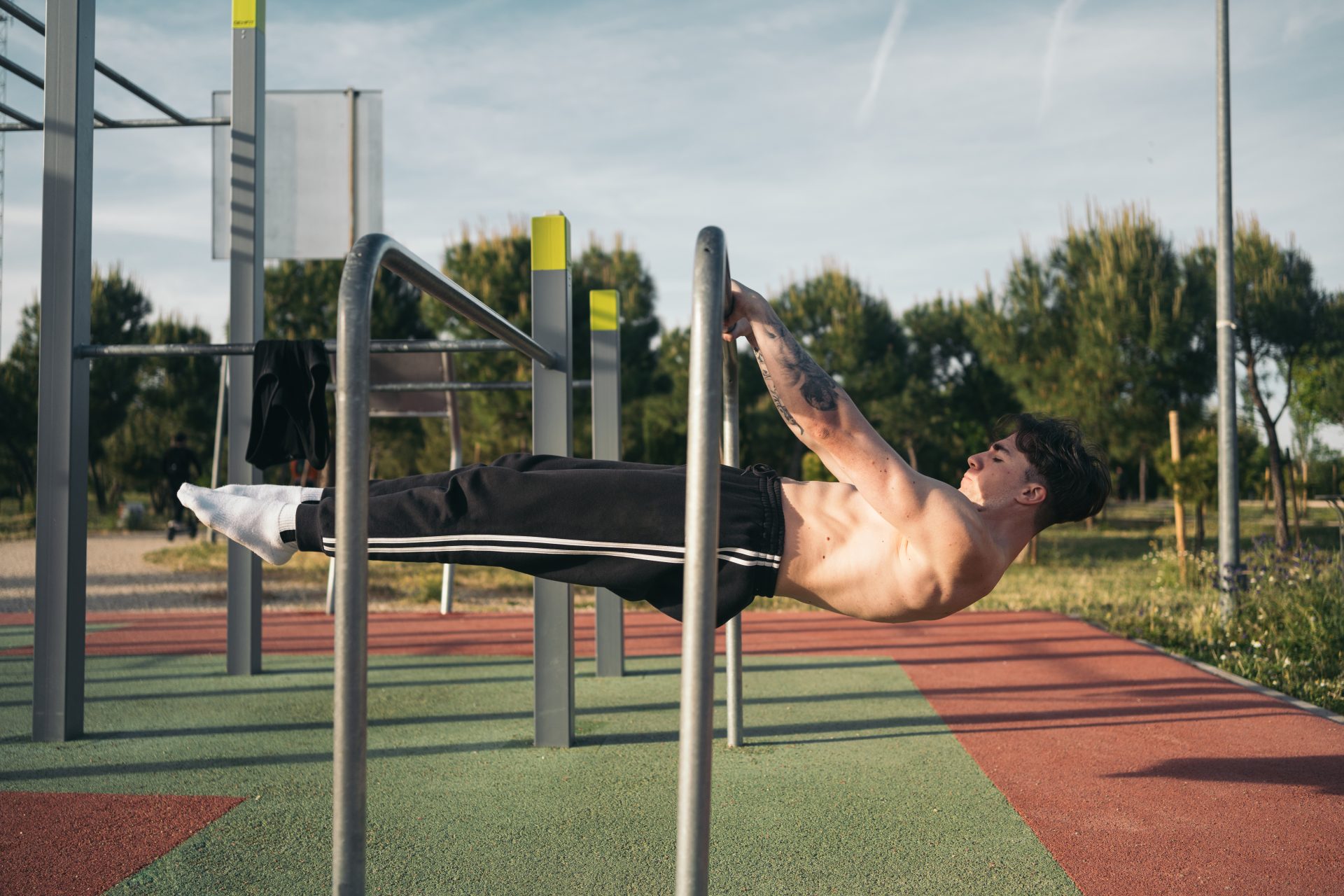
Crab walk exercises are a full-body bodyweight movement performed by sitting on the floor, placing the hands behind the body palms-down with fingers facing the feet, planting the feet flat on the floor with knees bent, and lifting the hips off the floor to form a reverse tabletop position (body facing the ceiling, hands and feet supporting the load). From this position, you “walk” by alternately moving one hand and the opposite foot in a coordinated pattern — sideways, forward, or backward. The unmistakable resemblance to a crab walking is what gives the exercise its name. What is a crab walk exercise really doing biomechanically: simultaneously training the glutes (which hold the hips high), the triceps and shoulders (which support upper-body weight), the core (which stabilises the hip-lift position), and the hip flexors and quads (which control the leg movement). Few bodyweight exercises hit so many muscle groups in one motion.
The mechanism is what makes crab walks uniquely effective despite their playful appearance. The reverse tabletop position is essentially a “reverse plank” — the same kind of full-body stability demand placed on the body during a regular plank, but oriented so the front body is engaged through hip extension and shoulder retraction rather than spinal flexion. Adding sideways or forward locomotion forces the body to maintain that reverse-plank position dynamically, which is significantly harder than a static hold. Is crab walk a good exercise question searchers ask reflects the unusual nature of the move: it doesn’t fit the standard categories. The answer is yes — particularly for posterior-chain (glutes, hamstrings) development, shoulder stability, and the kind of full-body coordination most ab exercises miss. For broader full-body strength programming that integrates crab walks with progressive lifts, the programme covers them as part of a complete movement pattern toolkit.
Builds Posterior-Chain Strength (Glutes, Hamstrings, Lower Back)
The hip-lift position of the crab walk forces continuous gluteus maximus and hamstring activation throughout every step. Benefits of crab walk exercise include strong posterior-chain development without traditional weighted exercises like deadlifts. EMG research on hip-extension and glute-bridge-pattern exercises (Distasio et al. and follow-up gluteus literature) shows reverse-tabletop hip-lift movements produce high glute activation comparable to glute-bridge isolation work — but with full-body integration added.
Strengthens Triceps, Shoulders and Wrist Stability
The supporting arm position loads the triceps (which extend the elbow against gravity) and the shoulder stabilisers (which keep the shoulder blade locked). Daily practice produces measurable triceps endurance and improved shoulder integrity — particularly valuable for those who struggle with push-up performance or have shoulder mobility limits.
Trains Full-Body Coordination Through Cross-Body Movement
The contralateral pattern of crab walking (right hand and left foot move together, then switch) trains cross-body neuromuscular coordination — the same pattern used in walking, running and most athletic movement. Stat: research on coordination-focused training (sport-science literature on agility and lateral movement) shows meaningful agility improvements when cross-body coordination exercises are added to existing programmes over 6–8 week protocols.
Elevates Heart Rate (Adds a Cardio Component)
Sustained 30-second crab walk sets push heart rate into the cardio training zone — the constantly shifting load and full-body engagement make this surprisingly demanding. Adding 2–3 minutes of crab walks to a strength workout adds genuine cardiovascular conditioning alongside the muscular work.
Exercise 1: Standard Crab Walk (Forward and Backward) — Full-Body Strength — 3 sets × 30 seconds
Sit on the floor, hands behind you palms down (fingers pointing toward feet), knees bent, feet flat on the floor. Lift the hips off the floor to form a reverse tabletop. Walk forward by moving the right hand and left foot together, then left hand and right foot. After 4–5 forward steps, walk backward to the start. 3 sets × 30 seconds. The foundational variation. Modification: reduce the duration to 15 seconds initially; keep the hips lower if shoulder fatigue limits the held position.
Exercise 2: Lateral Crab Walk — Hip Abductors + Coordination — 3 sets × 30 seconds
Same starting position. Walk sideways — right hand and right foot move right together, then left hand and left foot follow. Continue 4–5 steps right, then 4–5 steps left. 3 sets × 30 seconds. The lateral movement engages the hip abductors (gluteus medius) significantly more than the standard forward variation, plus adds rotational core demand. Modification: reduce step size if balance is challenging; build to wider lateral steps over 2–3 weeks.
Exercise 3: Single-Arm Crab Walk Hold — Advanced Stability — 3 sets × 15 seconds each side
Hold the reverse tabletop position. Lift one hand off the floor, balancing on the other arm and both feet, hold for 15 seconds. Switch arms. 3 sets × 15 seconds each side. The advanced single-arm hold variation — multiplies the demand on the supporting shoulder, triceps and contralateral core. Save for week 6+ once standard crab walks are clean. Modification: reduce hold time to 8 seconds initially; lower the hips slightly if shoulder fatigue is excessive.
Mistake 1: Letting the Hips Drop Toward the Floor — Correction: Squeeze Glutes, Hold Hip-High Position
The most common crab walk error: as fatigue sets in, the hips drift down toward the floor — which removes the entire posterior-chain training stimulus. The exercise becomes a confused upper-body movement with weak glute engagement. What to do instead: consciously squeeze the glutes throughout every step. The hips should stay high, ideally at the level of the bent knees, throughout the duration of the set. The moment the hips drop, stop, reset, and continue at a slower pace. Form first; pace second.
Mistake 2: Wrist Pain From Bad Hand Position — Correction: Fingers Toward Feet, Not Out to the Sides
If you place the hands with fingers pointing out to the sides, the wrists hyperextend at an awkward angle and bear load they shouldn’t. Wrist pain results within minutes. What to do instead: hands behind the body with FINGERS POINTING TOWARD THE FEET (not out to the sides, not back). This positions the wrist correctly under the shoulder and lets the triceps bear the actual load. If wrist mobility is limited, place the hands slightly wider than shoulder-width to reduce strain.
Mistake 3: Going Too Fast With Sloppy Form — Correction: Controlled Tempo, Deliberate Steps
Speed-doing crab walks by scrambling across the floor as fast as possible trains nothing — momentum carries the move and the muscles barely engage. What to do instead: moderate, deliberate pace. Each hand-and-foot pairing should move with intention, the hips staying high throughout. 4–5 controlled steps per direction beat 10 chaotic ones for both muscle development and joint safety. The programme reinforces this controlled-tempo principle for all integrated movement work.
Integrated Movement Programming, Not Isolated Muscle Work
Most home workouts isolate one muscle at a time — bicep curls for biceps, squats for legs, crunches for abs. Habuild’s daily sessions explicitly programme compound movements like crab walks, mountain climbers, and bear crawls alongside isolation work, ensuring members get the full-body integration that translates into real-world movement quality.
Live Daily Sessions With Real-Time Form Correction
The dropped-hips error, the wrist-position error, the speed-step error — all corrected within seconds on the live call. Crab walks done badly cause wrist pain or fail to load the glutes; crab walks done well are highly effective full-body movements. The difference is form, and form requires live coaching.
Progressive Overload Built Into Every Session
Week 1: standard crab walks at 20-second intervals. Week 4: lateral crab walks added, longer 45-second intervals. Week 6: single-arm hold variation introduced. Week 10: combined crab walk circuits with bear crawl and mountain climber transitions. Members don’t programme this — duration, complexity and movement-pattern integration build progressively within the live class flow.
Accountability, Streaks and Community
Crab walks feel awkward initially — the coordination takes 2–3 weeks to develop. Daily streak tracking, the WhatsApp community and live morning sessions keep members on the mat through the early window where the move feels disproportionately hard before strength and coordination catch up.
Complete Beginners Starting from Zero
Crab walks begin on the floor with no equipment — just enough space to move sideways or forward. The movement is slow and controlled, making it accessible for complete beginners once the wrist position is established. The only requirement is showing up consistently — strength and technique follow from that.
Intermediate Trainees Looking to Fill a Gap
Crab walks build shoulder, tricep, and glute strength in a movement pattern that most conventional exercises completely miss. They are particularly valuable for athletes who need shoulder stability from multiple angles and for anyone building functional full-body strength without a gym. Adding crab walk exercises to an existing routine addresses a specific conditioning gap that most general workouts miss.
Those Building Functional Strength and Athletes in Unconventional Training
Crab walks build shoulder, tricep, and glute strength in a movement pattern that most conventional exercises completely miss. They are particularly valuable for athletes who need shoulder stability from multiple angles and for anyone building functional full-body strength without a gym.
Senior Citizens and Older Adults (50+)
Crab Walk Exercises can be adapted for older adults by controlling tempo, reducing range of motion, and using supported variations. Habuild’s live instructors modify exercises in real time for different fitness levels and physical conditions in the same session.
Is Crab Walk Exercises Good for Beginners?
Yes — absolutely. Crab Walk Exercises begin at very low intensity with fully accessible entry-level variations. Habuild’s live instructor adapts the session in real time so beginners and experienced trainees can train together without either being left behind.
How Often to Do Crab Walk Exercises — Frequency Guide
Train crab walk exercises 3–4 times per week. This frequency gives the muscle and nervous system adequate stimulus without outpacing recovery. Consistency matters more than intensity in the early weeks — showing up regularly produces better results than infrequent all-out sessions.
When in Your Workout to Do Crab Walk Exercises
Place crab walk exercises as a warm-up to activate the shoulders and glutes, or as a conditioning circuit exercise. Sequencing exercises correctly ensures you bring maximum quality to crab walk exercises rather than performing them under accumulated fatigue from earlier work.
What to Pair Crab Walk Exercises With
Combine crab walk exercises with bear crawls, mountain climbers, and push-ups for an equipment-free full-body conditioning circuit. This combination develops complementary muscle groups in the same session and builds the balanced strength that prevents compensation and injury.
How to Progress Crab Walk Exercises Over Time
Once the base movement feels controlled and repeatable, increase distance, add weight on the hips, progress to crab walk push-ups (lowering to the ground during the walk), or combine with a kick-through at each step. Progress only when form is consistent — adding difficulty before mastering the base movement reinforces poor mechanics and stalls long-term results.
Habuild is India’s First Habit Building Program — and through its strength and fitness sessions, it brings the same habit-based philosophy to targeted exercise training. Every session is structured around your specific goal, not a one-size-fits-all class.
Goal-Specific Programming — Not a Generic Fitness Class
Every exercise, rep range, and rest period in Habuild’s crab walk exercises sessions is chosen because it produces results for crab walk exercises specifically. Habuild does not run the same session for every goal — the programme is structured to drive your specific outcome with every session, not general fitness that happens to include crab walk exercises.
Live Daily Sessions with Real-Time Form Correction
Unlike pre-recorded videos, Habuild’s live daily sessions allow the instructor to see and correct your form in real time — the specific errors that limit crab walk exercises results and increase injury risk. This live correction is the difference between training that works and training that wastes effort and creates bad habits.
Progressive Overload Built into Every Session
Members do not need to design their own progressive overload for crab walk exercises — it is built into the programme structure. Each week, sessions are deliberately more challenging than the last, ensuring the body never fully adapts and results continue coming rather than stalling.
Accountability, Streaks, and Community
The most common reason people stop exercising is not effort — it is missing sessions until the habit breaks. Habuild’s streak system, live session accountability, and community of members training the same goal alongside you resolves this directly. Members who join with a specific goal like crab walk exercises and stay consistent for 30 days almost universally report that showing up has become automatic.
"120-day streak. Adding crab walks 3 times a week to my Habuild routine — squat depth improved and glute strength obviously increased. The hip extension demand transferred directly into stronger lower-body lifts."
"180-day streak. My shoulders had been weak for years — push-ups capped at 5 reps. Six months of Habuild compound bodyweight movements including crab walks — push-up max now 17 reps. The triceps and shoulder stability transfer was significant."


Practice Strong Everyday with Trishala Bothra, an IIT-B and London School of Business alumni
Trishala is focused on making movement feel lighter, more engaging, and something you actually look forward to.
In just 3 years, over 50,000 people began their strength journey, and 10,000+ join every week to keep getting stronger.