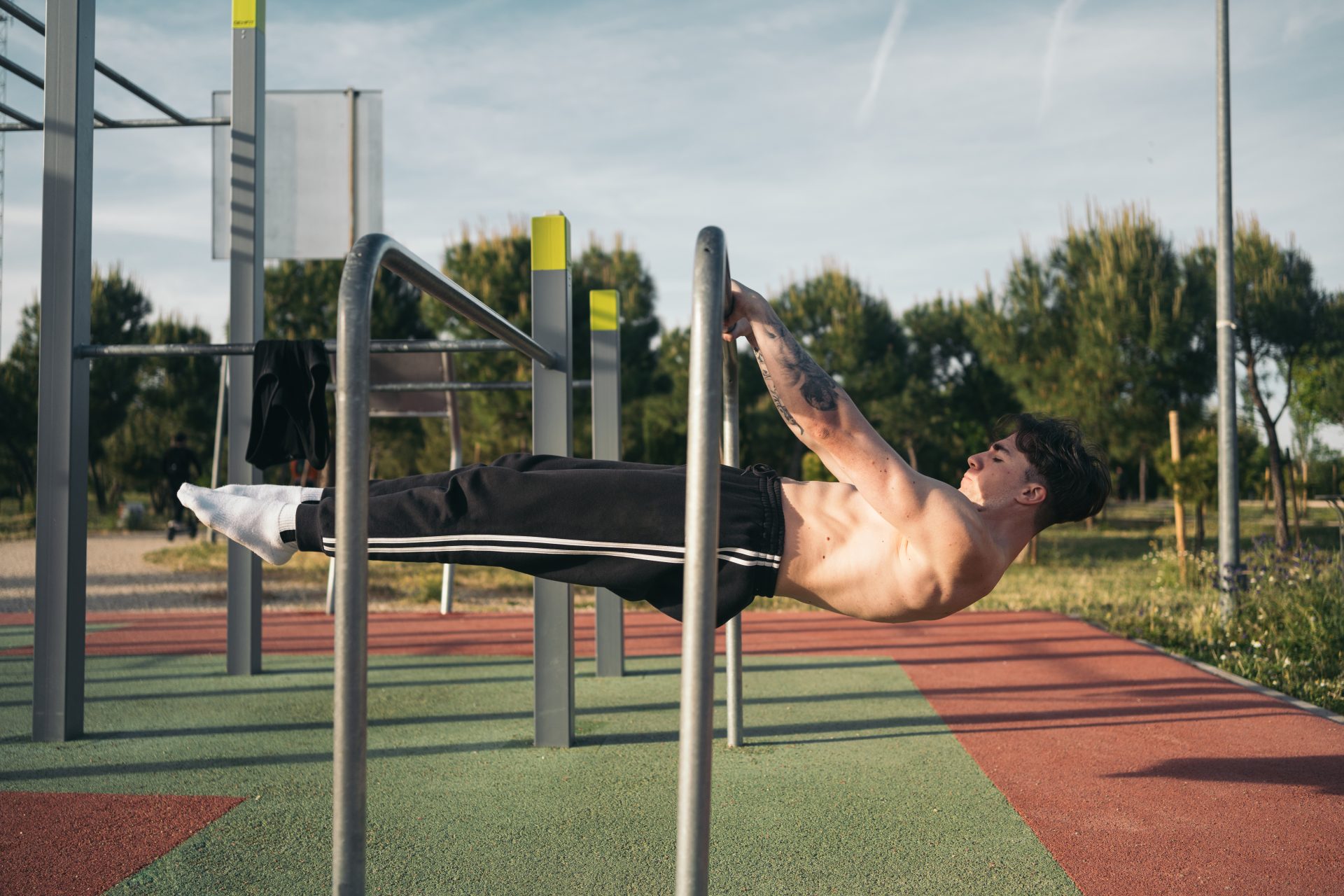
Bear crawls (sometimes called bear claw workout drills) are a quadrupedal movement exercise where you crawl forward on your hands and feet, with your knees hovering just an inch or two off the ground. The movement looks elementary — like a child crawling — but produces some of the most integrated full-body conditioning of any bodyweight exercise. Where standard exercises tend to isolate one quality (squats train legs, push-ups train pressing, planks train core), bear crawls train all of them simultaneously: shoulder endurance, core anti-rotation strength, leg drive, hip mobility, coordination, and cardiovascular output. That’s why CrossFit, military training, and athletic strength-and-conditioning programmes all rely on bear crawls as a foundational movement.
The mechanism is multi-system stress. As you crawl forward, the shoulders support a significant portion of bodyweight isometrically while the legs drive the body forward. The core must fire constantly to prevent the hips from rotating side-to-side or the lower back from sagging. The cardiovascular system spikes within 20–30 seconds because so many muscles are working simultaneously. The result: a single exercise that develops strength, conditioning, mobility, and coordination at the same time. For home trainers without equipment, exercises like bear crawl deliver more total adaptation per minute than almost any alternative.
Builds Full-Body Strength in One Movement
Bear crawls activate almost every major muscle group simultaneously — core, shoulders, and legs working together at meaningful intensity, comparable to the integrated activation produced by compound lifts.
Develops Elite Core Stability and Anti-Rotation Strength
The core must constantly resist rotation as opposite limbs move. Research on core training, particularly anti-rotation work like bear crawls, consistently shows meaningful reductions in low back pain frequency and improved athletic performance over crunch-based .
Builds Shoulder Endurance and Stability
The constant load-bearing position trains the rotator cuff and scapular stabilisers under real load — directly reducing shoulder injury risk in pressing exercises and overhead sports. Pair bear crawls with focused for complete shoulder development.
Significant Cardiovascular Conditioning Effect
Bear crawls produce among the highest cardiovascular output of any bodyweight exercise — comparable to moderate jogging — while simultaneously building strength. Few exercises combine these qualities so effectively, making them ideal for any .
Variation 1: Standard Forward Bear Crawl — Full Body — 3 sets × 30–60 seconds
How to perform: Start on all fours. Lift your knees just off the ground (1–2 inches). Crawl forward by moving opposite limbs together (right hand + left foot, then left hand + right foot). Maintain a flat back. Why it suits this goal: The benchmark variation. Modification: Reduce duration to 15–20 seconds initially; allow brief breaks between rounds.
Variation 2: Reverse Bear Crawl — Posterior Chain + Core — 3 sets × 30 seconds
How to perform: Same starting position; crawl backward. Why it suits this goal: Reverse direction shifts emphasis to glutes, hamstrings, and triceps — complementing the anterior bias of forward crawls. Modification: Slow the pace; focus on form over distance. Build duration over 2–3 weeks.
Variation 3: Lateral Bear Crawl — Hip Stabilisers + Obliques — 3 sets × 30 seconds (each direction)
How to perform: Standard bear crawl position; crawl sideways in one direction, then back. Why it suits this goal: Adds frontal-plane movement that forward and reverse crawls miss — strengthening hip abductors, glute medius, and obliques. The same lateral-loading mechanism appears in dedicated . Modification: Take small lateral steps instead of full crawling; build coordination first.
Mistake 1: Lifting the Hips Too High — Correction: Hips Level With Shoulders, Knees Just Off Ground
What it is + why it undermines results: Most beginners pike the hips into a downward-dog position to make the movement easier — eliminating the core challenge entirely. What to do instead: Keep the hips at shoulder height with knees hovering 1–2 inches off the ground. The body should look like a low table.
Mistake 2: Moving Same-Side Limbs Together — Correction: Always Move Opposite Limbs
What it is + why it undermines results: Same-side movement (right hand + right foot) eliminates the anti-rotation challenge. What to do instead: Always move opposite limbs together — right hand with left foot, left hand with right foot. The cross-body coordination is what delivers the core benefit.
Mistake 3: Rushing for Distance — Correction: Slow and Controlled
What it is + why it undermines results: Fast bear crawls bypass core engagement and become a coordination drill rather than a strength exercise. What to do instead: Move slowly with controlled, deliberate steps. Quality over speed. In a live Habuild class, the coach catches the hip-pike and same-side-step the moment they appear — invisible to the trainer, every time.
50,000+ members already training with Habuild every morning
Live daily sessions · Expert instructor · Cancel anytime
Movement-Pattern Programming, Not Random Workouts
Habuild’s strength sessions deliberately programme bear crawls as full-body conditioning finishers — when warmed up but not exhausted. The position in the session matters: too early and the core can’t keep up, too late and form breaks down completely.
Live Daily Sessions With Real-Time Form Correction
The three bear crawl failures — high hips, same-side movement, rushed pace — are all invisible to the trainer. A live coach catches them immediately, before bad patterns set in.
Progressive Overload Built Into Every Session
Members progress from forward to reverse to lateral variations on a structured schedule. Duration, pace, and complexity all advance over weeks.
Accountability, Streaks, and Community
Bear crawls are demanding enough that home trainers skip them when training alone. Daily streaks and live cohort timing keep members showing up.
Complete Beginners Starting from Zero
Bear crawls require no equipment and can be done in any open space — a hallway, garden, or living room floor. The movement scales simply by shortening distance or slowing the pace. The only requirement is showing up consistently — strength and technique follow from that.
Intermediate Trainees Looking to Fill a Gap
Bear crawls replicate natural quadrupedal movement patterns and are a staple in athletic and military conditioning. They build full-body coordination, core endurance, and shoulder stability that transfer directly to sport and daily movement. Adding bear crawls to an existing routine addresses a specific conditioning gap that most general workouts miss.
Athletes and Functional Fitness Enthusiasts
Bear crawls replicate natural quadrupedal movement patterns and are a staple in athletic and military conditioning. They build full-body coordination, core endurance, and shoulder stability that transfer directly to sport and daily movement.
Senior Citizens and Older Adults (50+)
Bear Crawls can be adapted for older adults by controlling tempo, reducing range of motion, and using supported variations. Habuild’s live instructors modify exercises in real time for different fitness levels and physical conditions in the same session.
Is Bear Crawls Good for Beginners?
Yes — absolutely. Bear Crawls begin at very low intensity with fully accessible entry-level variations. Habuild’s live instructor adapts the session in real time so beginners and experienced trainees can train together without either being left behind.
How Often to Do Bear Crawls — Frequency Guide
Train bear crawls 3–4 times per week. This frequency gives the muscle and nervous system adequate stimulus without outpacing recovery. Consistency matters more than intensity in the early weeks — showing up regularly produces better results than infrequent all-out sessions.
When in Your Workout to Do Bear Crawls
Place bear crawls as a conditioning finisher after your main workout, or during the warm-up phase to activate the core and shoulders. Sequencing exercises correctly ensures you bring maximum quality to bear crawls rather than performing them under accumulated fatigue from earlier work.
What to Pair Bear Crawls With
Combine bear crawls with mountain climbers, push-ups, and bodyweight squats for a full-body conditioning circuit. This combination develops complementary muscle groups in the same session and builds the balanced strength that prevents compensation and injury.
How to Progress Bear Crawls Over Time
Once the base movement feels controlled and repeatable, increase distance or duration first, then add lateral and backward bear crawls, and finally progress to weighted bear crawls with a light plate on the back. Progress only when form is consistent — adding difficulty before mastering the base movement reinforces poor mechanics and stalls long-term results.
Habuild is India’s First Habit Building Program — and through its strength and fitness sessions, it brings the same habit-based philosophy to targeted exercise training. Every session is structured around your specific goal, not a one-size-fits-all class.
Goal-Specific Programming — Not a Generic Fitness Class
Every exercise, rep range, and rest period in Habuild’s bear crawls sessions is chosen because it produces results for bear crawls specifically. Habuild does not run the same session for every goal — the programme is structured to drive your specific outcome with every session, not general fitness that happens to include bear crawls.
Live Daily Sessions with Real-Time Form Correction
Unlike pre-recorded videos, Habuild’s live daily sessions allow the instructor to see and correct your form in real time — the specific errors that limit bear crawls results and increase injury risk. This live correction is the difference between training that works and training that wastes effort and creates bad habits.
Progressive Overload Built into Every Session
Members do not need to design their own progressive overload for bear crawls — it is built into the programme structure. Each week, sessions are deliberately more challenging than the last, ensuring the body never fully adapts and results continue coming rather than stalling.
Accountability, Streaks, and Community
The most common reason people stop exercising is not effort — it is missing sessions until the habit breaks. Habuild’s streak system, live session accountability, and community of members training the same goal alongside you resolves this directly. Members who join with a specific goal like bear crawls and stay consistent for 30 days almost universally report that showing up has become automatic.
90-day streak. "Crunches never fixed my back. Daily bear crawls and anti-rotation work — six weeks and the back pain was gone. Stayed gone for months."
150-day streak. "Recurrent shoulder strain from tennis serves. Three months of bear crawls — shoulder stability transformed. No more strain."


Practice Strong Everyday with Trishala Bothra, an IIT-B and London School of Business alumni
Trishala is focused on making movement feel lighter, more engaging, and something you actually look forward to.
In just 3 years, over 50,000 people began their strength journey, and 10,000+ join every week to keep getting stronger.