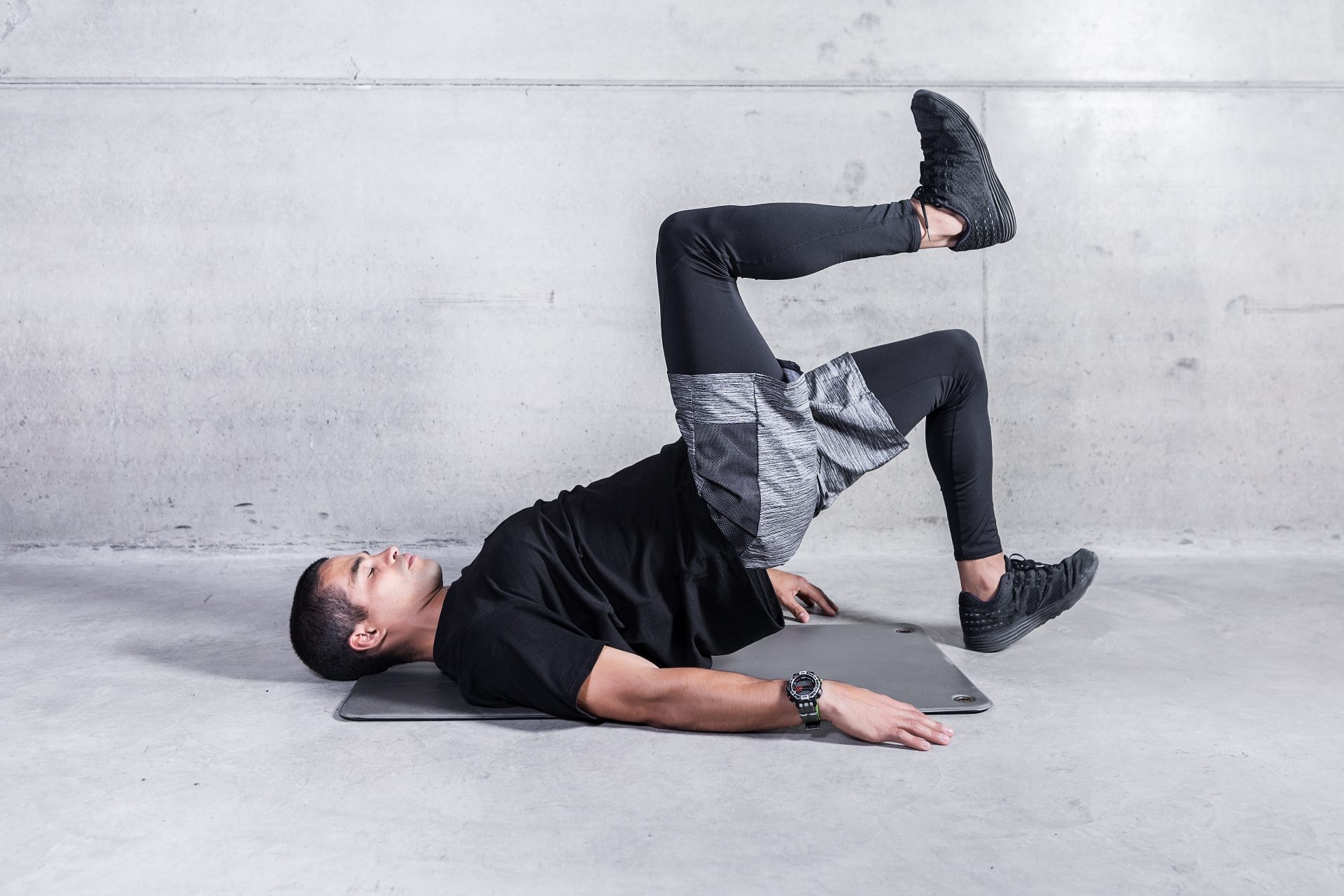
A curtsy lunge is a single-leg strength exercise where you step one leg diagonally behind the other and lower into a lunge — the position mimicking the action of a formal curtsy. The crossing-behind angle is what makes the movement special. Where forward and reverse lunges work the quadriceps and gluteus maximus straight up the front and back of the leg, the curtsy lunge shifts the load onto the gluteus medius (the side glute), the inner thigh adductors, and the hip stabilisers. These are the muscles most home leg routines completely ignore. If you’re newer to structured lower-body training, the curtsy lunge fits naturally into a broader programme that builds the foundational movement patterns first.
The mechanism is rotational and lateral. As you cross one leg behind the other, the support-leg glute medius fires hard to keep your hips level and prevent collapse. The lowered leg’s adductors stretch under load. The result is a lunge that builds width and stability in the hips alongside the strength and size standard lunges produce. Strong glute medius muscles also reduce knee valgus (the inward knee collapse common in squats) — protecting the knees during heavier lifts down the track.
Targets the Gluteus Medius — The “Side Glute” Most Workouts Miss
The gluteus medius is responsible for the rounded, capped look on the outside of the glutes. EMG-based research on lunge variations consistently shows substantially higher glute medius activation in cross-step movements (curtsy lunges, lateral lunges) than in standard forward or reverse lunges. Adding them to a complete routine is the single fastest way to develop the side-glute shape.
Stronger Inner Thighs and Better Hip Stability
The crossing-behind motion stretches the adductors (inner thighs) under load — a movement standard squats and lunges don’t produce. Stronger adductors mean better balance, better closed-chain knee stability, and reduced injury risk in any single-leg sport.
Improved Single-Leg Balance and Functional Strength
Real life happens on one leg — walking, climbing stairs, getting out of a car. Curtsy lunges train the single-leg stability that two-legged exercises like squats can’t. Research on single-leg training consistently links it to meaningful reductions in fall risk for adults over 50, alongside improved balance and confidence in everyday movement. Many women specifically use this movement as a centrepiece of because it produces the lifted, rounded glute shape without bulking the quads.
Sharper Glute-to-Hip Aesthetic and Better Posture
The combination of glute medius development and hip-stabiliser strength produces the rounded, lifted glute aesthetic — and the upright pelvis posture that supports it.
Variation 1: Standard Bodyweight Curtsy Lunge — Glutes, Inner Thighs — 3 sets × 10 reps each side
How to perform: Stand with feet hip-width apart. Step your right leg diagonally behind and across your left, lowering into a lunge until your right knee almost touches the floor. Drive through the left heel to return to standing. Why it suits this goal: It’s the foundation movement and the form benchmark. Modification: Use a chair or wall for balance and step only halfway behind initially.
Variation 2: Curtsy Lunge to Side Kick — Glutes, Hip Abductors — 3 sets × 12 reps each side
How to perform: From a standard curtsy lunge, drive up explosively and kick the back leg out to the side at hip height before returning to the lunge. Why it suits this goal: Combines the curtsy action with a side-glute activation kick, doubling glute medius work in one rep. Modification: Skip the kick at first — just touch the foot to the side and return.
Variation 3: Weighted Curtsy Lunge — Glutes, Quads, Adductors — 3 sets × 10 reps each side
How to perform: Hold a dumbbell or kettlebell in each hand (or one at chest level) and perform the standard curtsy lunge. Why it suits this goal: Adds the load required for visible glute hypertrophy beyond what bodyweight can produce. For trainers wanting maximum tension at minimum joint stress, the weighted curtsy lunge also pairs well with — using a 6-second descent and 2-second drive instead of normal tempo. Modification: Start with light weights (3–5 kg per hand) and prioritise depth and control over weight.
Mistake 1: Letting the Front Knee Cave Inward — Correction: Drive the Front Knee Out
What it is + why it undermines results: When the support knee collapses inward (toward the midline), the glute medius switches off and the strain transfers to the knee joint. What to do instead: Actively push the front knee out — toward the pinky toe — throughout the rep. Imagine spreading the floor with your feet.
Mistake 2: Stepping Too Wide Behind — Correction: Cross 30–45 Degrees, Not 90
What it is + why it undermines results: Stepping too far across reduces stability and removes load from the glutes, putting strain on the IT band and lateral knee instead. What to do instead: Cross at roughly a 30–45 degree angle behind your front leg — enough to feel the side-glute engagement, not so far that you wobble.
Mistake 3: Rushing Through Reps for Higher Counts — Correction: 3 Seconds Down, 1 Second Up
What it is + why it undermines results: Curtsy lunges work via tempo and depth. Fast reps use momentum, dramatically reducing glute activation and producing the cardio-not-strength effect most home trainers don’t realise they’re getting. What to do instead: Lower for 3 seconds, drive up for 1, with a brief pause at the bottom. Half the reps, double the glute work. In a live Habuild class, knee-cave gets called out the moment it starts — that’s the cue most self-trainers miss for years and that quietly stalls glute development.
Glute-Specific Programming, Not Generic Leg Day
Habuild’s lower-body sessions deliberately sequence curtsy lunges before standard squats — when the glute medius is freshest. Most home routines reverse this order, fatiguing the bigger muscles first and leaving glute medius work to a tired body. The full lower-body progression sits inside our broader framework, which sequences exercises for maximum total adaptation.
Live Daily Sessions With Real-Time Form Correction
Curtsy lunge form has two invisible failure points — knee-cave and excessive cross-step. A live coach catches them in real time, before they wreck your knees or your results.
Progressive Overload Built Into Every Session
Members progress from bodyweight to weighted to plyometric variations on a structured schedule. No guessing when to add weight or change difficulty — the programme handles it.
Accountability, Streaks, and Community
Daily streaks and live cohort timing keep members showing up. Most home strength training fails at week 3 from inconsistency — Habuild’s structure removes that failure point.
Complete Beginners Starting from Zero
Curtsy lunges begin with bodyweight only, holding a wall or chair for balance if needed. The movement pattern is simple — step one leg diagonally behind the other — and the depth is fully controlled by the individual. The only requirement is showing up consistently — strength and technique follow from that.
Intermediate Trainees Looking to Fill a Gap
The curtsy lunge activates the gluteus medius and outer hip more than standard lunges — muscles that are frequently underdeveloped and a common source of hip and lower back pain. They also improve hip mobility and provide a different stimulus for the quads and glutes compared to forward or reverse lunges. Adding curtsy lunges to an existing routine addresses a specific conditioning gap that most general workouts miss.
Those Targeting Glutes, Outer Hips, and Looking for a Lunge Variation
The curtsy lunge activates the gluteus medius and outer hip more than standard lunges — muscles that are frequently underdeveloped and a common source of hip and lower back pain. They also improve hip mobility and provide a different stimulus for the quads and glutes compared to forward or reverse lunges.
Senior Citizens and Older Adults (50+)
Curtsy Lunges can be adapted for older adults by controlling tempo, reducing range of motion, and using supported variations. Habuild’s live instructors modify exercises in real time for different fitness levels and physical conditions in the same session.
Is Curtsy Lunges Good for Beginners?
Yes — absolutely. Curtsy Lunges begin at very low intensity with fully accessible entry-level variations. Habuild’s live instructor adapts the session in real time so beginners and experienced trainees can train together without either being left behind.
How Often to Do Curtsy Lunges — Frequency Guide
Train curtsy lunges 3–4 times per week. This frequency gives the muscle and nervous system adequate stimulus without outpacing recovery. Consistency matters more than intensity in the early weeks — showing up regularly produces better results than infrequent all-out sessions.
When in Your Workout to Do Curtsy Lunges
Place curtsy lunges in the main lower-body block, typically after compound squats and before isolated glute work. Sequencing exercises correctly ensures you bring maximum quality to curtsy lunges rather than performing them under accumulated fatigue from earlier work.
What to Pair Curtsy Lunges With
Combine curtsy lunges with glute bridges, clamshells, and lateral band walks for a complete outer hip and glute programme. This combination develops complementary muscle groups in the same session and builds the balanced strength that prevents compensation and injury.
How to Progress Curtsy Lunges Over Time
Once the base movement feels controlled and repeatable, add dumbbells held at the sides, increase depth, add a pulse at the bottom of each rep, and progress to weighted curtsy lunges with a front rack hold. Progress only when form is consistent — adding difficulty before mastering the base movement reinforces poor mechanics and stalls long-term results.
Habuild is India’s First Habit Building Program — and through its strength and fitness sessions, it brings the same habit-based philosophy to targeted exercise training. Every session is structured around your specific goal, not a one-size-fits-all class.
Goal-Specific Programming — Not a Generic Fitness Class
Every exercise, rep range, and rest period in Habuild’s curtsy lunges sessions is chosen because it produces results for curtsy lunges specifically. Habuild does not run the same session for every goal — the programme is structured to drive your specific outcome with every session, not general fitness that happens to include curtsy lunges.
Live Daily Sessions with Real-Time Form Correction
Unlike pre-recorded videos, Habuild’s live daily sessions allow the instructor to see and correct your form in real time — the specific errors that limit curtsy lunges results and increase injury risk. This live correction is the difference between training that works and training that wastes effort and creates bad habits.
Progressive Overload Built into Every Session
Members do not need to design their own progressive overload for curtsy lunges — it is built into the programme structure. Each week, sessions are deliberately more challenging than the last, ensuring the body never fully adapts and results continue coming rather than stalling.
Accountability, Streaks, and Community
The most common reason people stop exercising is not effort — it is missing sessions until the habit breaks. Habuild’s streak system, live session accountability, and community of members training the same goal alongside you resolves this directly. Members who join with a specific goal like curtsy lunges and stay consistent for 30 days almost universally report that showing up has become automatic.
I joined Habuild in January 2025 as a school teacher. I can now do Yoga Mudra and Nataraj Asana — things I couldn't manage before. Earlier I couldn't even touch my leg; now I do it with complete ease. My mental peace has become strong. I finished the Tata Marathon (6 km) and want to do 21 km. I also walk alone now — something I used to be afraid of. I get all this strength from Habuild.

I am 64 years old and was very rigid in my body. I've been doing Habuild every single day — I don't miss it because if I do, I don't feel fit. Before, in Dhanurasana, I couldn't even reach my legs. Now my hands go all the way to my feet. Saurabh Sir guides really well and I've done many other yoga classes in my life — but I have continued only with Habuild.


Practice Strong Everyday with Trishala Bothra, an IIT-B and London School of Business alumni
Trishala is focused on making movement feel lighter, more engaging, and something you actually look forward to.
In just 3 years, over 50,000 people began their strength journey, and 10,000+ join every week to keep getting stronger.