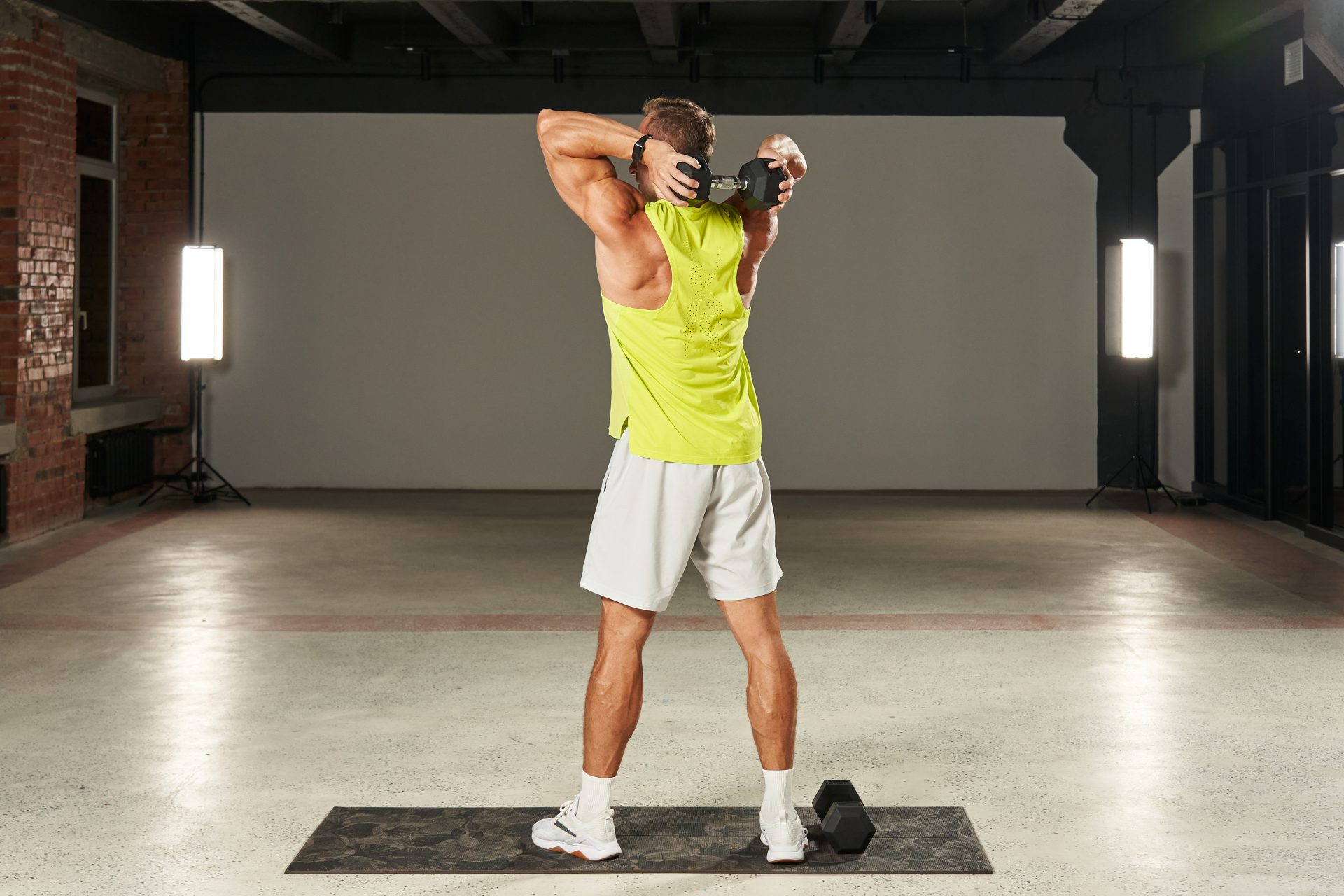
Exercises for the biceps are strength movements that target the biceps brachii — the muscle on the front of the upper arm responsible for elbow flexion and forearm rotation. Despite being a relatively small muscle, the biceps deliver outsized aesthetic value because they are highly visible and respond quickly to training. A well-designed bicep routine builds visible arm size within 8 to 12 weeks. The biceps are also one of the most fun muscles to train because progress is fast, the movements are simple, and the equipment is accessible. A pair of dumbbells or even a sturdy backpack loaded with books is enough to start — and the multi-angle approach pairs naturally with broader built around progressive overload.
The mechanism of bicep growth is mechanical tension applied across multiple angles. The biceps brachii has two heads. The long head sits on the outer arm and creates the bicep peak. The short head sits on the inner arm and creates arm width. Different exercises bias different heads. Standard curls hit both. Hammer curls bias the long head and the brachialis muscle underneath. Wide-grip curls bias the short head. Full bicep development requires all three angles, which is exactly what at home arm workouts cover when programmed correctly.
Builds Visible Arm Size and Definition
Direct bicep training is the fastest path to visible arm development. 8 to 12 weeks of consistent training produces measurable changes in arm circumference for most adults — and the same hypertrophy principles apply across generally.
Improves Pulling Strength Across All Movements
Strong biceps directly improve pull-ups, rows, deadlifts, and any pulling movement. The biceps are the limiting muscle in most pulling exercises.
Supports Functional Daily Strength
Lifting bags, carrying groceries, opening jars, and pulling doors all involve the biceps. Daily strength carryover is significant.
Trains Both Arm Heads for Complete Development
The 7-exercise routine below covers the long head (peak), short head (width), and brachialis (depth). Best arm workouts for women and men both follow the same multi-angle principle. Full upper-body programming sits inside a broader framework that addresses biceps, triceps, and shoulders together.
Exercise 1: Standing Dumbbell Curl — Biceps Brachii (Both Heads) — 3 sets of 10 reps
How to perform: Stand with feet hip-width apart, dumbbells in each hand, palms facing forward. Curl the weights toward your shoulders by bending at the elbows. Keep your elbows pinned to your sides. Lower with control. Why it suits this goal: This is the foundation bicep exercise. It hits both bicep heads equally and is accessible from day one. Modification: Sit on a bench with back support if balance is a concern.
Exercise 2: Hammer Curl — Long Head, Brachialis — 3 sets of 10 reps each side
How to perform: Stand with dumbbells in each hand, palms facing each other (neutral grip). Curl the weights toward your shoulders without rotating the wrists. Why it suits this goal: This biases the long head of the biceps and the brachialis muscle underneath, which adds depth and width to the arm. Excellent for at home arm workouts and pairs well with broader . Modification: Perform alternating reps if you find lifting both arms simultaneously too taxing.
Exercise 3: Concentration Curl — Bicep Peak Isolation — 3 sets of 10 reps each side
How to perform: Sit on a bench with feet wide. Rest your right elbow against the inside of your right thigh, dumbbell hanging straight down. Curl the weight toward your shoulder. Lower with control. Why it suits this goal: This is the strongest bicep peak builder. The braced position eliminates momentum and forces the bicep to do all the work. Modification: Reduce weight significantly. The strict form makes light dumbbells feel heavy.
Mistake 1: Swinging the Body to Lift Heavier Weights — Correction: Strict Form
What it is and why it undermines results: Using body momentum to swing the weights up reduces bicep activation and turns the exercise into a back movement. What to do instead: Lower the weight. Pin your elbows to your sides. Lift the weight slowly with bicep contraction alone.
Mistake 2: Not Lowering With Control — Correction: 3-Second Eccentric
What it is and why it undermines results: Most people drop the weight on the way down. The eccentric (lowering) phase is where most muscle damage and growth happens. Skipping it loses a substantial portion of the available stimulus. What to do instead: Lower for 3 seconds on every rep. Half the reps with full eccentric control deliver double the result.
Mistake 3: Training Biceps Every Day — Correction: 2 to 3 Days a Week
What it is and why it undermines results: The biceps are small muscles that recover slowly. Daily training prevents adaptation and slows growth. What to do instead: Train biceps 2 to 3 days a week with at least one rest day between sessions. In a live Habuild class, the coach catches the body-swing the moment it starts — invisible to the lifter, every time, and the silent reason most home arm work plateaus early.
50,000+ members already training with Habuild every morning
Live daily sessions · Expert instructor · Cancel anytime

Multi-Angle Bicep Programming, Not Random Sets
Habuild’s upper-body sessions programme biceps with deliberate angle variation across the week. Standard curls one day, hammer curls another, concentration curls on the third.
Live Daily Sessions With Real-Time Form Correction
The two invisible bicep failures (body swing and skipped eccentrics) are caught immediately by a live coach. Most home trainers default to swinging within 4 to 5 reps without realising it.
Progressive Overload Built Into Every Session
Members progress from light dumbbells to moderate to heavy variations on a structured schedule based on rep benchmarks. No guessing when to add weight.
Accountability, Streaks, and Community
Visible bicep change takes 8 to 12 weeks of consistent training. Daily streaks and live cohort timing keep members showing up across the long timeline strength change requires.
Complete Beginners Starting from Zero
Bicep exercises begin with bodyweight or very light resistance — resistance bands, water bottles, or light dumbbells are enough to start. No gym is required. The only requirement is showing up consistently — strength and technique follow from that.
Intermediate Trainees Looking to Fill a Gap
Whether the goal is visible arm definition or functional upper-body pulling strength, bicep exercises deliver both. They complement back training and support better performance in rows, pull-ups, and carrying tasks. Adding bicep exercises to an existing routine addresses a specific conditioning gap that most general workouts miss.
Those Wanting Arm Definition and Upper-Body Strength
Whether the goal is visible arm definition or functional upper-body pulling strength, bicep exercises deliver both. They complement back training and support better performance in rows, pull-ups, and carrying tasks.
Senior Citizens and Older Adults (50+)
Exercises for Biceps can be adapted for older adults by controlling tempo, reducing range of motion, and using supported variations. Habuild’s live instructors modify exercises in real time for different fitness levels and physical conditions in the same session.
Is Exercises for Biceps Good for Beginners?
Yes — absolutely. Exercises for Biceps begin at very low intensity with fully accessible entry-level variations. Habuild’s live instructor adapts the session in real time so beginners and experienced trainees can train together without either being left behind.
How Often to Do Exercises for Biceps — Frequency Guide
Train bicep exercises 2–3 times per week. This frequency gives the muscle and nervous system adequate stimulus without outpacing recovery. Consistency matters more than intensity in the early weeks — showing up regularly produces better results than infrequent all-out sessions.
When in Your Workout to Do Exercises for Biceps
Place bicep exercises after your back or pull-day compound movements, never as a first exercise of the session. Sequencing exercises correctly ensures you bring maximum quality to bicep exercises rather than performing them under accumulated fatigue from earlier work.
What to Pair Exercises for Biceps With
Combine bicep exercises with lat pulldowns, rows, and shoulder presses for a complete upper-body push-pull session. This combination develops complementary muscle groups in the same session and builds the balanced strength that prevents compensation and injury.
How to Progress Exercises for Biceps Over Time
Once the base movement feels controlled and repeatable, add weight in small increments (0.5–1 kg) each week, then introduce tempo manipulation (slow eccentrics) and variation (hammer curls, concentration curls). Progress only when form is consistent — adding difficulty before mastering the base movement reinforces poor mechanics and stalls long-term results.
Habuild is India’s First Habit Building Program — and through its strength and fitness sessions, it brings the same habit-based philosophy to targeted exercise training. Every session is structured around your specific goal, not a one-size-fits-all class.
Goal-Specific Programming — Not a Generic Fitness Class
Every exercise, rep range, and rest period in Habuild’s bicep exercises sessions is chosen because it produces results for bicep exercises specifically. Habuild does not run the same session for every goal — the programme is structured to drive your specific outcome with every session, not general fitness that happens to include bicep exercises.
Live Daily Sessions with Real-Time Form Correction
Unlike pre-recorded videos, Habuild’s live daily sessions allow the instructor to see and correct your form in real time — the specific errors that limit bicep exercises results and increase injury risk. This live correction is the difference between training that works and training that wastes effort and creates bad habits.
Progressive Overload Built into Every Session
Members do not need to design their own progressive overload for bicep exercises — it is built into the programme structure. Each week, sessions are deliberately more challenging than the last, ensuring the body never fully adapts and results continue coming rather than stalling.
Accountability, Streaks, and Community
The most common reason people stop exercising is not effort — it is missing sessions until the habit breaks. Habuild’s streak system, live session accountability, and community of members training the same goal alongside you resolves this directly. Members who join with a specific goal like bicep exercises and stay consistent for 30 days almost universally report that showing up has become automatic.
90-day streak. "Standard curls never built my arms past a point. Switched to a multi-angle routine with hammers and concentrations. Visible arm change by week 9."
150-day streak. "Wanted defined arms, not bulky ones. Daily moderate-load bicep work plus clean eating gave me exactly the look I wanted in 4 months."



Practice Strong Everyday with Trishala Bothra, an IIT-B and London School of Business alumni
Trishala is focused on making movement feel lighter, more engaging, and something you actually look forward to.
In just 3 years, over 50,000 people began their strength journey, and 10,000+ join every week to keep getting stronger.