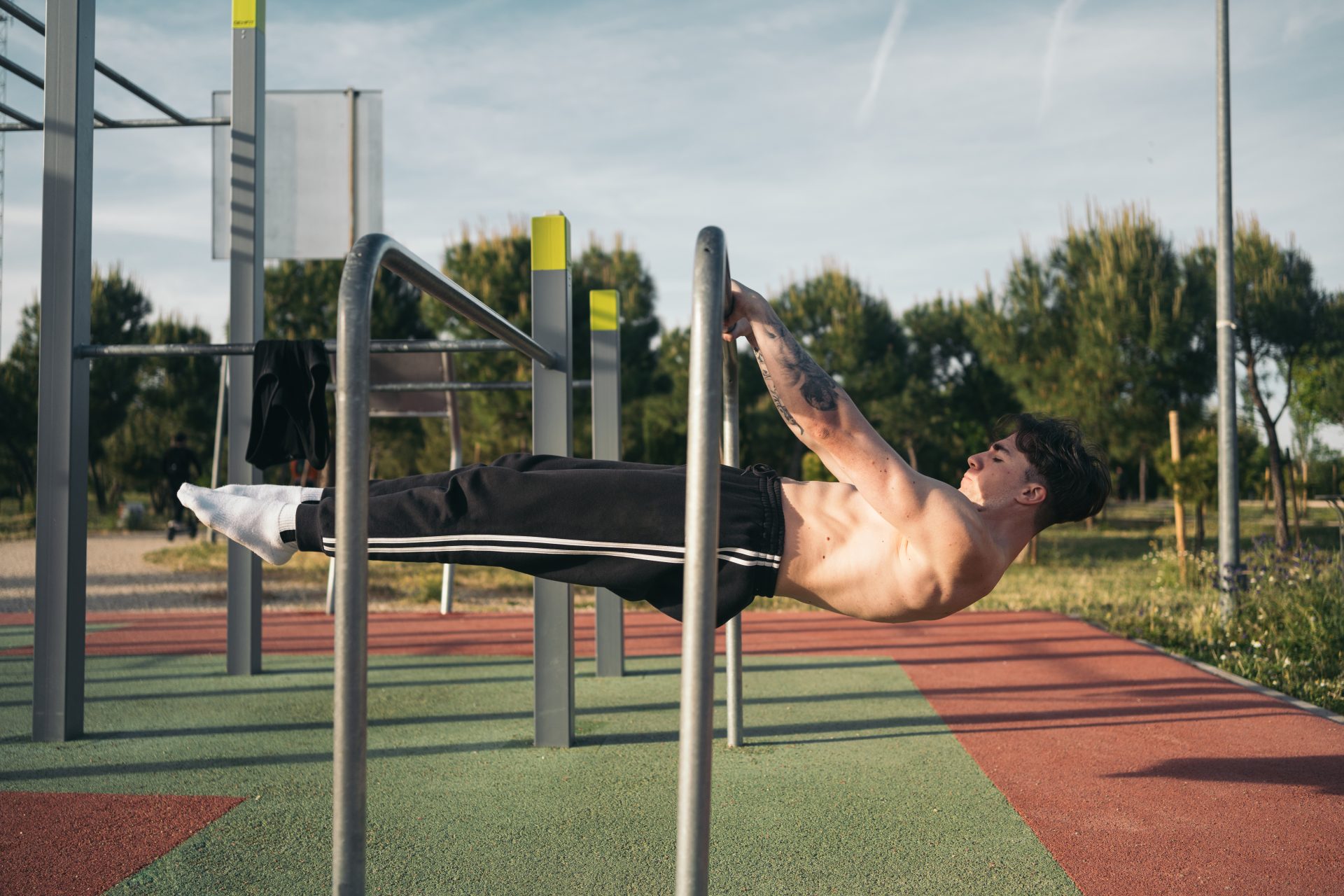
Calisthenics core workouts are bodyweight training sessions specifically designed to strengthen the muscles that stabilise your spine, pelvis, and torso — collectively called the core. Unlike general fitness classes that treat the core as an afterthought, these workouts are built around movements that demand constant trunk engagement. The goal is not just stronger abs, but a more stable and injury-resistant mid-section that functions under real-world load. The mechanism is straightforward: exercises like hollow body holds force the deep transverse abdominis to contract isometrically, dead bugs and bird-dogs demand coordinated firing across the entire anterior and posterior chain, and dynamic movements like leg raises progressively load the hip flexors and lower abs through a full range of motion. This combination of isometric, dynamic, and anti-rotation patterns trains the core the way it actually works in daily life — not in isolated, single-plane contractions.
Benefit 1 — Improved Functional Strength and Daily Movement Quality
A stronger core means every physical task — lifting groceries, sitting at a desk for hours, climbing stairs — becomes easier and less taxing. When the trunk is stable, force generated by the arms and legs is transmitted efficiently rather than being lost through a weak middle. Every organ, muscle, and tissue in your torso receives better structural support, reducing the compressive load on your lumbar spine with each movement.
Research insight: Studies published in the Journal of Strength and Conditioning Research found that core stability training significantly reduces injury risk in the lower back and improves dynamic balance in adults across all age groups.
Benefit 2 — Gradual Relief from Lower Back Discomfort
Most people searching for core workouts are not chasing a six-pack — they are dealing with persistent lower back tension that makes everyday life uncomfortable. Calisthenics exercises like the dead bug, bird-dog, and hollow hold specifically counteract the anterior pelvic tilt and weak lumbar support that contribute to this discomfort.
Practiced consistently, these movements gradually ease tension and help you manage back-related symptoms more effectively over time. If back pain is your primary concern, Yoga For Back Pain offers a complementary approach through targeted mobility work.
Benefit 3 — Long-Term Postural Adaptation
Consistent calisthenics core training builds endurance in the stabilising muscles of the spine — not just strength at peak contraction, but the ability to maintain good posture across an entire workday. Over six to twelve weeks of regular practice, most people notice measurable improvement in their resting posture, reduced shoulder rounding, and a more natural lumbar curve.
The WHO recommends 150 minutes of moderate-intensity physical activity per week for adults. Structured core sessions of 20–30 minutes, four to five times per week, integrate easily within that guideline while delivering targeted postural benefit.
Benefit 4 — Better Breathing, Energy, and Mental Focus
The diaphragm and the deep core muscles work together as part of the intra-abdominal pressure system. When core strength improves, breathing mechanics often become more efficient — the diaphragm can descend fully without restriction, increasing oxygen uptake per breath.
Many Habuild members report noticeably higher energy levels and sharper morning focus within the first few weeks of consistent core training, a downstream effect of better breathing and improved sleep posture.
What you eat directly determines how fast you recover, how much you progress, and how consistently you can train. Here is what your nutrition plan should look like to support your calisthenics core training effectively.
Protein — Fuelling Athletic Power and Recovery
Athletic training demands the highest protein intake — 1.8–2.2 g/kg/day — to fuel power output and accelerate recovery. Time your protein intake so that a high-quality source (eggs, chicken, whey) appears within 30–45 minutes post-session. Dal, rajma, paneer, and curd round out your daily totals effectively.
Calcium and Vitamin D — Joint and Bone Health
Strong bones provide the structural foundation for all movement — include calcium-rich foods like milk, curd, paneer, ragi, and sesame seeds (til) daily. Vitamin D is essential for calcium absorption; aim for 15–20 minutes of morning sunlight alongside dietary sources like eggs and fatty fish. Deficiency in either nutrient accelerates joint wear over time.
Anti-Inflammatory Foods — Faster Recovery
Recovery speed is directly influenced by your body’s inflammatory status. Turmeric with black pepper (curcumin + piperine), fresh ginger, and omega-3 fatty acids from flaxseeds, walnuts, and fatty fish all actively reduce exercise-induced inflammation. Include these consistently rather than only on hard training days.
Hydration — Performance and Joint Lubrication
Athletic performance degrades rapidly with even mild dehydration — fluid loss of just 2% body weight impairs power output. Drink 500 ml of water 30 minutes before your morning session and keep total daily intake at 3–3.5 L. Post high-intensity sessions, coconut water or a banana with water helps restore electrolyte balance quickly.
Magnesium — Muscle Function and Sleep Quality
Magnesium governs over 300 enzymatic reactions including muscle contraction and relaxation — making it essential for any movement-based training. Include pumpkin seeds, bananas, dark chocolate (70%+), spinach, and whole grains in your daily diet. Many Indians are mildly deficient; if you experience frequent muscle cramps or poor sleep quality, a magnesium glycinate supplement may help.
Starting a new training programme is often the hardest part. Here is a clear, week-by-week plan to begin your calisthenics core training without injury or overwhelm.
Before You Begin — Setting Your Baseline
Begin with a frank assessment of your sport-specific limitations: where do you lose power, coordination, or speed? Identify your one or two most critical weak points and design your starting programme around improving them. Set a performance-based goal — for example, improving jump height by 3 cm or reducing 10 m sprint time — as your 8-week benchmark.
Week 1–2: Foundation
Focus entirely on movement quality and neuromuscular patterning in the first two weeks — speed and power come later. Athletic movements place significant eccentric demand on muscles; expect pronounced DOMS after the first few sessions. Limit plyometric or explosive work to 2–3 sets of 5–6 reps per exercise and prioritise full recovery between sets.
Week 3–4: Building Consistency
Begin increasing intensity and reducing rest periods as your body adapts to the movement patterns. Training first thing in the morning sharpens neuromuscular recruitment patterns over time — elite athletes frequently use morning sessions for skill-based work. Track power output or rep quality rather than just volume in this phase.
Week 5–8: Progression
Peak adaptation in athletic training typically occurs between weeks 6 and 8, when neuromuscular efficiency catches up with muscular conditioning. Introduce sport-specific loading scenarios — unilateral work, reactive drills, or loaded carries — to make strength transfer to your activity. Recovery becomes as important as training at this stage; prioritise sleep and nutrition around sessions.
Athletic development is built on disciplined daily practice far more than on occasional maximal efforts.

Exercise 1 — Hollow Body Hold — Deep Abdominals and Hip Flexors — 3 × 20–30 seconds
What it does: The hollow body hold trains the entire anterior chain — transverse abdominis, rectus abdominis, and hip flexors — in one static contraction. It directly transfers to harder skills like pull-ups and push-up progressions because it teaches your body to maintain a rigid, braced midline under load. It is one of the foundational moves in any serious calisthenics workout programme.
Dosage: 3 sets of 20–30 seconds. Rest 30–45 seconds between sets. Aim for 4–5 sessions per week.
Beginner modification: Keep knees bent at 90 degrees and arms by your sides rather than extended overhead. Focus on pressing the lower back firmly into the floor before lifting your legs.
Exercise 2 — Dead Bug — Lumbar Stability and Contralateral Coordination — 3 × 10 reps per side
What it does: The dead bug trains the core to resist extension and rotation simultaneously — exactly the anti-movement pattern the spine needs during walking, running, and lifting. By moving opposite arm and leg in a slow, controlled arc while keeping the lower back flat, you develop the deep stabiliser endurance that prevents the lower back from collapsing under dynamic load.
Pair this with other core strength exercises for a complete anti-movement training block.
Dosage: 3 sets of 10 controlled repetitions per side. Move slowly — the slower, the harder.
Beginner modification: Keep the stationary leg bent with the foot flat on the floor rather than raised. Only extend one limb at a time until you can maintain a flat lower back throughout.
Exercise 3 — Hanging Knee Raise — Hip Flexors, Lower Abs, and Grip — 3 × 12–15 reps
What it does: Hanging knee raises load the lower abdominal region through a dynamic range of motion that floor exercises cannot fully replicate. Hanging from a bar also forces the core to work against gravity while the shoulders and lats maintain an active, depressed scapula — making it a full upper-body and core integration drill.
Dosage: 3 sets of 12–15 reps. Pause briefly at the top to eliminate momentum.
Beginner modification: Use a resistance band looped around the bar to reduce the load on your grip. If no bar is available, substitute lying leg raises on the floor with bent knees.
Mistake 1 — Prioritising Crunch Volume Over Stability Work — Correction: Add Anti-Movement Patterns
What it is: Many people equate core training with high-rep crunches and sit-ups. While these recruit the superficial rectus abdominis, they do almost nothing for the deep stabilisers — the transverse abdominis and multifidus — which are the muscles that actually protect your spine and improve posture. Overloading spinal flexion without balancing it with anti-extension and anti-rotation work also increases lumbar disc stress over time.
What to do instead: Build your sessions around holds and anti-rotation drills before adding any high-rep flexion work. A well-designed core strength routine always prioritises stability over rep count.
Mistake 2 — Holding Your Breath During Core Exercises — Correction: Exhale on Exertion
What it is: Breath-holding during planks or leg raises dramatically spikes intra-abdominal pressure and reduces the time-under-tension that produces strength adaptation. It also triggers the Valsalva response unnecessarily, increasing blood pressure and causing premature fatigue — meaning you get less out of every set.
What to do instead: Practice slow nasal inhales and controlled mouth exhales. During dynamic reps, exhale on the effort phase. During holds, breathe in a slow 4-second cycle throughout the duration.
Mistake 3 — Skipping Progressive Overload — Correction: Systematically Increase Difficulty
What it is: Doing the same plank for the same duration week after week produces rapid early adaptation — then nothing. The core is a highly adaptable system; if it is not consistently challenged with greater time-under-tension, range of motion, or movement complexity, it stops adapting. This is the most common reason people plateau after four to six weeks of home workouts.
What to do instead: Increase hold durations by five seconds per week, add one rep per set, or progress to a harder variation — for example, from a standard plank to a demanding core strength plank variation with a leg lift. Track your progressions in a simple log.
Calisthenics Core training is not a one-size-fits-all programme — but it is far more broadly accessible than most people assume. Here is who benefits most.
Complete Beginners Starting from Zero
You do not need any prior fitness experience to begin calisthenics core exercises. Every movement in a well-structured programme comes with easier modifications — for example, performing the exercise seated, with a reduced range of motion, or using a wall or chair for support. The only requirement is willingness to show up consistently; the strength and technique will follow.
People With Back Pain or Poor Posture
This training is especially valuable for people managing Back Pain or Poor Posture. Calisthenics Core exercises specifically target the muscular imbalances and movement patterns that drive these conditions. Always begin at a reduced intensity and range, and increase gradually as your body adapts.
Office Workers and Sedentary Adults
Prolonged sitting creates a predictable pattern: weakened glutes, tight hip flexors, and excessive lumbar loading — all of which this training directly counters. Even 20 minutes of targeted core and postural work each morning can measurably reduce the back pain and stiffness that accumulate over a working day. Office workers who train consistently report improved concentration and reduced fatigue by mid-afternoon.
Active Adults and Athletes
Competitive athletes and active adults use calisthenics core training to fill movement-quality gaps that sport-specific training misses. Addressing these gaps reduces injury frequency, improves technique efficiency, and extends athletic careers. This type of training complements rather than replaces sport-specific conditioning.
Seniors Maintaining Functional Independence
Older adults benefit significantly from calisthenics core training as it maintains the functional strength, balance, and joint health required for independent daily living. Even those who have been sedentary for years can make meaningful progress with a consistent, progressive programme. Starting with modified, low-impact variations and building gradually is the safest and most effective approach.
Core-Specific Programming — Not a Generic Fitness Class
Every exercise selection, movement sequence, and rest period in Habuild’s strength training sessions is chosen for measurable core benefit. Sessions open with diaphragmatic breathing and deep stabiliser activation — because priming the transverse abdominis before loading it is what separates effective core training from injury-prone ab classes.
They close with progressive static holds that lock in the endurance adaptations the dynamic work builds earlier in the session. To see how this fits into a broader strength framework, explore Habuild’s Full Body Workout For Strength programming that layers core work alongside compound movements.
Live Daily Sessions with Real-Time Form Correction
The single biggest reason calisthenics core training fails at home is poor form — specifically, lower back sagging in planks, momentum-driven leg raises, and breath-holding during holds. Habuild’s live format means your instructor can see and correct these errors in real time, before they become ingrained habits. Pre-recorded videos cannot do this; a live session with a qualified instructor changes the quality of every rep you perform.
Progressive Overload Built into Every Session
You do not need to programme your own progressions. Habuild builds them in — week by week, duration, movement complexity, and intensity increase in a structured ladder. Members who join as complete beginners and follow the daily sessions consistently typically report visible posture improvement within four to six weeks, without needing to manage their own programme.
Accountability, Streaks, and Community
Consistency is the only variable that produces lasting core strength. Habuild’s streak tracking, WhatsApp accountability community, and live session structure create the daily habit loop that keeps members showing up past the first two weeks — which is where most solo home workout attempts end. Members with 90-day streaks report qualitatively different results from those who train sporadically.
My homeopathy doctor suggested yoga and I found Habuild. In the free 14 days, I already felt changes. The biggest surprise: I used to be unable to get down from a pavement by myself. Now I can jump. My core and lower body strength have rebuilt themselves through consistent practice. Habuild is a complete package — it strengthens everything, not just flexibility.
I have been with Habuild for 1,050 days. My energy has increased and I don't feel drained by work anymore. My patience has grown — things that used to stress me out don't affect me the same way. My kids at home have also picked up the yoga habit. Most importantly, my knowledge about breathing and how it affects the entire body has transformed. My nervous system feels calmer, my digestion is better, and there is a steadiness in my body and mind that I had never experienced before.



Practice Strong Everyday with Trishala Bothra, an IIT-B and London School of Business alumni
Trishala is focused on making movement feel lighter, more engaging, and something you actually look forward to.
In just 3 years, over 50,000 people began their strength journey, and 10,000+ join every week to keep getting stronger.