
Strength training for beginners is a structured progressive resistance programme designed specifically for those with no prior training history — built around the specific requirements and limitations of an untrained body. What makes beginner-specific training different from general strength training is its emphasis on movement pattern development before loading, conservative progression to allow connective tissue adaptation alongside muscle adaptation, and the deliberate habit-building that transforms occasional exercise into a daily practice. The mechanism for beginners is unique: the initial strength gains in the first 6–8 weeks are primarily neurological rather than muscular — the nervous system learns to recruit existing muscle fibres more efficiently, producing strength improvements before significant muscle hypertrophy occurs. This neurological adaptation is faster and more dramatic in beginners than at any subsequent stage of training — making the beginner window the most productive period for strength development in a person’s entire training life. The structural (muscle tissue) adaptations follow at weeks 6–12 onward.
Start Your Free 14 Day Trial
Benefit 1: Rapid Initial Strength Gains Through Neurological Adaptation
Beginners experience the fastest strength improvements of any training phase — the nervous system’s rapid adaptation to new movement patterns produces strength increases of 20–40% within 8–12 weeks. This progress is motivating, measurable, and a powerful foundation for ongoing training consistency.
Benefit 2: Improved Body Composition and Muscle Tone
Resistance training builds lean muscle alongside reducing relative body fat — producing the toned, defined appearance that motivates many beginners. The combination of muscle development and metabolic elevation produces visible body composition changes within 8–10 weeks of consistent twice-weekly training.
Benefit 3: Better Posture and Reduced Daily Physical Discomfort
Many beginners experience chronic back, neck, and shoulder discomfort from sedentary work patterns. Beginner strength training specifically builds the postural muscles — spinal erectors, rhomboids, glutes — that reduce the muscular imbalances underlying this discomfort.
Benefit 4: Improved Energy, Mood, and Daily Functional Capacity
The metabolic and hormonal improvements from consistent resistance training produce meaningful energy level improvements within 4–6 weeks — often cited by beginners as the most immediately valued outcome, before aesthetic changes become visible.
Protein — The Foundation of Beginners Training
Aim for 1.6–2.0g of protein per kg of bodyweight per day. Best sources include eggs, paneer, lentils (dal), chicken, Greek yoghurt, and whey protein. Distribute protein evenly across 3–4 meals rather than loading it all in one sitting. Adequate protein is non-negotiable — without it, training effort produces minimal adaptation regardless of programme quality.
Carbohydrates — Fuel for Beginners Performance
Complex carbohydrates (oats, brown rice, sweet potato, whole wheat roti) should form 40–50% of total calories. Consume a carbohydrate-containing meal 60–90 minutes before your strength training for beginners session to ensure glycogen availability. Post-session carbohydrates restore muscle glycogen within the critical 30-minute recovery window.
Anti-Inflammatory Foods for Recovery
Include turmeric (with black pepper for bioavailability), ginger, and omega-3 rich foods (flaxseeds, walnuts, fatty fish) daily. These directly reduce the systemic inflammation that accumulates with consistent training, speeding recovery between sessions.
Hydration — Often Underestimated
Aim for 35–40ml of water per kg of bodyweight daily. Add an additional 500ml for every 30 minutes of active training. Even mild dehydration (2% body weight) measurably reduces strength output and exercise capacity.
Before You Begin — What to Check
No medical clearance is required for healthy individuals beginning a conservative bodyweight programme. Those with cardiovascular conditions, recent surgeries, or joint replacements should consult their doctor before starting. Establish your baseline: can you complete 10 bodyweight squats with good depth? Can you hold a plank for 15 seconds? These are your starting reference points. Note any movements that produce pain — inform the live instructor before beginning.
Your First 2 Weeks — Foundation Phase
Two sessions per week. Bodyweight movements only — squats, push-ups from knees, glute bridges, bird-dog. Focus entirely on learning the movement patterns rather than maximising effort. Expect muscular soreness 24–48 hours after the first few sessions — this is normal. Do not train through sharp joint pain.
Weeks 3–8 — Progressive Loading Phase
Three sessions per week. Begin adding light resistance — a backpack with books, water bottles, resistance bands. Add reps before adding weight. Track sessions: date, exercise, reps. Normal discomfort: muscular burning during the last reps, mild soreness the next day. Warning signs: sharp or localised joint pain, dizziness, shortness of breath.
Beyond 8 Weeks — Long-Term Maintenance
Introduce periodisation — alternating heavier and lighter weeks. Begin varying exercises to prevent adaptation plateau. Measure progress through performance (more reps, more weight, better form) rather than scale weight alone. Three sessions per week with adequate recovery between is the evidence-supported long-term maintenance frequency.
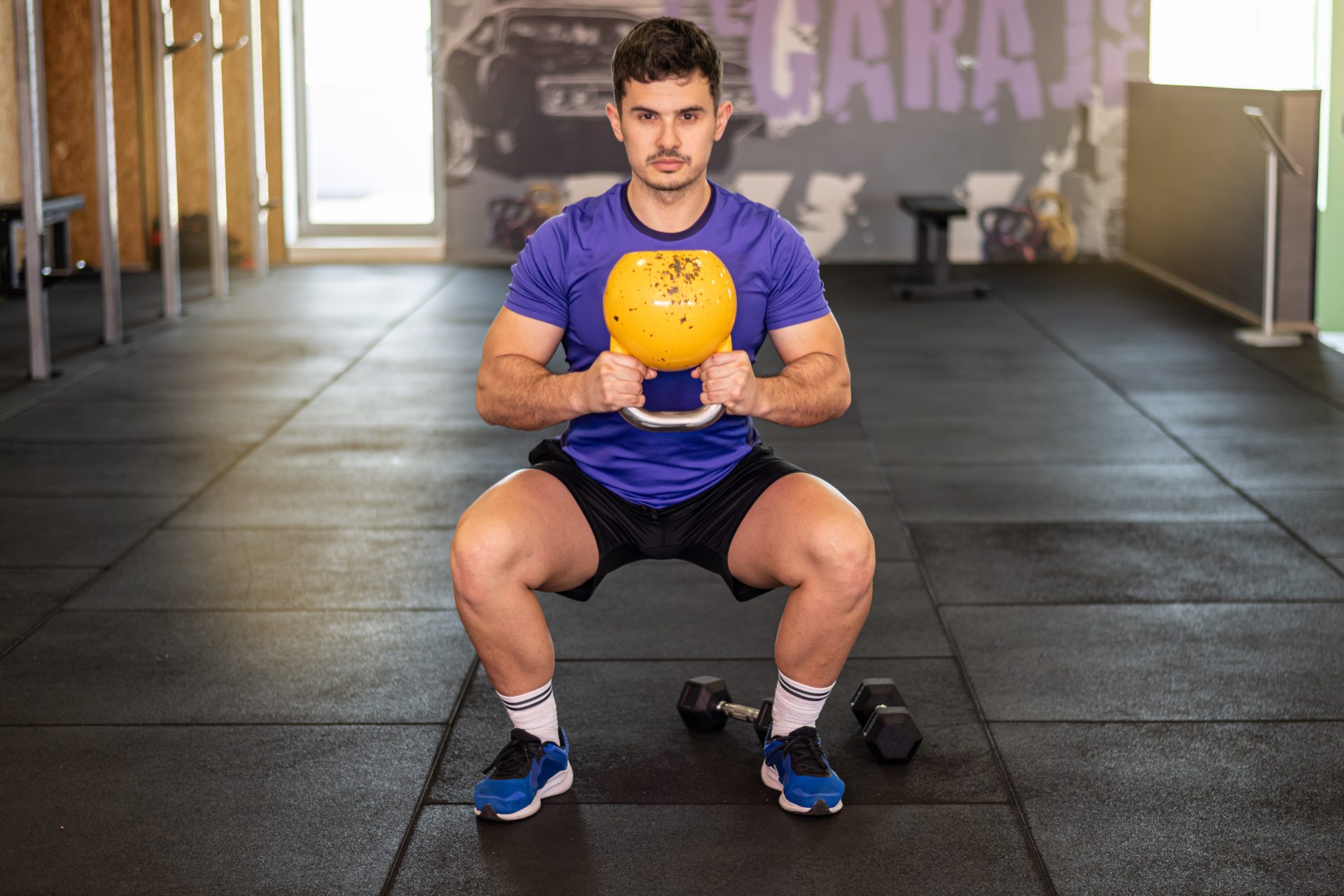
Goblet Squat — Quadriceps, Glutes, Hamstrings, Core
The goblet squat — holding a weight at chest height — is the safest and most teachable loaded squat for beginners, as the counterbalance naturally promotes an upright torso and correct depth. It is the most important lower body exercise for beginners because it simultaneously builds leg and glute strength, core stability, and hip mobility. Beginner: use a water bottle or light bag at chest height; focus on depth before adding any significant load.
Push-Up Progression — Chest, Shoulders, Triceps, Core
The push-up is the most accessible upper body pressing exercise — requiring no equipment and providing a complete chest, shoulder, and tricep training stimulus alongside core stabilisation. The progression from wall to incline to knee to full push-up makes it appropriate for absolute beginners at any strength level. Beginner: begin against a wall (standing push-up) and progress to an elevated surface (table edge) before moving to floor knees, then full.
Bird-Dog — Core Stabilisers, Glutes, Spinal Erectors
The bird-dog develops the anti-rotation core stability and posterior chain strength that safe loaded training requires — making it the most important exercise for beginners to establish before progressing to heavier movements. It teaches the neutral spine position and contralateral coordination that all compound exercises depend on. Beginner: perform with arms only or legs only until the full arm-and-leg version can be completed without the lower back rotating or shifting.
Mistake 1: Trying to Do Too Much Too Soon
Beginners frequently attempt too many exercises, too many sets, or too much weight in the first weeks — producing excessive soreness, discouraging the programme, and risking injury before adaptation is established. Two exercises per session at 2 sets is sufficient in weeks 1–2.
Mistake 2: Skipping Rest Days Because ‘More is Better’
Adaptation occurs during rest — the training session provides the stimulus, but the improvement happens in the recovery period. Beginners particularly need rest days because their connective tissues adapt more slowly than their muscles.
Mistake 3: Comparing Progress to More Experienced Trainees
The most demotivating mistake for beginners is comparing their early-stage progress to those who have been training for years. Beginner progress is actually faster than at any other stage — but it requires different measurements.
Mistake 4: Ignoring Form in Favour of Heavier Weight
Beginners learning new movement patterns under excessive load develop compensatory movement patterns that become increasingly difficult to correct. Poor form reinforced early becomes the baseline the body defaults to under fatigue.
Complete Beginners Starting from Zero
No prior experience with strength training for beginners is required to start. Every movement is taught from its most foundational form, with modifications for those who cannot yet perform the standard version. Live instructor feedback prevents the form errors that cause beginners to plateau or get injured before results arrive.
Intermediate Trainees Who Have Hit a Plateau
If you have been exercising inconsistently or without structured progressive overload, strength training for beginners delivers the systematic load progression that general fitness classes do not. The programme targets the specific weaknesses and imbalances holding you back, producing results that months of unstructured training have failed to achieve.
Desk Workers and Sedentary Professionals
Extended sitting creates the exact muscle imbalances and weaknesses that strength training for beginners training corrects. No gym, no equipment, and no prior experience is required — the programme begins with bodyweight fundamentals and builds progressively from there. Habuild’s morning sessions fit into a working day without disruption.
Live Daily Sessions with Real-Time Instructor Feedback
Habuild’s live sessions provide real-time form corrections for the specific technique issues that beginner strength training requires attention to. Unlike pre-recorded content, the live format means the instructor sees and corrects in the moment — building correct habits from the first session.
Condition-Specific Modifications in Every Session
Every exercise in the Habuild beginner strength training programme is selected and modified with this specific population and goal in mind — not a generic class with an optional modification. The programme is built from the ground up for beginner strength training outcomes.
Progressive Programming That Respects Your Timeline
The programme structure follows the physiological timeline of improvement — not an arbitrary 4-week marketing format. Progression is earned through demonstrated capacity and built in week by week.
Community of Members with the Same Goals


Practice Strong Everyday with Trishala Bothra, an IIT-B and London School of Business alumni
Trishala is focused on making movement feel lighter, more engaging, and something you actually look forward to.
In just 3 years, over 50,000 people began their strength journey, and 10,000+ join every week to keep getting stronger.