Pilates strength training combines the body-awareness and deep core activation principles of classical Pilates with the progressive resistance loading of modern strength training — producing a training system that develops muscular strength alongside the postural awareness and movement control that pure strength training often neglects. What distinguishes pilates strength training from standard resistance work is its emphasis on precise muscle engagement, spinal alignment, and breathing coordination throughout every exercise. The mechanism is simultaneous activation of the deep core stabilisers (transverse abdominis, pelvic floor, multifidi) alongside the primary movers (glutes, hamstrings, shoulder girdle). By requiring the deep stabilisers to be engaged and the spine to be in neutral alignment throughout every loaded movement, pilates strength training produces a higher quality of muscle activation per exercise than standard strength training — with particular benefit for postural improvement and spinal health.
Start Your Free 14 Day Trial
Benefit 1: Deeper Core Activation and Stronger Spinal Stabilisers
Pilates strength training specifically recruits the transverse abdominis and pelvic floor — the deep stabilisers that standard exercises rarely engage precisely. This deep core development produces the spinal support that reduces back pain and improves postural stability in all activities.
Benefit 2: Improved Posture and Reduced Chronic Tension
The postural awareness cultivated through pilates strength training — neutral spine, scapular stability, ribcage positioning — produces lasting changes in resting posture that reduce the chronic neck, shoulder, and lower back tension that poor postural habits create.
Benefit 3: Greater Body Awareness and Movement Quality
Pilates strength training develops proprioception — the body’s awareness of its own position and movement — producing the movement quality that reduces injury risk and improves performance in all physical activities beyond the training sessions themselves.
Benefit 4: Improved Muscle Tone and Flexibility Simultaneously
The combination of resistance loading and full-range movement that pilates strength training requires develops strength through a greater range of motion than conventional strength training — producing the long, lean muscle tone that pilates is associated with.
Protein — The Foundation of Pilates Strength Training Training
Aim for 1.6–2.0g of protein per kg of bodyweight per day. Best sources include eggs, paneer, lentils (dal), chicken, Greek yoghurt, and whey protein. Distribute protein evenly across 3–4 meals rather than loading it all in one sitting. Adequate protein is non-negotiable — without it, training effort produces minimal adaptation regardless of programme quality.
Carbohydrates — Fuel for Pilates Strength Training Performance
Complex carbohydrates (oats, brown rice, sweet potato, whole wheat roti) should form 40–50% of total calories. Consume a carbohydrate-containing meal 60–90 minutes before your pilates strength training session to ensure glycogen availability. Post-session carbohydrates restore muscle glycogen within the critical 30-minute recovery window.
Anti-Inflammatory Foods for Recovery
Include turmeric (with black pepper for bioavailability), ginger, and omega-3 rich foods (flaxseeds, walnuts, fatty fish) daily. These directly reduce the systemic inflammation that accumulates with consistent training, speeding recovery between sessions.
Hydration — Often Underestimated
Aim for 35–40ml of water per kg of bodyweight daily. Add an additional 500ml for every 30 minutes of active training. Even mild dehydration (2% body weight) measurably reduces strength output and exercise capacity.
Before You Begin — What to Check
No specific medical clearance is required for healthy individuals. For those with disc herniations, spondylolisthesis, or recent abdominal surgery, consult your doctor or physiotherapist before beginning. Establish baseline awareness: can you engage the transverse abdominis (the ‘drawing-in’ sensation) independently of holding your breath? This is the foundational skill the programme builds from.
Your First 2 Weeks — Foundation Phase
Two sessions per week at bodyweight. Focus entirely on deep core engagement — learning to activate the transverse abdominis before every movement. Exercises: pelvic tilts, supine leg slides, dead bug with breathing coordination. Every movement is slow and controlled; speed is irrelevant in this phase.
Weeks 3–8 — Progressive Loading Phase
Three sessions per week. Introduce light resistance — resistance bands or light dumbbells — to loaded pilates movements: standing rows, lateral band walks, weighted bridges. Maintain the deep core engagement cue in every exercise. The challenge is sustaining stabiliser activation under light external load.
Beyond 8 Weeks — Long-Term Maintenance
Progress to more challenging integrated movements: single-leg variations, rotational resistance patterns, and combination exercises that require simultaneous upper and lower body loading with spinal stabilisation. The programme evolves toward functional strength built on the pilates foundation of body awareness and deep stabiliser activation.
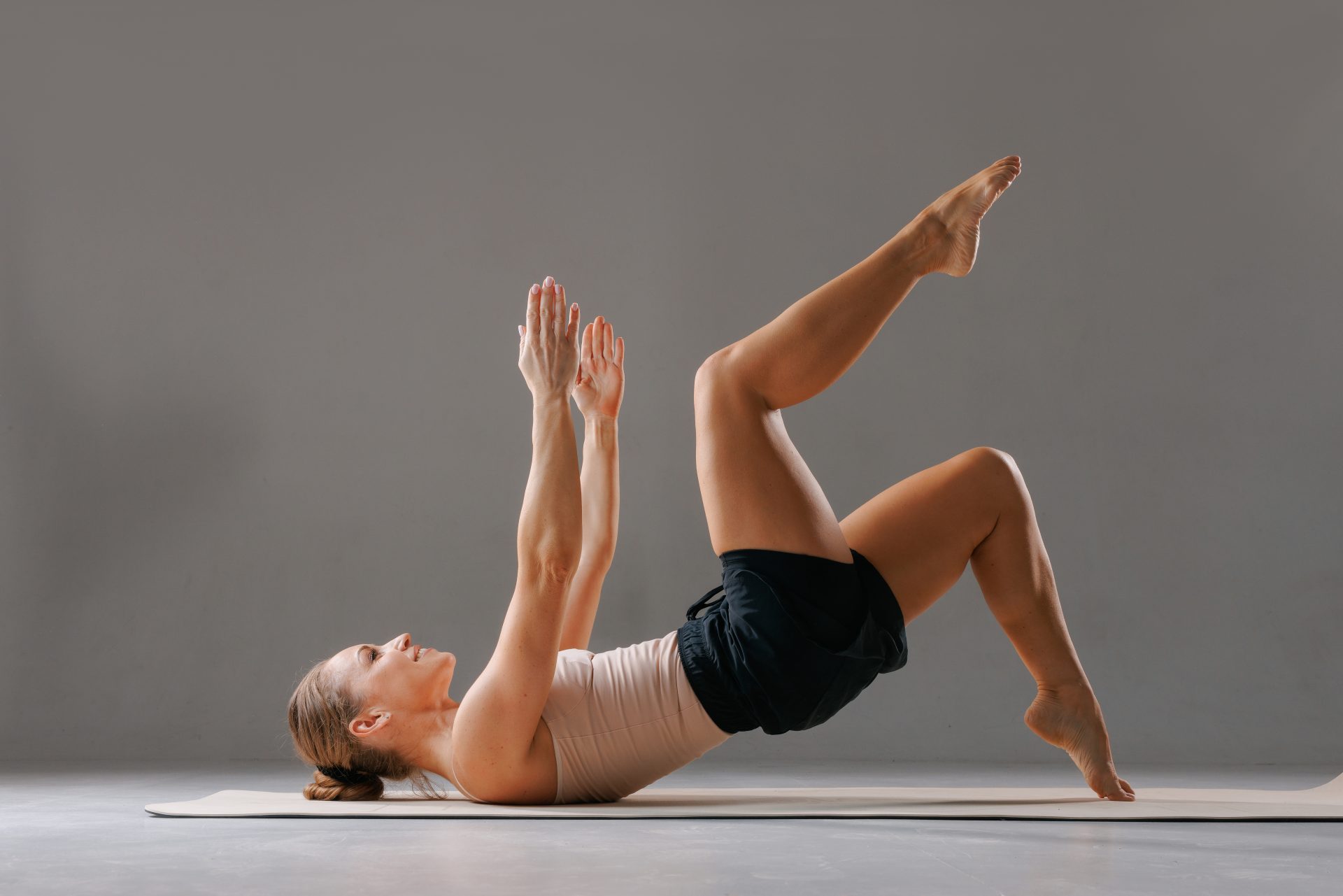
The Hundred (Pilates Core Activation) — Rectus Abdominis, Transverse Abdominis, Hip Flexors — Breathwork Integration
The Hundred coordinates deep core activation with controlled breathing — developing the breath-core relationship that pilates strength training depends on. It is the foundational pilates exercise for building sustained core muscular endurance. Beginner: perform with knees bent at 90 degrees rather than legs extended; coordinate the breath rhythm (5 beats in, 5 beats out) before attempting leg extension.
Pilates Bridge with Resistance Band — Glutes, Hamstrings, Pelvic Floor, Adductors
The pilates bridge adds a resistance band above the knees to the standard glute bridge — requiring the hip abductors to resist the band’s inward pull while the glutes perform the extension. This produces simultaneous glute, hip stabiliser, and pelvic floor activation that the standard bridge does not. Beginner: standard bodyweight bridge without band; add band when bridge form and pelvic stability are secure.
Standing Pilates Row (Band) — Rhomboids, Mid-Trapezius, Rear Deltoids, Deep Core Stabilisers
The standing band row requires the core to stabilise the spine against the pulling resistance — developing the anti-rotation core stability that pilates emphasises alongside the upper back musculature. Beginner: perform seated on a chair to reduce the balance and core stability demand while learning the movement pattern.
Mistake 1: Performing Movements Too Quickly
Pilates strength training derives its effectiveness from slow, controlled movement that maintains continuous deep stabiliser engagement. Fast, momentum-driven movements bypass the deep core activation that makes pilates training distinct from standard exercise.
Mistake 2: Holding Breath During Exercises
Breath-holding defeats the breathing-core coordination that pilates training specifically develops. The breathing pattern is part of the exercise — not incidental to it.
Mistake 3: Neglecting Deep Core Engagement for Heavier Loads
As loads increase, the temptation is to abandon deep stabiliser engagement and substitute global muscle recruitment. This defeats the pilates principle of every movement being supported by the deep core.
Mistake 4: Skipping Postural Awareness in Standing Exercises
Most pilates benefit comes from the postural alignment precision maintained throughout every exercise. Losing neutral spine, allowing rib flare, or permitting scapular winging during standing exercises reduces the effectiveness and safety of pilates strength training.
Complete Beginners Starting from Zero
No prior experience with pilates strength training is required to start. Every movement is taught from its most foundational form, with modifications for those who cannot yet perform the standard version. Live instructor feedback prevents the form errors that cause beginners to plateau or get injured before results arrive.
Intermediate Trainees Who Have Hit a Plateau
If you have been exercising inconsistently or without structured progressive overload, pilates strength training delivers the systematic load progression that general fitness classes do not. The programme targets the specific weaknesses and imbalances holding you back, producing results that months of unstructured training have failed to achieve.
Desk Workers and Sedentary Professionals
Extended sitting creates the exact muscle imbalances and weaknesses that pilates strength training training corrects. No gym, no equipment, and no prior experience is required — the programme begins with bodyweight fundamentals and builds progressively from there. Habuild’s morning sessions fit into a working day without disruption.
Live Daily Sessions with Real-Time Instructor Feedback
Habuild’s live sessions — delivered daily by expert instructors — provide real-time form corrections for the specific technique errors that pilates strength training training requires attention to. Unlike pre-recorded content, the live format means the instructor can see you and correct in the moment — the difference between building correct habits and reinforcing incorrect ones.
Condition-Specific Modifications in Every Session
Every exercise in the Habuild pilates strength training programme is selected and modified with this specific goal in mind. Members are not attending a generic fitness class with a modification option bolted on — they are in a programme designed from the ground up for pilates strength training outcomes.
Progressive Programming That Respects Your Recovery Timeline
The programme structure follows the physiological timeline of improvement — not an arbitrary 4-week or 8-week marketing format. Progression is earned through demonstrated capacity, not assumed by a calendar week.
Community of Members With the Same Goals


Practice Strong Everyday with Trishala Bothra, an IIT-B and London School of Business alumni
Trishala is focused on making movement feel lighter, more engaging, and something you actually look forward to.
In just 3 years, over 50,000 people began their strength journey, and 10,000+ join every week to keep getting stronger.