A lunges workout that builds leg, thigh, and glute strength through varied lunge exercise patterns.
1. Covers different lunge exercise variations
2. Builds legs, thighs, and glutes together
3. Suited for consistent daily home practice
4. Guided by instructor Trishala Bothra's Strong Everyday programme
5. Combines strength training with habit-building philosophy

The lunge is a unilateral compound movement — it trains one leg at a time, loading the quadriceps, glute, hamstring, and hip flexor on the working leg while demanding balance and core stability from the entire kinetic chain.
This unilateral nature makes lunges workouts superior to bilateral squats for identifying and correcting left-right strength asymmetry, developing single-leg balance, and building the functional lower body strength that daily activities — climbing stairs, walking, stepping over objects — actually require.
Different lunge exercises target different portions of the lower body: forward lunges emphasise the quadriceps; reverse lunges reduce knee shear and target the glutes; lateral lunges develop the adductors and gluteus medius; walking lunges combine all three with a cardiovascular demand.
Lunges workout muscles include the quadriceps (primary mover in knee extension), gluteus maximus (primary mover in hip extension), hamstrings (knee flexion at the back leg), and hip flexors (controlling the descent).
Core musculature activates isometrically throughout to maintain upright torso alignment.
At Habuild, lunges are programmed within strength training for legs as the primary unilateral lower body exercise — developing the single-leg strength and balance that bilateral squatting cannot build.
Builds Unilateral Lower Body Strength and Corrects Imbalances
Bilateral exercises like squats allow the stronger leg to compensate for the weaker — masking imbalances that progressively worsen over time. Lunges workouts force each leg to work independently, identifying strength disparities and correcting them through equal loading. Research shows that unilateral training produces 10–15% greater individual leg strength gains compared to matched bilateral training volume over 12 weeks.
Develops Single-Leg Balance and Functional Stability
The lunges exercise at home and in training demands balance, proprioception, and ankle stability from the working leg — developing the functional stability that walking, stair-climbing, and athletic movement require. This proprioceptive demand is absent from bilateral squats and machine exercises, making lunges uniquely effective for the balance and coordination that strength training for stamina and sport performance require.
Targets Multiple Lower Body Muscle Groups Simultaneously
Lunges workout muscles span the entire lower body — quadriceps, glutes, hamstrings, hip flexors, and adductors — in a single movement. The specific emphasis shifts with variation: forward lunges maximise quadriceps; reverse lunges shift emphasis to glutes and hamstrings; lateral lunges develop the adductors and gluteus medius that most lower body programmes neglect entirely.
Improves Hip Flexor Flexibility and Reduces Lower Back Pain
The rear leg in a lunge is placed in hip extension — the same hip flexor stretch position that tight hip flexors from prolonged sitting most need. Consistent lunges workout programming develops hip flexor length over time, reducing the anterior pelvic tilt and lower back compression that chronically shortened hip flexors produce in sedentary adults.
Protein — The Foundation of Lunges Workout Training
Aim for 1.6–2.0g of protein per kg of bodyweight per day. Best sources include eggs, paneer, lentils (dal), chicken, Greek yoghurt, and whey protein. Distribute protein evenly across 3–4 meals rather than loading it all in one sitting. Adequate protein is non-negotiable — without it, training effort produces minimal adaptation regardless of programme quality.
Carbohydrates — Fuel for Lunges Workout Performance
Complex carbohydrates (oats, brown rice, sweet potato, whole wheat roti) should form 40–50% of total calories. Consume a carbohydrate-containing meal 60–90 minutes before your lunges workout session to ensure glycogen availability. Post-session carbohydrates restore muscle glycogen within the critical 30-minute recovery window.
Anti-Inflammatory Foods for Recovery
Include turmeric (with black pepper for bioavailability), ginger, and omega-3 rich foods (flaxseeds, walnuts, fatty fish) daily. These directly reduce the systemic inflammation that accumulates with consistent training, speeding recovery between sessions.
Hydration — Often Underestimated
Aim for 35–40ml of water per kg of bodyweight daily. Add an additional 500ml for every 30 minutes of active training. Even mild dehydration (2% body weight) measurably reduces strength output and exercise capacity.
Before You Begin — Setting Your Baseline
Before beginning, assess your current fitness level honestly. Can you complete 10 bodyweight squats with good form? Can you hold a plank for 20 seconds? These are the practical baselines for this programme. Set a specific, measurable goal — not just ‘get stronger’ but ‘complete all sessions consistently for 8 weeks’. Identify what space and equipment you have available.
Week 1–2: Foundation and Form
Focus entirely on movement quality, not load or intensity. Every exercise should be performed through full range of motion with controlled tempo. Use this phase to build the motor patterns that make lunges workout training safe and effective long-term. 3 sessions per week is the optimal starting frequency — enough stimulus for adaptation, enough recovery to avoid overuse.
Week 3–4: Building Progressive Load
Once form is consistent, introduce progressive overload by adding 1–2 reps per set or a small increase in resistance each week. Track your sessions in a simple log — date, exercises, sets, reps. This data tells you exactly when to progress and prevents both undertraining and overtraining.
Ongoing: Consistency Over Intensity
The single biggest determinant of lunges workout results is session consistency over 8–12 weeks. Missing one session is inconsequential; missing two consecutive weeks disrupts adaptation. Habuild’s live daily sessions are specifically designed to remove the decision-making barrier — the session is always there, always structured.
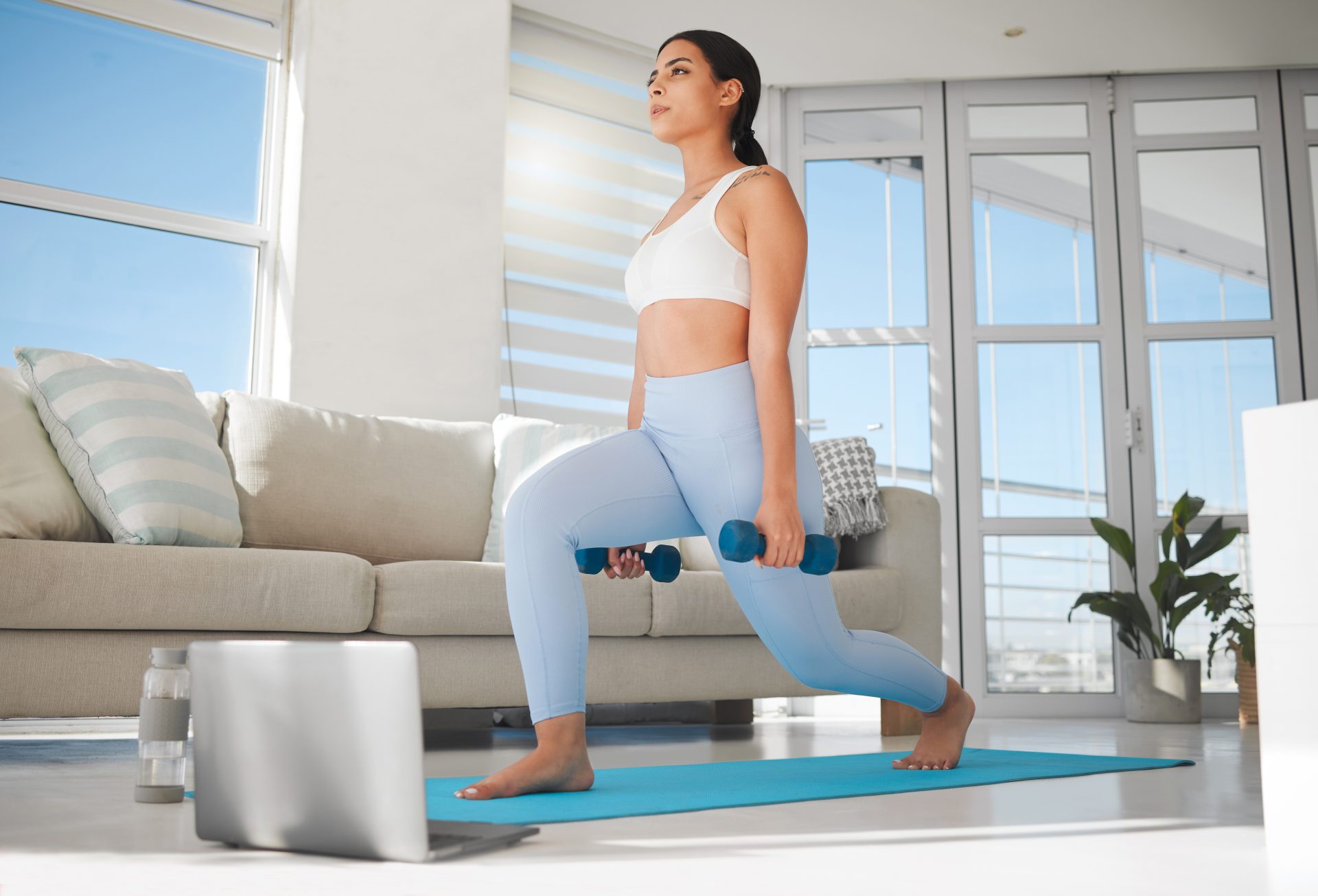
Forward Lunge — Quadriceps Focus — 3 Sets × 12 Reps Each Leg
The forward lunge — stepping forward until the front thigh reaches parallel and the rear knee hovers 2–3 cm above the floor — is the foundational lunge exercise at home and the highest-quad-demand variation. Keep the front knee tracking directly over the second toe; maintain an upright torso. 3 sets of 12 reps per leg. Modification: Reduce the step length to lower knee flexion angle for those with knee sensitivity; hold a wall for balance if stability is a limiting factor.
Reverse Lunge — Glute and Hamstring Focus — 3 Sets × 15 Reps Each Leg
The reverse lunge — stepping backward rather than forward — reduces anterior knee shear force by 30–40% compared to the forward lunge, making it the safest lunge variation for people with knee sensitivity while simultaneously shifting emphasis to the glutes and hamstrings. 3 sets of 15 reps per leg. The reverse lunge is the best lunge exercise for practitioners managing knee discomfort during forward lunges. Modification: Use a chair for balance support during the learning phase.
Lateral Lunge — Adductor and Glute Medius — 3 Sets × 10 Reps Each Side
The lateral lunge — stepping directly to the side with toes pointing forward, sitting into the working hip while the opposite leg remains straight — is the most effective lunges workout muscles exercise for the adductors and gluteus medius, which standard forward and reverse lunges significantly underload. 3 sets of 10 reps per side. Pair with strength training for thighs for complete inner and outer thigh development.
Allowing the front knee to collapse inward
Knee valgus during lunges places excessive medial knee stress and reduces glute activation.
Drive the front knee outward over the second and third toes throughout the entire movement. A resistance band above the knees is the most effective training tool for correcting knee cave during lunges.
Leaning forward excessively with the torso
Forward torso lean shifts the load from the quadriceps and glutes to the lower back — reducing lower body stimulus and increasing lumbar compression.
Maintain an upright torso throughout by engaging the core and keeping the chest lifted. If forward lean is unavoidable, reduce the step length until hip mobility improves.
Performing only forward lunges
Forward lunges alone develop the quadriceps but neglect the glutes, hamstrings, and adductors that a complete lower body programme requires.
Rotate through different lunge exercises
forward, reverse, lateral, and walking variations — across the training week for balanced lower body development.
Complete Beginners Starting from Zero
No prior experience with lunges workout is required to start. Every movement is taught from its most foundational form, with modifications for those who cannot yet perform the standard version. Live instructor feedback prevents the form errors that cause beginners to plateau or get injured before results arrive.
Intermediate Trainees Who Have Hit a Plateau
If you have been exercising inconsistently or without structured progressive overload, lunges workout delivers the systematic load progression that general fitness classes do not. The programme targets the specific weaknesses and imbalances holding you back, producing results that months of unstructured training have failed to achieve.
Desk Workers and Sedentary Professionals
Extended sitting creates the exact muscle imbalances and weaknesses that lunges workout training corrects. No gym, no equipment, and no prior experience is required — the programme begins with bodyweight fundamentals and builds progressively from there. Habuild’s morning sessions fit into a working day without disruption.
Lunges-Specific Programming
Habuild’s lunges sessions open with hip flexor and ankle mobility preparation, progress through forward and reverse lunges for quad and glute loading, and close with lateral lunges for adductor and gluteus medius development. Every session addresses all lunges workout muscles through varied lunge types in a single efficient sequence.
Live Daily Sessions with Real-Time Corrections
Lunge technique errors — knee cave, forward lean, insufficient depth — are the primary causes of knee discomfort and reduced muscle activation during lunges. Habuild’s live real-time corrections identify and resolve these errors from the first session, ensuring safe and effective lunges training for every fitness level.
Progressive Lunge Programming
Habuild progresses lunges workouts systematically: bodyweight forward lunges to reverse lunges to walking lunges to loaded and Bulgarian split squat variations. Members progress automatically based on competency — the programme designs overload so practitioners never plateau or repeat the same stimulus indefinitely.
Daily Community and Consistency
Unilateral lower body development requires 2–3 lunges sessions weekly for optimal progress. Habuild’s daily live format and accountability community create the training frequency and habit consistency that produce lasting lower body strength and balance improvements.
The classes are easy to follow, perfectly suited to my fitness level, and always leave me feeling positive.
This was my first time trying strength sessions, and I absolutely loved it! I joined out of curiosity.


Practice Strong Everyday with Trishala Bothra, an IIT-B and London School of Business alumni
Trishala is focused on making movement feel lighter, more engaging, and something you actually look forward to.
In just 3 years, over 50,000 people began their strength journey, and 10,000+ join every week to keep getting stronger.