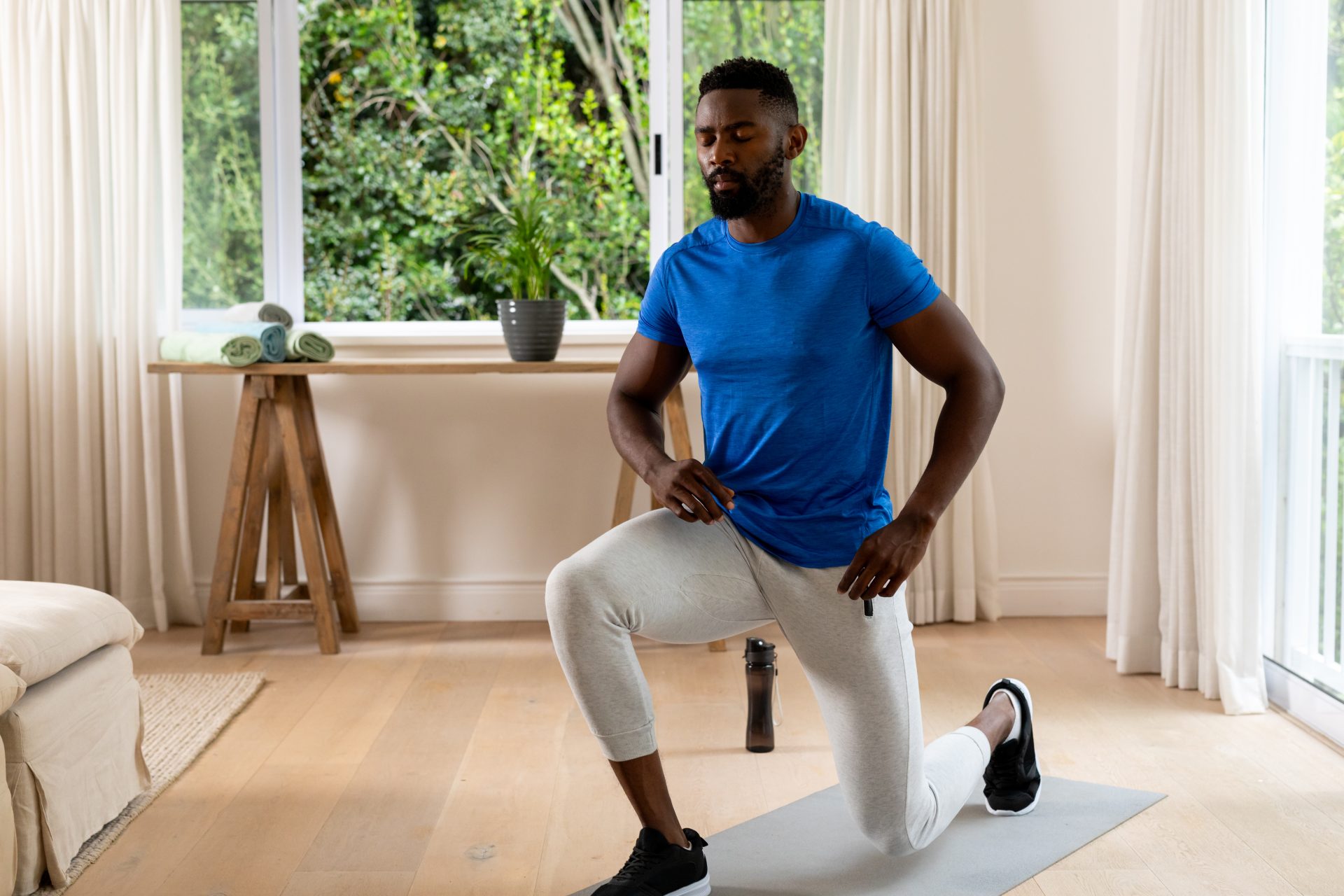
A lower body workout targets all the major muscle groups below the waist — the quadriceps, hamstrings, glutes, calves, and hip stabilisers — through a combination of bilateral and unilateral exercises. Unlike upper body training, lower body work engages the largest muscle groups in the body, producing the greatest hormonal training response and the highest metabolic demand of any resistance training session. A well-structured lower body workout at home can be as effective as gym-based training when the correct movement patterns are selected and progressively overloaded. Lower body muscle development occurs through the same progressive overload and mechanical tension principles that govern all strength training. The lower body also plays a central role in the systemic hormonal response to training — squats and hip hinges that load the glutes and quadriceps simultaneously produce the testosterone and growth hormone elevations that stimulate muscle growth throughout the entire body. This is why strength training for legs is foundational to any complete strength programme.
Start Your Free 14 Day Trial
Benefit 1: Builds the Largest Muscle Groups for Maximum Hormonal Response
Training the glutes, quadriceps, and hamstrings under load produces the greatest acute release of testosterone and growth hormone of any exercise type. This systemic hormonal response benefits muscle development throughout the entire body, making lower body workouts the most time-efficient sessions for trainees seeking total body development alongside leg-specific strength. Training the lower body — the three largest muscle groups — produces 2–3× the acute testosterone and growth hormone release of upper body training alone, benefiting muscle development throughout the entire body.
Benefit 2: Reduces Knee and Hip Pain Through Targeted Muscle Development
Most knee and hip pain originates from muscular imbalances around the joint rather than structural damage. Weak quadriceps fail to control the patella during movement; weak glutes allow the hip to drop during single-leg activities; tight hip flexors create anterior pelvic tilt that strains the lumbar spine. A lower body workout programme addresses these imbalances directly.
Benefit 3: Boosts Metabolic Rate and Supports Body Composition Goals
The lower body contains the largest muscles in the body. Developing them significantly increases resting metabolic rate — the calories burned at rest. A lower body workout that consistently stimulates the glutes, quads, and hamstrings through compound movements produces the lean muscle mass that elevates baseline energy expenditure 24 hours a day. The lower body houses 60% of total skeletal muscle mass. Adding 2kg of lower body lean mass elevates resting caloric expenditure by approximately 25 calories per day — the most sustainable metabolic uplift available.
Benefit 4: Improves Functional Movement for Daily Life and Sport
Lower body strength governs the quality of every standing, walking, climbing, and jumping movement. Building this capacity through a regular lower body workout reduces the physical effort required for daily activities, improves balance and stability, and directly enhances performance in all sports. Combining lower body training with full body workout sessions produces the total functional fitness that single-pattern training cannot achieve alone.
Protein — The Foundation of Lower Body Workout Training
Aim for 1.6–2.0g of protein per kg of bodyweight per day. Best sources include eggs, paneer, lentils (dal), chicken, Greek yoghurt, and whey protein. Distribute protein evenly across 3–4 meals rather than loading it all in one sitting. Adequate protein is non-negotiable — without it, training effort produces minimal adaptation regardless of programme quality.
Carbohydrates — Fuel for Lower Body Workout Performance
Complex carbohydrates (oats, brown rice, sweet potato, whole wheat roti) should form 40–50% of total calories. Consume a carbohydrate-containing meal 60–90 minutes before your lower body workout session to ensure glycogen availability. Post-session carbohydrates restore muscle glycogen within the critical 30-minute recovery window.
Anti-Inflammatory Foods for Recovery
Include turmeric (with black pepper for bioavailability), ginger, and omega-3 rich foods (flaxseeds, walnuts, fatty fish) daily. These directly reduce the systemic inflammation that accumulates with consistent training, speeding recovery between sessions.
Hydration — Often Underestimated
Aim for 35–40ml of water per kg of bodyweight daily. Add an additional 500ml for every 30 minutes of active training. Even mild dehydration (2% body weight) measurably reduces strength output and exercise capacity.
Before You Begin — Setting Your Baseline
Before beginning, assess your current fitness level honestly. Can you complete 10 bodyweight squats with good form? Can you hold a plank for 20 seconds? These are the practical baselines for this programme. Set a specific, measurable goal — not just ‘get stronger’ but ‘complete all sessions consistently for 8 weeks’. Identify what space and equipment you have available.
Week 1–2: Foundation and Form
Focus entirely on movement quality, not load or intensity. Every exercise should be performed through full range of motion with controlled tempo. Use this phase to build the motor patterns that make lower body workout training safe and effective long-term. 3 sessions per week is the optimal starting frequency — enough stimulus for adaptation, enough recovery to avoid overuse.
Week 3–4: Building Progressive Load
Once form is consistent, introduce progressive overload by adding 1–2 reps per set or a small increase in resistance each week. Track your sessions in a simple log — date, exercises, sets, reps. This data tells you exactly when to progress and prevents both undertraining and overtraining.
Ongoing: Consistency Over Intensity
The single biggest determinant of lower body workout results is session consistency over 8–12 weeks. Missing one session is inconsequential; missing two consecutive weeks disrupts adaptation. Habuild’s live daily sessions are specifically designed to remove the decision-making barrier — the session is always there, always structured.

Exercise 1: Romanian Deadlift — Hamstrings, Glutes, Lower Back — 3 sets × 10–12 reps
The Romanian deadlift is the most effective exercise for the hamstrings and glutes through the hip hinge pattern — the movement the lower body uses in every bending and lifting activity. Lowering a load with straight legs while maintaining a neutral spine creates a powerful eccentric stretch across the entire posterior chain, producing the hamstring and glute hypertrophy that squats and lunges cannot fully replicate. This exercise is essential in any complete lower body workout. Beginner modification: Use light dumbbells or no weight initially. Keep a slight bend in the knees. Reduce the range of motion to the point where a neutral spine can be maintained.
Exercise 2: Glute Bridge — Gluteus Maximus, Hamstrings, Core — 3 sets × 15–20 reps
The glute bridge isolates the gluteus maximus through hip extension with the spine supported on the floor, producing maximum glute activation without the balance and mobility demands of standing exercises. This makes it the most accessible high-stimulus glute exercise, particularly effective for activating the glutes in people whose desk-based lifestyle has reduced their glute recruitment patterns. The glute bridge is a prerequisite exercise before loading squats and deadlifts. Beginner modification: Perform with feet flat on the floor and arms at the sides. Add a resistance band above the knees to increase glute medius activation once the basic pattern is consistent.
Exercise 3: Reverse Lunge — Glutes, Hamstrings, Quadriceps, Core Stabilisers — 3 sets × 12 reps each leg
The reverse lunge trains unilateral leg strength and glute activation while reducing the patella-femoral stress of forward lunges, making it the preferred single-leg exercise for those with knee sensitivity. Each reverse lunge exposes and corrects strength asymmetries between the left and right legs that bilateral exercises like squats allow to persist indefinitely. Beginner modification: Take a smaller step back than full depth initially. Hold a wall or chair for balance support. Progress to a full step and bodyweight-only once strength and balance develop.
Mistake 1: Neglecting the Posterior Chain
Most trainees naturally gravitate toward quad-dominant exercises — squats, leg press, lunges — while undertraining the hamstrings and glutes. This anterior-posterior imbalance is the most common cause of knee pain, lower back strain, and running injuries. Correction: Include at least one hip hinge and one glute-dominant exercise in every lower body session.
Mistake 2: Skipping Single-Leg Work
Bilateral exercises allow the dominant leg to compensate for the weaker one indefinitely. Single-leg training exposes and corrects these asymmetries, developing the balance and stability that bilateral training cannot produce. Most lower limb injuries in sport occur during single-leg activities. Correction: Include one unilateral exercise (reverse lunge, split squat) in every lower body session.
Mistake 3: Using Too Much Load Before Establishing Movement Quality
The lower body exercises that produce the greatest training stimulus — squats, RDLs, and lunges — also require the highest degree of mobility and technique to perform safely. Loading a movement pattern before it is technically sound produces inferior muscle stimulus and elevated joint injury risk. Correction: Master bodyweight versions of all exercises before adding external resistance. Two to four weeks of bodyweight-only lower body training builds the movement foundation that loaded training requires.
Complete Beginners Starting from Zero
No prior experience with lower body workout is required to start. Every movement is taught from its most foundational form, with modifications for those who cannot yet perform the standard version. Live instructor feedback prevents the form errors that cause beginners to plateau or get injured before results arrive.
Intermediate Trainees Who Have Hit a Plateau
If you have been exercising inconsistently or without structured progressive overload, lower body workout delivers the systematic load progression that general fitness classes do not. The programme targets the specific weaknesses and imbalances holding you back, producing results that months of unstructured training have failed to achieve.
Desk Workers and Sedentary Professionals
Extended sitting creates the exact muscle imbalances and weaknesses that lower body workout training corrects. No gym, no equipment, and no prior experience is required — the programme begins with bodyweight fundamentals and builds progressively from there. Habuild’s morning sessions fit into a working day without disruption.
Lower Body-Specific Programming — Not a Generic Fitness Class Habuild’s lower body sessions are sequenced posterior-chain-first: sessions open with glute activation and hip hinge work before progressing to quad-dominant squats and lunge patterns. This sequencing ensures the often-inactive glutes are firing before they are called upon as primary stabilisers in bilateral and unilateral compound movements.
Live Daily Sessions with Real-Time Form Correction
Every Habuild session is live — not pre-recorded. Instructors watch your form in real time and correct the specific errors that limit progress and increase injury risk.
Progressive Overload Built into Every Session
Members do not need to design their own progressive overload. Load, volume, tempo, and movement complexity are built in week by week. Every session is a step forward — not a repetition of the previous routine.
Accountability, Streaks and Community
Streak tracking, a WhatsApp community, and live daily sessions create the accountability structure that keeps members consistent long enough to see measurable results. Most strength adaptations require 6–12 weeks of sustained effort.


Practice Strong Everyday with Trishala Bothra, an IIT-B and London School of Business alumni
Trishala is focused on making movement feel lighter, more engaging, and something you actually look forward to.
In just 3 years, over 50,000 people began their strength journey, and 10,000+ join every week to keep getting stronger.