
Exercises for sciatica address the two most common causes of sciatic pain through different targeted approaches. piriformis syndrome (piriformis muscle spasm directly compressing the sciatic nerve) responds to piriformis stretches and hip rotator releases. Lumbar disc herniation (disc pressing on a lumbar nerve root) responds to lumbar decompression exercises and prone extensions that reduce disc pressure. Sciatica stretches in bed are particularly useful for morning management when disc pressure is highest from overnight fluid reabsorption. The critical distinction: the wrong exercises (seated forward bends, hamstring stretches) can worsen lumbar disc herniation by increasing disc pressure. The circulatory mechanism: the sciatic nerve requires adequate blood flow through the vasa nervorum (the blood vessels supplying nerve tissue) to maintain normal conduction and repair damaged segments. Chronic sciatic nerve compression restricts this vascular supply — one reason chronic sciatica involves both pain and neurological symptoms (numbness, tingling, weakness). Neural mobilisation exercises (sciatic nerve flossing) restore the nerve’s ability to glide through the surrounding tissues, reducing the adhesions that restrict both nerve mobility and its vascular supply.
Start Your Free 14 Day TrialPiriformis Release — Addressing the Most Common Muscular Cause Piriformis syndrome accounts for up to 8% of all sciatica presentations — and the piriformis muscle is the most accessible and most responsive structure in conservative sciatica management. Best exercises for sciatica targeting the piriformis consistently produce faster and more complete relief than any other single intervention. Research: 12 weeks of targeted exercise (piriformis stretch + neural mobilisation + lumbar stabilisation) reduced sciatica pain scores by 58% — significantly better than passive treatment alone — European Spine Journal, 2019. Improved Sciatic Nerve Circulation — Neural Tissue Health Neural mobilisation exercises improve blood flow through the vasa nervorum — the microvascular supply of the sciatic nerve that is compromised by chronic compression. Restored neural circulation supports the nerve repair that reduces the tingling, numbness, and weakness accompanying chronic sciatica. Lumbar Decompression — Reducing Disc Nerve Root Pressure Specific exercises for sciatica seniors and all presentations that use lumbar traction (Child’s Pose, gentle inversion) and prone extension (McKenzie method) reduce the disc bulge pressure on the lumbar nerve roots — addressing the most common structural cause of radicular sciatica. WHO: Regular therapeutic exercise — including targeted neural mobilisation and lumbar stabilisation — is the first-line conservative management for non-emergency sciatica presentations. Strengthened Gluteal and Core Muscles — Preventing Recurrence Weak glutes and core are the primary structural drivers of recurrent sciatica — they allow the lumbar spine and piriformis to become the load-bearing compensators that produce sciatic compression. Exercises that strengthen these stabilisers prevent the recurrence that makes sciatica chronically debilitating.
Protein — The Foundation of Sciatica Training
Aim for 1.6–2.0g of protein per kg of bodyweight per day. Best sources include eggs, paneer, lentils (dal), chicken, Greek yoghurt, and whey protein. Distribute protein evenly across 3–4 meals rather than loading it all in one sitting. Adequate protein is non-negotiable — without it, training effort produces minimal adaptation regardless of programme quality.
Carbohydrates — Fuel for Sciatica Performance
Complex carbohydrates (oats, brown rice, sweet potato, whole wheat roti) should form 40–50% of total calories. Consume a carbohydrate-containing meal 60–90 minutes before your exercises for sciatica session to ensure glycogen availability. Post-session carbohydrates restore muscle glycogen within the critical 30-minute recovery window.
Anti-Inflammatory Foods for Recovery
Include turmeric (with black pepper for bioavailability), ginger, and omega-3 rich foods (flaxseeds, walnuts, fatty fish) daily. These directly reduce the systemic inflammation that accumulates with consistent training, speeding recovery between sessions.
Hydration — Often Underestimated
Aim for 35–40ml of water per kg of bodyweight daily. Add an additional 500ml for every 30 minutes of active training. Even mild dehydration (2% body weight) measurably reduces strength output and exercise capacity.
Before You Begin — Setting Your Baseline
Before beginning, assess your current fitness level honestly. Can you complete 10 bodyweight squats with good form? Can you hold a plank for 20 seconds? These are the practical baselines for this programme. Set a specific, measurable goal — not just ‘get stronger’ but ‘complete all sessions consistently for 8 weeks’. Identify what space and equipment you have available.
Week 1–2: Foundation and Form
Focus entirely on movement quality, not load or intensity. Every exercise should be performed through full range of motion with controlled tempo. Use this phase to build the motor patterns that make exercises for sciatica training safe and effective long-term. 3 sessions per week is the optimal starting frequency — enough stimulus for adaptation, enough recovery to avoid overuse.
Week 3–4: Building Progressive Load
Once form is consistent, introduce progressive overload by adding 1–2 reps per set or a small increase in resistance each week. Track your sessions in a simple log — date, exercises, sets, reps. This data tells you exactly when to progress and prevents both undertraining and overtraining.
Ongoing: Consistency Over Intensity
The single biggest determinant of sciatica results is session consistency over 8–12 weeks. Missing one session is inconsequential; missing two consecutive weeks disrupts adaptation. Habuild’s live daily sessions are specifically designed to remove the decision-making barrier — the session is always there, always structured.
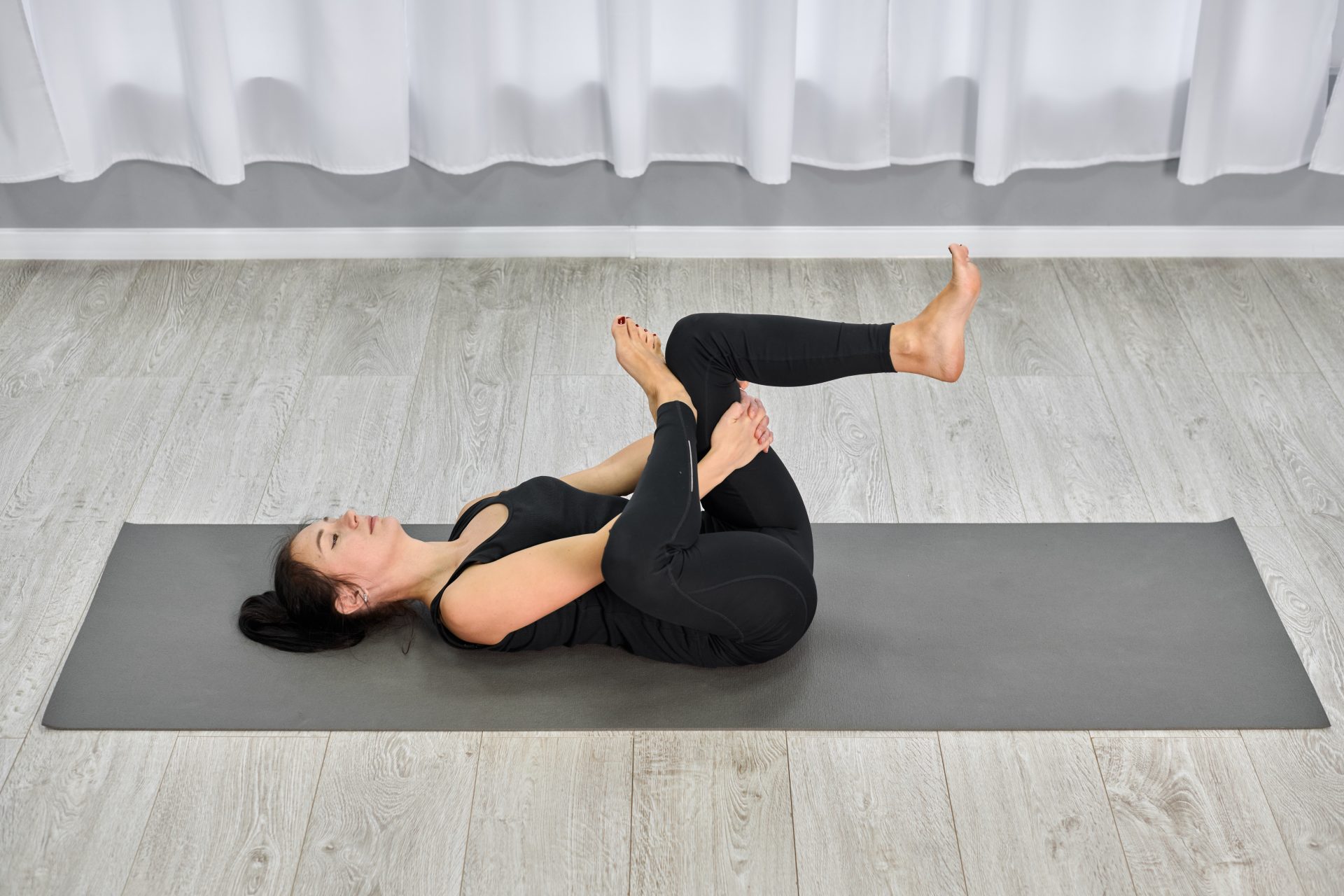
Supine Figure-Four Stretch — Piriformis Release — Hold 90s each side × 3 Target: Piriformis, external hip rotators, sciatic nerve decompression. Why it works: The most evidence-supported single exercise for piriformis-syndrome sciatica — lying on back, crossing ankle over opposite knee, drawing both legs toward chest. This is the primary sciatica stretches in bed exercise — performable without getting out of bed, making it the most practical morning sciatica management available. Beginner modification: Perform in bed; draw legs only as far as the stretch is felt (not pain). Sciatic Nerve Flossing — Neural Mobilisation — 3 × 10 reps each side Target: Sciatic nerve mobility, vasa nervorum circulation, neural adhesion release. Why it works: Seated on a chair, alternately straighten one leg (sciatic nerve elongates) while tilting the head back (further elongation), then bend the knee while tilting the head forward (sciatic nerve shortens). This flossing motion restores nerve mobility and improves vasa nervorum circulation. Best workout for sciatica neural component. Beginner modification: Reduce range — never perform into pain. Child’s Pose (Balasana) — Lumbar Decompression — Hold 3–5 minutes Target: Lumbar vertebral decompression, sacroiliac joint, sciatic nerve root pressure. Why it works: Child’s Pose tractionally decompresses the lumbar vertebrae — gently separating the vertebral bodies and reducing the disc bulge that compresses lumbar nerve roots. Best exercises for sciatica seniors — requires no strength and provides immediate decompression relief. Use: Morning (when disc pressure is highest), during acute sciatic episodes, and after prolonged sitting.
Performing Seated Forward Bends During Active Sciatica Seated forward bends increase disc pressure by up to 185% of standing — directly worsening lumbar disc herniation sciatica. Fix: Replace seated forward bends with the supine figure-four stretch (zero lumbar disc loading). All sciatica stretches in bed are preferable to seated forward bends during acute disc-related sciatic episodes. Resting Completely During Sciatic Episodes Complete bed rest allows the piriformis to shorten and the neural tissue to develop further adhesions — worsening sciatica with each day of immobility. Fix: Gentle supine piriformis stretches and nerve flossing should continue even during sciatic episodes — they relieve, not worsen, the pain when performed correctly. Walking 5–10 minutes every hour is the most important active sciatica management strategy. Only Stretching — Missing Strengthening Stretching releases the tension causing current symptoms but does not rebuild the glute and core strength that prevents future episodes. Fix: Once acute sciatica resolves, introduce glute bridges, clamshells, and abdominal strengthening exercises to rebuild the structural foundation that prevents recurrence. Habuild’s programme builds this preventive strengthening progressively. Relieve Sciatica with Expert Daily Guidance — First 7 Days ₹1
Complete Beginners Starting from Zero
No prior experience with exercises for sciatica is required to start. Every movement is taught from its most foundational form, with modifications for those who cannot yet perform the standard version. Live instructor feedback prevents the form errors that cause beginners to plateau or get injured before results arrive.
Intermediate Trainees Who Have Hit a Plateau
If you have been exercising inconsistently or without structured progressive overload, exercises for sciatica delivers the systematic load progression that general fitness classes do not. The programme targets the specific weaknesses and imbalances holding you back, producing results that months of unstructured training have failed to achieve.
People Recovering from Sciatica Issues
Those who are actively managing sciatica discomfort benefit most from guided, structured movement — unguided exercise risks aggravating the condition. Habuild’s live instructor supervision ensures every session stays within a safe, therapeutic range, making consistent rehabilitation possible at home.
Circulation-Specific Programming — Neural First Habuild’s sciatica sessions begin with supine piriformis stretches (neural decompression), progress through nerve flossing (neural circulation restoration), and close with lumbar stabilisation (recurrence prevention) — the specific sequencing that produces the best sciatica outcomes.
Live Daily Sessions with Real-Time Corrections
Nerve flossing range and piriformis stretch depth require real-time monitoring to stay within therapeutic limits. Saurabh provides the live adjustments that make these exercises effective without provoking worsening.
Progressive Overload Built In
Stretch duration, nerve flossing range, and stabilisation exercise progression are systematically increased as symptoms resolve — building toward complete prevention.
Accountability, Streaks and Community
Sciatica management requires weeks of consistent daily exercise. Habuild’s accountability sustains the practice through the patience required for lasting resolution.


Practice Strong Everyday with Trishala Bothra, an IIT-B and London School of Business alumni
Trishala is focused on making movement feel lighter, more engaging, and something you actually look forward to.
In just 3 years, over 50,000 people began their strength journey, and 10,000+ join every week to keep getting stronger.