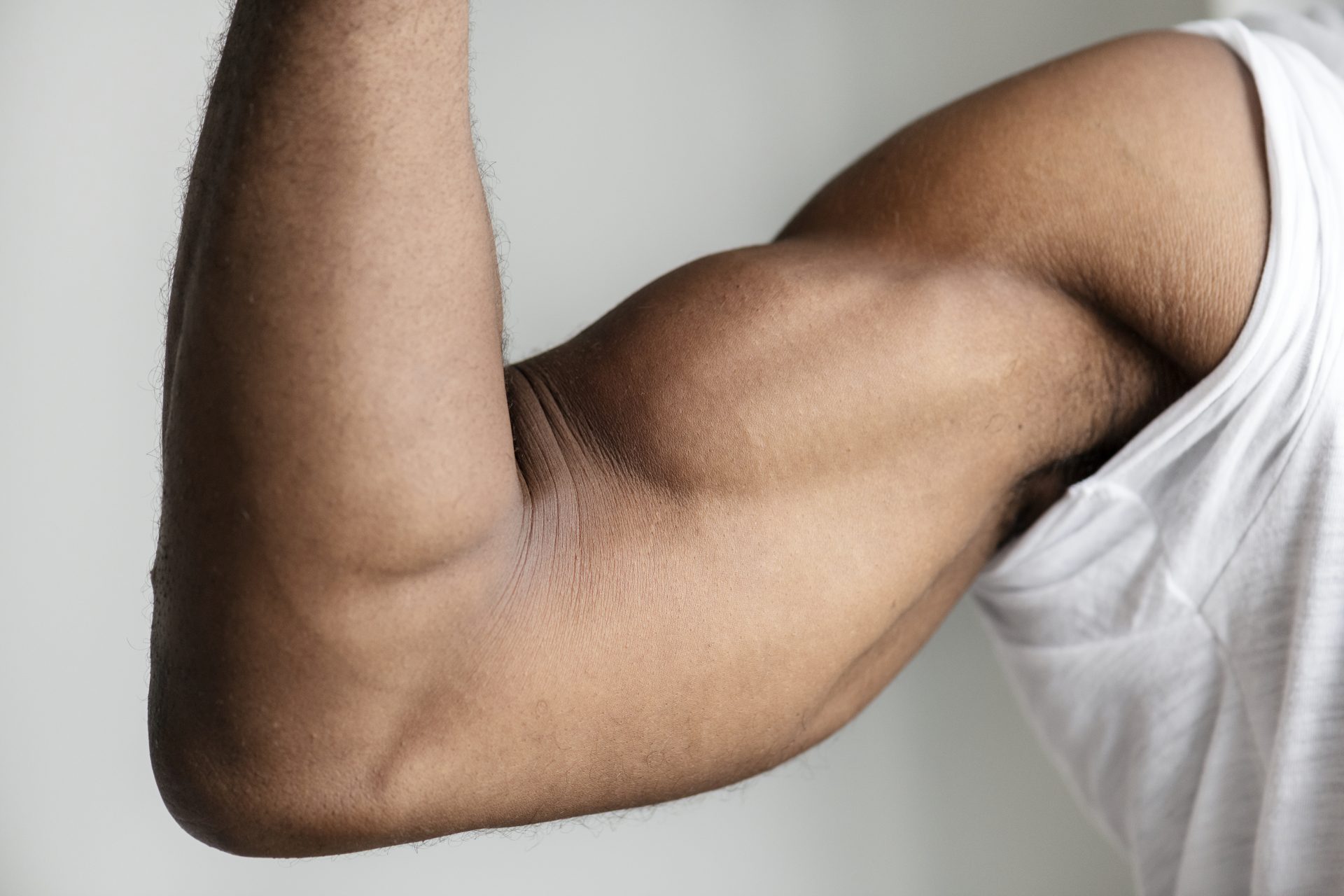
The biceps brachii — a two-headed muscle comprising the long head (outer peak) and short head (inner thickness) — functions primarily as an elbow flexor and forearm supinator. Effective bicep workouts must target both heads through supinated curls (long head emphasis), hammer curls (brachialis and brachioradialis), and incline curls (long head stretch). The brachialis — the muscle beneath the bicep — is equally important for arm thickness and is best targeted through hammer curls and reverse curls. The best bicep workout addresses all three muscles through varied grip and angle. Bicep workouts drive muscle growth through progressive mechanical tension on the elbow flexor complex — the same progressive overload principle that governs all muscular hypertrophy. At home arm workouts require minimal equipment: chin-ups, inverted rows, and dumbbell curls produce bicep development equivalent to machine-based training when volume and progressive overload are maintained. Habuild structures at home arm workouts within the strength training for arms programme for progressive upper arm development without gym access.
Start Your Free 14 Day Trial
Builds Arm Peak and Upper Arm Definition
The long head of the bicep produces the characteristic “peak” visible when the arm is flexed — the most sought-after aesthetic outcome of dedicated bicep training. Best bicep workouts for peak development emphasise the long head through supinated dumbbell curls with the elbow slightly behind the body (incline curls) and full supination at the top of each repetition.
Increases Pulling Strength for Back Exercises
The biceps are primary synergists in all pulling movements — pull-ups, rows, and lat pulldowns all require strong bicep engagement for full range elbow flexion. A dedicated beginner back and bicep workout improves pulling performance across all compound back exercises, accelerating overall upper body pulling strength. Combine bicep training with strength training for back for maximum pulling power development.
Improves Grip Strength and Forearm Development
Bicep curl variations — particularly hammer curls and reverse curls — develop the brachioradialis and wrist flexors alongside the biceps, building the grip strength and forearm thickness that heavy pulling exercises and daily carrying tasks require. This integrated forearm development is a secondary benefit of consistent bicep workouts that isolation machines cannot replicate.
Supports the Best Way to Build Biceps for Beginners
Bicep workouts are uniquely beginner-friendly — the elbow flexion movement pattern is natural, the load is easily controlled, and progressive overload is immediately measurable (adding weight or reps weekly). Beginners consistently experience rapid strength and size gains in the first 8–12 weeks of bicep training — the neuromuscular adaptation phase produces the fastest visible results of any training period.
Protein — The Foundation of Bicep Workouts Training
Aim for 1.6–2.0g of protein per kg of bodyweight per day. Best sources include eggs, paneer, lentils (dal), chicken, Greek yoghurt, and whey protein. Distribute protein evenly across 3–4 meals rather than loading it all in one sitting. Adequate protein is non-negotiable — without it, training effort produces minimal adaptation regardless of programme quality.
Carbohydrates — Fuel for Bicep Workouts Performance
Complex carbohydrates (oats, brown rice, sweet potato, whole wheat roti) should form 40–50% of total calories. Consume a carbohydrate-containing meal 60–90 minutes before your bicep workouts session to ensure glycogen availability. Post-session carbohydrates restore muscle glycogen within the critical 30-minute recovery window.
Anti-Inflammatory Foods for Recovery
Include turmeric (with black pepper for bioavailability), ginger, and omega-3 rich foods (flaxseeds, walnuts, fatty fish) daily. These directly reduce the systemic inflammation that accumulates with consistent training, speeding recovery between sessions.
Hydration — Often Underestimated
Aim for 35–40ml of water per kg of bodyweight daily. Add an additional 500ml for every 30 minutes of active training. Even mild dehydration (2% body weight) measurably reduces strength output and exercise capacity.
Before You Begin — Setting Your Baseline
Before beginning, assess your current fitness level honestly. Can you complete 10 bodyweight squats with good form? Can you hold a plank for 20 seconds? These are the practical baselines for this programme. Set a specific, measurable goal — not just ‘get stronger’ but ‘complete all sessions consistently for 8 weeks’. Identify what space and equipment you have available.
Week 1–2: Foundation and Form
Focus entirely on movement quality, not load or intensity. Every exercise should be performed through full range of motion with controlled tempo. Use this phase to build the motor patterns that make bicep workouts training safe and effective long-term. 3 sessions per week is the optimal starting frequency — enough stimulus for adaptation, enough recovery to avoid overuse.
Week 3–4: Building Progressive Load
Once form is consistent, introduce progressive overload by adding 1–2 reps per set or a small increase in resistance each week. Track your sessions in a simple log — date, exercises, sets, reps. This data tells you exactly when to progress and prevents both undertraining and overtraining.
Ongoing: Consistency Over Intensity
The single biggest determinant of bicep workouts results is session consistency over 8–12 weeks. Missing one session is inconsequential; missing two consecutive weeks disrupts adaptation. Habuild’s live daily sessions are specifically designed to remove the decision-making barrier — the session is always there, always structured.
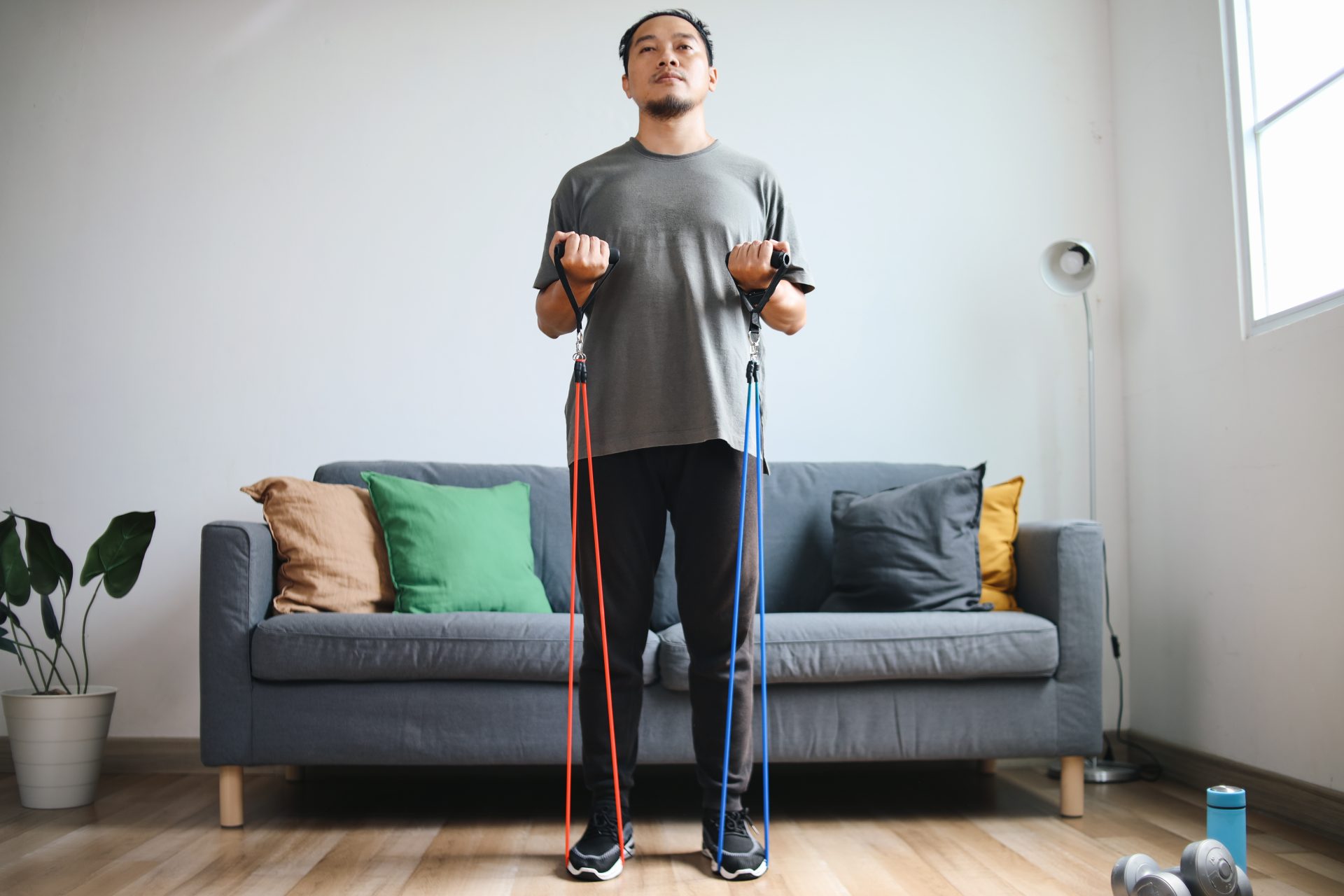
Dumbbell Supinated Curl — Peak Development — 3 Sets × 12 Reps
The dumbbell supinated curl — fully rotating the palm upward at the top of the movement — maximises bicep contraction through complete supination, activating the long head and producing the peak contraction that defines bicep shape. Stand with elbows fixed at the sides; curl with a controlled 2-second lowering phase for maximum time under tension. 3 sets of 12 reps. Modification: Seated curl for those with lower back sensitivity; reduce weight to maintain full supination at the top.
At Home Arm Workouts: Chin-Ups — 3 Sets × Max Reps
Chin-ups — pull-ups performed with a supinated (palms-facing-you) grip — are the most effective at home arm workout for biceps because they load the elbow flexors under significantly greater resistance than dumbbells allow, while simultaneously developing the back and rear deltoids. 3 sets to technical failure (not muscular failure) produces the stimulus for rapid bicep strength development. Modification: Use a resistance band for assistance or perform inverted rows under a table as a regression.
Hammer Curls — Brachialis and Forearm — 3 Sets × 15 Reps
Hammer curls — neutral grip (thumbs up) throughout — target the brachialis, which lies beneath the bicep and contributes significantly to overall arm thickness when developed. 3 sets of 15 reps at moderate weight with a controlled tempo builds the brachialis and brachioradialis that standard curls neglect. Pairing hammer curls with standard curls in the same session produces complete elbow flexor development — the foundation of the best way to build biceps for both size and strength. Combine with strength training for muscle mass for comprehensive hypertrophy programming.
Swinging the torso to lift the weight — Momentum-assisted curls remove mechanical tension from the bicep at the critical bottom portion of the rep — where the stretch-mediated hypertrophic stimulus is greatest. Keep elbows fixed at the sides and the torso stationary; reduce weight until strict form is achievable for all reps. Not supinating fully at the top of the curl — Stopping the curl without fully rotating the palm upward reduces the peak bicep contraction by 20–30% — eliminating the most important portion of bicep activation. Consciously rotate the pinky upward at the top of every dumbbell curl to achieve full supination and maximum long-head engagement. Neglecting the lowering phase — Lowering the dumbbell quickly eliminates eccentric tension — the portion of the rep most responsible for muscle damage and subsequent hypertrophy. A 2–3 second controlled lowering phase doubles the hypertrophic stimulus of each repetition without adding any additional sets or time to the workout.
Complete Beginners Starting from Zero
No prior experience with bicep workouts is required to start. Every movement is taught from its most foundational form, with modifications for those who cannot yet perform the standard version. Live instructor feedback prevents the form errors that cause beginners to plateau or get injured before results arrive.
Intermediate Trainees Who Have Hit a Plateau
If you have been exercising inconsistently or without structured progressive overload, bicep workouts delivers the systematic load progression that general fitness classes do not. The programme targets the specific weaknesses and imbalances holding you back, producing results that months of unstructured training have failed to achieve.
Desk Workers and Sedentary Professionals
Extended sitting creates the exact muscle imbalances and weaknesses that bicep workouts training corrects. No gym, no equipment, and no prior experience is required — the programme begins with bodyweight fundamentals and builds progressively from there. Habuild’s morning sessions fit into a working day without disruption.
Bicep-Specific Programming
Habuild’s bicep sessions open with chin-up compound pulling for maximum neural drive and load, progress through supinated dumbbell curls for long-head peak development, and close with hammer curls for brachialis thickness and grip strength. This sequencing is designed for complete elbow flexor development in a single efficient session.
Live Daily Sessions with Real-Time Corrections
Bicep technique errors — torso swing, incomplete supination, rushed lowering — are the primary reasons bicep training fails to produce visible results despite consistent effort. Habuild’s live real-time corrections eliminate these errors from the first session, ensuring that every curl produces the full mechanical stimulus for bicep hypertrophy.
Progressive Overload Built In
The best way to build biceps is consistent progressive overload — adding reps or load every 1–2 weeks. Habuild tracks member progression and builds overload into each weekly session, ensuring that training remains in the hypertrophic stimulus zone rather than the maintenance zone where most self-directed programmes stagnate.
Daily Community and Accountability
Bicep development requires 10–15 sets of weekly direct volume, distributed across 2–3 sessions. Habuild’s daily live format and accountability community ensure members hit their weekly bicep volume targets consistently — the single most important variable for long-term arm development.


Practice Strong Everyday with Trishala Bothra, an IIT-B and London School of Business alumni
Trishala is focused on making movement feel lighter, more engaging, and something you actually look forward to.
In just 3 years, over 50,000 people began their strength journey, and 10,000+ join every week to keep getting stronger.