
An ankle strength workout is a targeted training programme for the musculature of the lower leg that controls ankle motion and stability — the peroneals (lateral stability), tibialis anterior (dorsiflexion), gastrocnemius and soleus (plantarflexion), and the deep ankle stabilisers that prevent the rolling movements that cause sprains. What makes a targeted ankle workout distinct from incidental ankle use in general exercise is the specific rehabilitation and strengthening of the ligaments, tendons, and muscles that ankle stability depends on. The mechanism is proprioceptive adaptation alongside muscular strengthening. The ankle contains a dense network of mechanoreceptors — sensory receptors that detect position and movement and trigger rapid stabilising muscle contractions. Targeted ankle training improves both the muscular strength that provides active joint support and the neural responsiveness that makes that support fast enough to prevent sprains. Both adaptations are required for complete ankle resilience.
Start Your Free 14 Day Trial
Benefit 1: Reduced Ankle Sprain Risk and Recurrence
Stronger ankle musculature — particularly the peroneals that resist inversion — and improved proprioception directly reduce the probability of ankle rolling under the unexpected surface changes and direction shifts of daily life and sport.
Benefit 2: Improved Balance and Single-Leg Stability
Strong ankles are the foundation of single-leg balance — the physical capacity that underpins confident walking on uneven surfaces, stair navigation, and all single-leg athletic movements. Many practitioners notice meaningful balance improvements within 4–6 weeks of consistent ankle training.
Benefit 3: Better Running Economy and Athletic Performance
Ankle strength and stiffness contribute to the energy return from each footstrike in running — stronger, stiffer ankles produce more efficient ground contact and improved running economy. For athletes in any running sport, ankle strength training produces measurable performance benefits.
Benefit 4: Reduced Knee and Hip Stress Through Better Ground Contact
Weak ankles produce compensatory movement at the knee and hip — the joints that absorb the ankle’s failure to absorb ground reaction forces effectively. Stronger ankles reduce the upstream joint stress that contributes to knee and hip injury in those with ankle instability.
Protein — The Foundation of Ankle Strength Workout Training
Aim for 1.6–2.0g of protein per kg of bodyweight per day. Best sources include eggs, paneer, lentils (dal), chicken, Greek yoghurt, and whey protein. Distribute protein evenly across 3–4 meals rather than loading it all in one sitting. Adequate protein is non-negotiable — without it, training effort produces minimal adaptation regardless of programme quality.
Carbohydrates — Fuel for Ankle Strength Workout Performance
Complex carbohydrates (oats, brown rice, sweet potato, whole wheat roti) should form 40–50% of total calories. Consume a carbohydrate-containing meal 60–90 minutes before your ankle strength workout session to ensure glycogen availability. Post-session carbohydrates restore muscle glycogen within the critical 30-minute recovery window.
Anti-Inflammatory Foods for Recovery
Include turmeric (with black pepper for bioavailability), ginger, and omega-3 rich foods (flaxseeds, walnuts, fatty fish) daily. These directly reduce the systemic inflammation that accumulates with consistent training, speeding recovery between sessions.
Hydration — Often Underestimated
Aim for 35–40ml of water per kg of bodyweight daily. Add an additional 500ml for every 30 minutes of active training. Even mild dehydration (2% body weight) measurably reduces strength output and exercise capacity.
Before You Begin — What to Check
Those with previous ankle sprains should consult a physiotherapist before beginning to ensure any ligament damage is appropriately assessed. Check for any ongoing swelling or instability before starting single-leg balance exercises — if significant swelling is present, more conservative exercises should be selected first. Assess baseline single-leg balance: can you stand on one leg for 10 seconds with eyes open? This is your starting point.
Your First 2 Weeks — Foundation Phase
Two sessions per week. Single-leg balance holds (progress from eyes open to eyes closed), ankle circles (both directions), and resistance band plantarflexion and dorsiflexion. All exercises are bodyweight only and focused on the range of motion and proprioceptive response rather than loading.
Weeks 3–8 — Progressive Loading Phase
Three sessions per week. Introduce single-leg calf raises, lateral band walks (peroneal activation), and wobble cushion or folded mat balance challenges. Begin loaded ankle work — farmer’s carries and step-ups that require ankle stability under load.
Beyond 8 Weeks — Long-Term Maintenance
Introduce plyometric progressions: small hops, lateral bounds, and jump landing mechanics. Maintain daily balance work (even 2 minutes of single-leg standing while brushing teeth produces meaningful proprioceptive training benefit). Measure progress through single-leg balance duration and the confidence of ankle performance in daily activities.
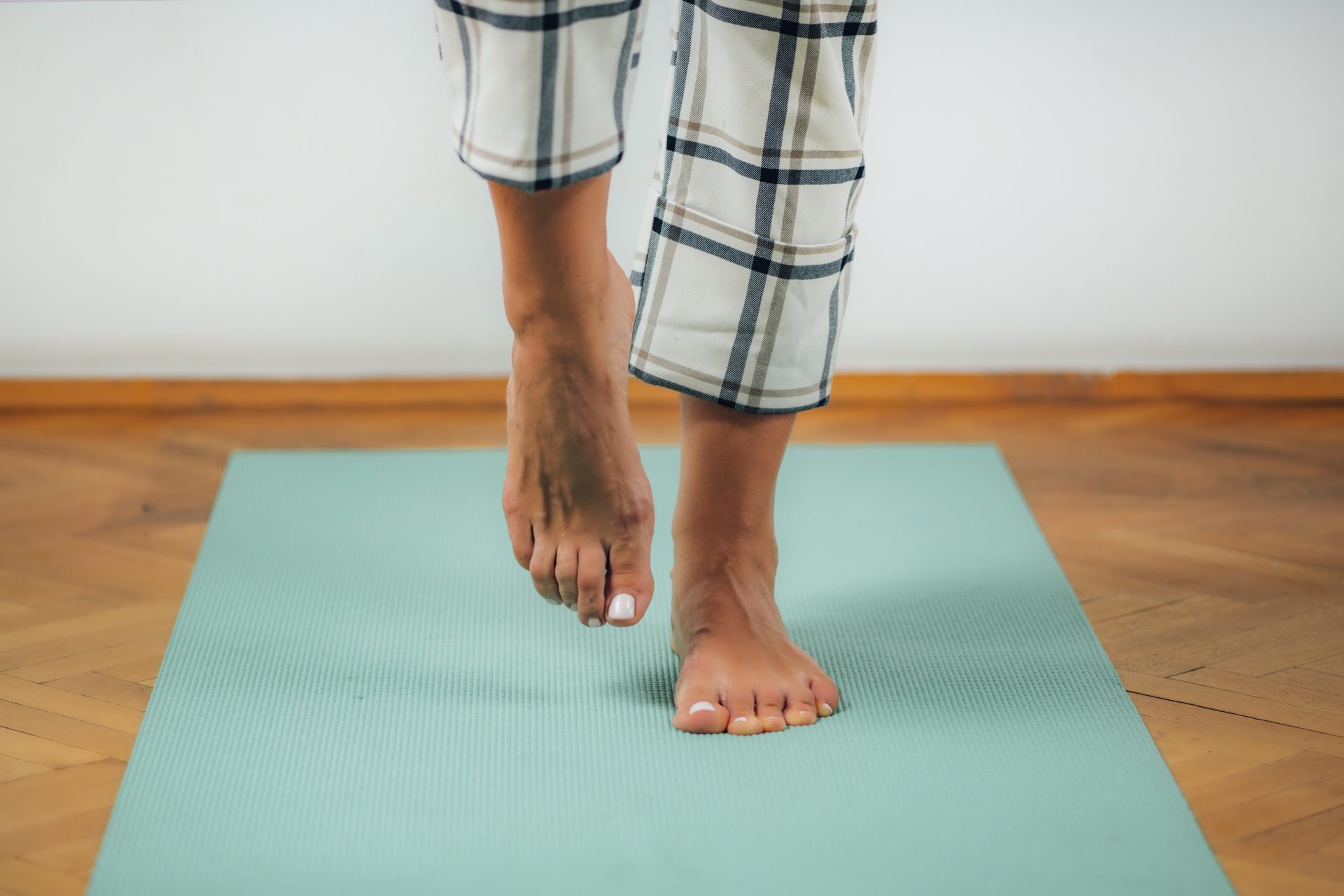
Single-Leg Balance (Progression: Eyes Open → Eyes Closed → Unstable Surface) — Peroneals, Tibialis Anterior, Deep Ankle Stabilisers, Proprioceptors
Single-leg balance training is the most important and most evidence-supported ankle stability exercise — it directly trains the proprioceptive responses that prevent ankle rolling. The eyes-closed progression removes visual compensation, requiring the ankle proprioceptors to work independently. Beginner: hold a wall or chair back initially; progress to freestanding balance as confidence develops.
Resistance Band Ankle Inversion/Eversion — Peroneals (Eversion), Tibialis Posterior (Inversion)
Band resistance training in both directions develops the specific ankle musculature that controls the rolling movements that cause sprains. Peroneal strength (resisting inward rolling) is the most critical ankle injury prevention target — this exercise directly develops it. Beginner: perform seated with a light resistance band; progress to standing for greater proprioceptive demand.
Single-Leg Calf Raise with Slow Eccentric — Gastrocnemius, Soleus, Ankle Plantarflexors
The single-leg calf raise with a 3-second eccentric lowering develops calf and Achilles tendon resilience alongside ankle plantarflexion strength. The slow eccentric specifically strengthens the Achilles tendon — the most commonly overloaded structure in runners and jumping athletes. Beginner: begin bilateral (both feet) and slowly shift to single-leg as ankle strength develops.
Mistake 1: Returning to Full Activity Too Soon After a Sprain
The most damaging mistake in ankle sprain management is returning to running or jumping activity before proprioceptive function has been restored. Painlessness is not the same as readiness — the proprioceptive deficit from a sprain can persist for weeks after pain resolves.
Mistake 2: Only Doing Calf Raises and Neglecting Ankle Stabilisers
Calf raises develop plantarflexion strength but do not address the lateral stabilisers (peroneals) that prevent the inversion sprains that are most common. A complete ankle programme requires multi-directional work, not just up-and-down motion.
Mistake 3: Training Through Ankle Pain or Swelling
Exercising through acute ankle swelling or pain can worsen ligament damage and delay healing. Pain and significant swelling are signals to reduce load immediately and seek assessment.
Mistake 4: Neglecting Ankle Training Because ‘My Ankles Are Fine’
Most ankle injuries happen to people who were not aware of any existing ankle weakness before the injury. Ankle stability training is most effective as prevention, before an injury creates the deficit that training then must rehabilitate.
Complete Beginners Starting from Zero
No prior experience with ankle strength workout is required to start. Every movement is taught from its most foundational form, with modifications for those who cannot yet perform the standard version. Live instructor feedback prevents the form errors that cause beginners to plateau or get injured before results arrive.
Intermediate Trainees Who Have Hit a Plateau
If you have been exercising inconsistently or without structured progressive overload, ankle strength workout delivers the systematic load progression that general fitness classes do not. The programme targets the specific weaknesses and imbalances holding you back, producing results that months of unstructured training have failed to achieve.
Desk Workers and Sedentary Professionals
Extended sitting creates the exact muscle imbalances and weaknesses that ankle strength workout training corrects. No gym, no equipment, and no prior experience is required — the programme begins with bodyweight fundamentals and builds progressively from there. Habuild’s morning sessions fit into a working day without disruption.
Live Daily Sessions with Real-Time Instructor Feedback
Habuild’s live sessions — delivered daily by expert instructors — provide real-time form corrections for the specific technique errors that ankle strength training requires attention to. Unlike pre-recorded content, the live format means the instructor can see you and correct in the moment — the difference between building correct habits and reinforcing incorrect ones.
Condition-Specific Modifications in Every Session
Every exercise in the Habuild ankle strength programme is selected and modified with this specific goal in mind. Members are not attending a generic fitness class with a modification option bolted on — they are in a programme designed from the ground up for ankle strength outcomes.
Progressive Programming That Respects Your Recovery Timeline
The programme structure follows the physiological timeline of improvement — not an arbitrary 4-week or 8-week marketing format. Progression is earned through demonstrated capacity, not assumed by a calendar week.
Community of Members With the Same Goals


Practice Strong Everyday with Trishala Bothra, an IIT-B and London School of Business alumni
Trishala is focused on making movement feel lighter, more engaging, and something you actually look forward to.
In just 3 years, over 50,000 people began their strength journey, and 10,000+ join every week to keep getting stronger.