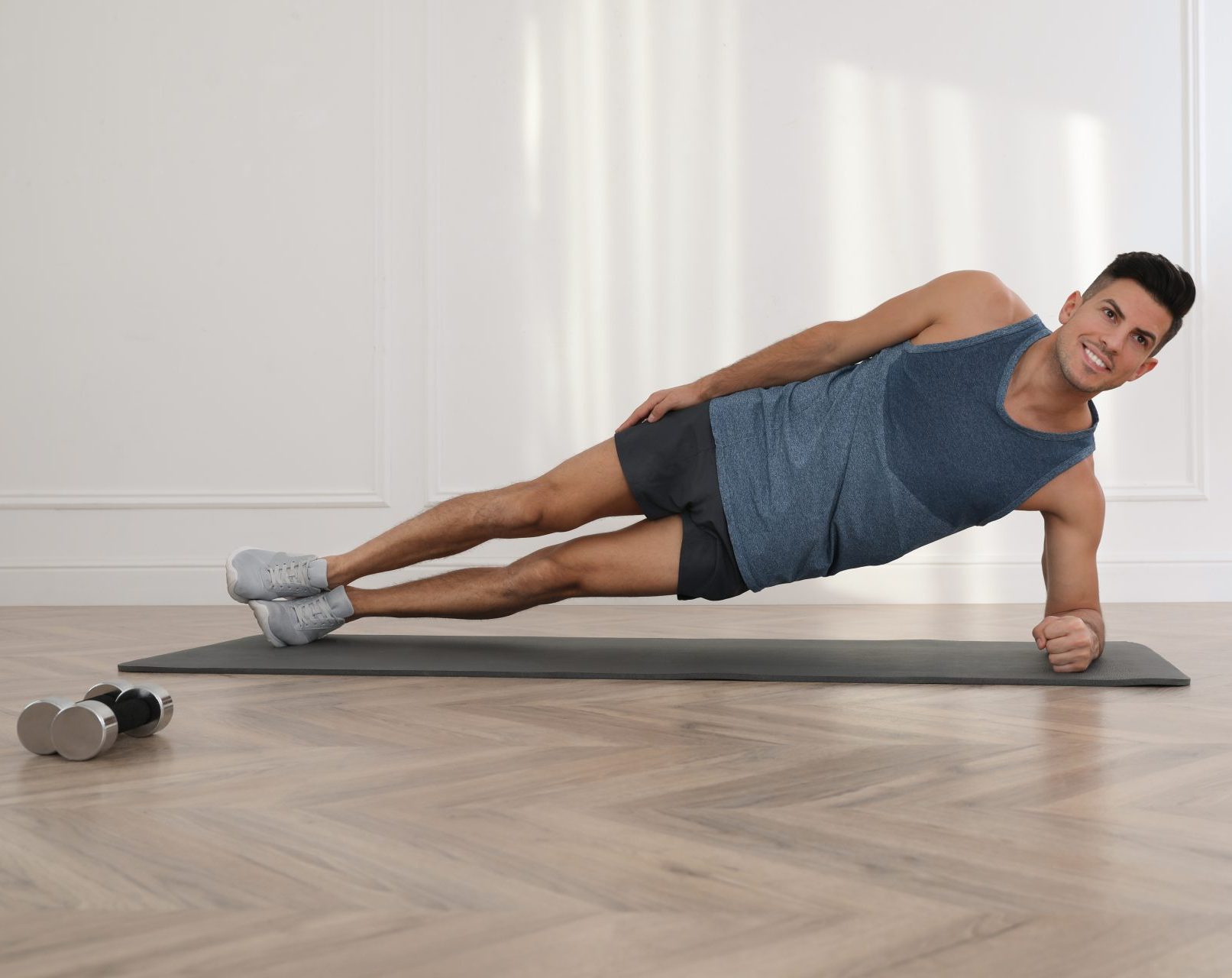
The abdominal musculature comprises four distinct layers, each with different functions that a complete abdominal workout must address. The rectus abdominis — the “six pack” muscle — performs spinal flexion and is trained through crunches, sit-ups, and leg raises. The transverse abdominis — the deepest layer — functions as a natural weight belt, providing intra-abdominal pressure and spinal stability, and is trained through Kapalbhati, dead bugs, and hollow body holds. The obliques — internal and external — produce rotation and lateral flexion, trained through bicycle crunches, Russian twists, and side planks. Most six pack workouts neglect the transverse abdominis and obliques, producing visible rectus development over an unstable, functionally weak core. Abdominal workouts produce visible abs only when body fat is sufficiently low — the rectus abdominis is present in every person, but visible definition requires roughly 14–17% body fat for men and 19–22% for women. The best ab exercises develop the muscle; dietary management and overall fat reduction reveal it. At Habuild, abdominal workouts are integrated with yoga for belly fat and Kapalbhati programming for both core development and the fat reduction that makes abs visible.
Start Your Free 14 Day Trial
Builds Visible Abdominal Definition and Six Pack Development
Consistent best ab exercises — targeting all four core layers with progressive volume and intensity — develop the rectus abdominis and obliques to the point of visible definition as body fat reduces. Six pack workout programming that combines flexion work (crunches, leg raises) with rotation work (bicycle crunches) and isometric holds (plank, hollow body) produces the complete abdominal development that single-exercise approaches cannot achieve.
Develops Deep Core Stability for All Athletic Movements
The transverse abdominis — trained through Kapalbhati, planks, and dead bugs — provides the spinal stability that all compound movements (squats, deadlifts, overhead press) require. Weak transverse abdominis is the primary cause of lower back pain during lifting and is consistently found in people with chronic lumbar instability. Dedicated abdominal workouts that include transverse abdominis training directly support strength training for back muscles safety and performance.
Reduces Lower Back Pain Through Core Muscular Support
The abdominal muscles and lumbar erectors work as an antagonistic pair to stabilise the spine. When abdominals are weak relative to the erectors — common in sedentary adults — the lumbar spine is inadequately supported in anterior shear positions, producing the disc loading and muscle strain that drives chronic lower back pain. Consistent abdominal workouts that build all four core layers measurably reduce lower back pain incidence in previously sedentary individuals.
Improves Posture and Breathing Through Core Activation
A strong transverse abdominis and diaphragm work together to maintain intra-abdominal pressure and upright spinal alignment during both exercise and daily activities. Core strength from consistent abdominal workouts improves resting posture, reduces the slumping that produces neck and upper back pain, and supports the diaphragmatic breathing mechanics that pranayama and yoga require.
Protein — The Foundation of Abdominal Workouts Training
Aim for 1.6–2.0g of protein per kg of bodyweight per day. Best sources include eggs, paneer, lentils (dal), chicken, Greek yoghurt, and whey protein. Distribute protein evenly across 3–4 meals rather than loading it all in one sitting. Adequate protein is non-negotiable — without it, training effort produces minimal adaptation regardless of programme quality.
Carbohydrates — Fuel for Abdominal Workouts Performance
Complex carbohydrates (oats, brown rice, sweet potato, whole wheat roti) should form 40–50% of total calories. Consume a carbohydrate-containing meal 60–90 minutes before your abdominal workouts session to ensure glycogen availability. Post-session carbohydrates restore muscle glycogen within the critical 30-minute recovery window.
Anti-Inflammatory Foods for Recovery
Include turmeric (with black pepper for bioavailability), ginger, and omega-3 rich foods (flaxseeds, walnuts, fatty fish) daily. These directly reduce the systemic inflammation that accumulates with consistent training, speeding recovery between sessions.
Hydration — Often Underestimated
Aim for 35–40ml of water per kg of bodyweight daily. Add an additional 500ml for every 30 minutes of active training. Even mild dehydration (2% body weight) measurably reduces strength output and exercise capacity.
Before You Begin — Setting Your Baseline
Before beginning, assess your current fitness level honestly. Can you complete 10 bodyweight squats with good form? Can you hold a plank for 20 seconds? These are the practical baselines for this programme. Set a specific, measurable goal — not just ‘get stronger’ but ‘complete all sessions consistently for 8 weeks’. Identify what space and equipment you have available.
Week 1–2: Foundation and Form
Focus entirely on movement quality, not load or intensity. Every exercise should be performed through full range of motion with controlled tempo. Use this phase to build the motor patterns that make abdominal workouts training safe and effective long-term. 3 sessions per week is the optimal starting frequency — enough stimulus for adaptation, enough recovery to avoid overuse.
Week 3–4: Building Progressive Load
Once form is consistent, introduce progressive overload by adding 1–2 reps per set or a small increase in resistance each week. Track your sessions in a simple log — date, exercises, sets, reps. This data tells you exactly when to progress and prevents both undertraining and overtraining.
Ongoing: Consistency Over Intensity
The single biggest determinant of abdominal workouts results is session consistency over 8–12 weeks. Missing one session is inconsequential; missing two consecutive weeks disrupts adaptation. Habuild’s live daily sessions are specifically designed to remove the decision-making barrier — the session is always there, always structured.
Kapalbhati — Transverse Abdominis and Fat Reduction — 5 Mins Daily
Kapalbhati — 60–120 forceful exhalations per minute — is the highest-frequency transverse abdominis contraction exercise available, activating the deepest abdominal layer far more effectively than planks or crunches. The simultaneous visceral fat reduction and core strengthening effects make it uniquely effective among abdominal workouts. 5 minutes of continuous Kapalbhati constitutes a complete transverse abdominis session. Begin with 3 rounds of 30 cycles; progress to 5 uninterrupted minutes over 6–8 weeks.
Bicycle Crunch — Oblique and Rectus — 3 Sets × 20 Reps Each Side
The bicycle crunch simultaneously activates the rectus abdominis (spinal flexion) and obliques (rotation) — producing the broadest abdominal stimulus of any single exercise. EMG research consistently ranks it among the highest-activation ab exercises for both the rectus and obliques. 3 sets of 20 reps per side with a controlled tempo — holding the rotation at the top of each rep — produces optimal abdominal stimulus. Modification: Reduce range and pace for beginners; keep lower back pressed into the floor throughout.
Leg Raises — Lower Rectus Abdominis — 3 Sets × 15 Reps
Leg raises — lying flat with both legs raised from the floor to vertical and slowly lowering — specifically target the lower rectus abdominis, which most crunches and sit-ups underactivate. 3 sets of 15 reps with a 3-second lowering phase. This exercise is also fundamental in yoga for flat tummy programming through Uttanpadasana — the yoga equivalent of the leg raise. Modification: Bent-knee leg raises for beginners or those with hip flexor tightness.
Expecting visible abs from abdominal exercises alone — Abdominal workouts develop the muscle; dietary fat reduction reveals it. No volume of ab exercises will produce visible six pack definition without reducing body fat to the threshold where the rectus abdominis becomes visible. Habuild’s combined approach — abdominal exercises plus Kapalbhati plus dietary awareness — addresses both components simultaneously. Only training the rectus abdominis with crunches — Crunches exclusively train spinal flexion — one of four abdominal functions. A complete abdominal workout includes rotation (bicycle crunches, Russian twists), anti-rotation (plank, dead bug), and isometric stability (hollow body hold) alongside flexion work. Single-exercise ab programmes produce the “half-developed” core that is visually and functionally incomplete. Pulling the neck with hands during crunches — Using the hands to pull the head forward during crunches places shear stress on the cervical spine and removes the load from the rectus abdominis. Place hands lightly at the temples (not interlaced behind the head), keep the chin away from the chest, and drive the movement from the abdominal muscles contracting rather than the neck pulling.
Complete Beginners Starting from Zero
No prior experience with abdominal workouts is required to start. Every movement is taught from its most foundational form, with modifications for those who cannot yet perform the standard version. Live instructor feedback prevents the form errors that cause beginners to plateau or get injured before results arrive.
Intermediate Trainees Who Have Hit a Plateau
If you have been exercising inconsistently or without structured progressive overload, abdominal workouts delivers the systematic load progression that general fitness classes do not. The programme targets the specific weaknesses and imbalances holding you back, producing results that months of unstructured training have failed to achieve.
Desk Workers and Sedentary Professionals
Extended sitting creates the exact muscle imbalances and weaknesses that abdominal workouts training corrects. No gym, no equipment, and no prior experience is required — the programme begins with bodyweight fundamentals and builds progressively from there. Habuild’s morning sessions fit into a working day without disruption.
Complete Abdominal Programming
Habuild’s abdominal sessions open with Kapalbhati (transverse abdominis and fat reduction), progress through leg raises (lower rectus), bicycle crunches (obliques and upper rectus), and close with plank variations (full core isometric stability). Every session targets all four core layers in a sequence that builds from deep to superficial.
Live Daily Sessions with Real-Time Corrections
Abdominal exercise errors — neck pulling, hip flexor dominance, shallow breathing — reduce core activation and risk cervical injury. Habuild’s live sessions correct these errors in real time, ensuring every crunch, leg raise, and plank produces genuine abdominal stimulus rather than compensated movement.
Progressive Abdominal Programming
Habuild progresses abdominal workouts systematically: bent-knee leg raises to straight-leg raises to hanging leg raises; standard planks to single-arm planks; basic Kapalbhati to 5-minute continuous sessions. Members progress automatically without needing to design their own core advancement.
Community and Daily Core Training
Core development requires daily training — the abdominal muscles recover rapidly (24 hours) and benefit from daily moderate-volume training unlike larger muscle groups. Habuild’s daily live format integrates core work into every session, producing cumulative core development that weekly gym-based ab circuits cannot match.


Practice Strong Everyday with Trishala Bothra, an IIT-B and London School of Business alumni
Trishala is focused on making movement feel lighter, more engaging, and something you actually look forward to.
In just 3 years, over 50,000 people began their strength journey, and 10,000+ join every week to keep getting stronger.