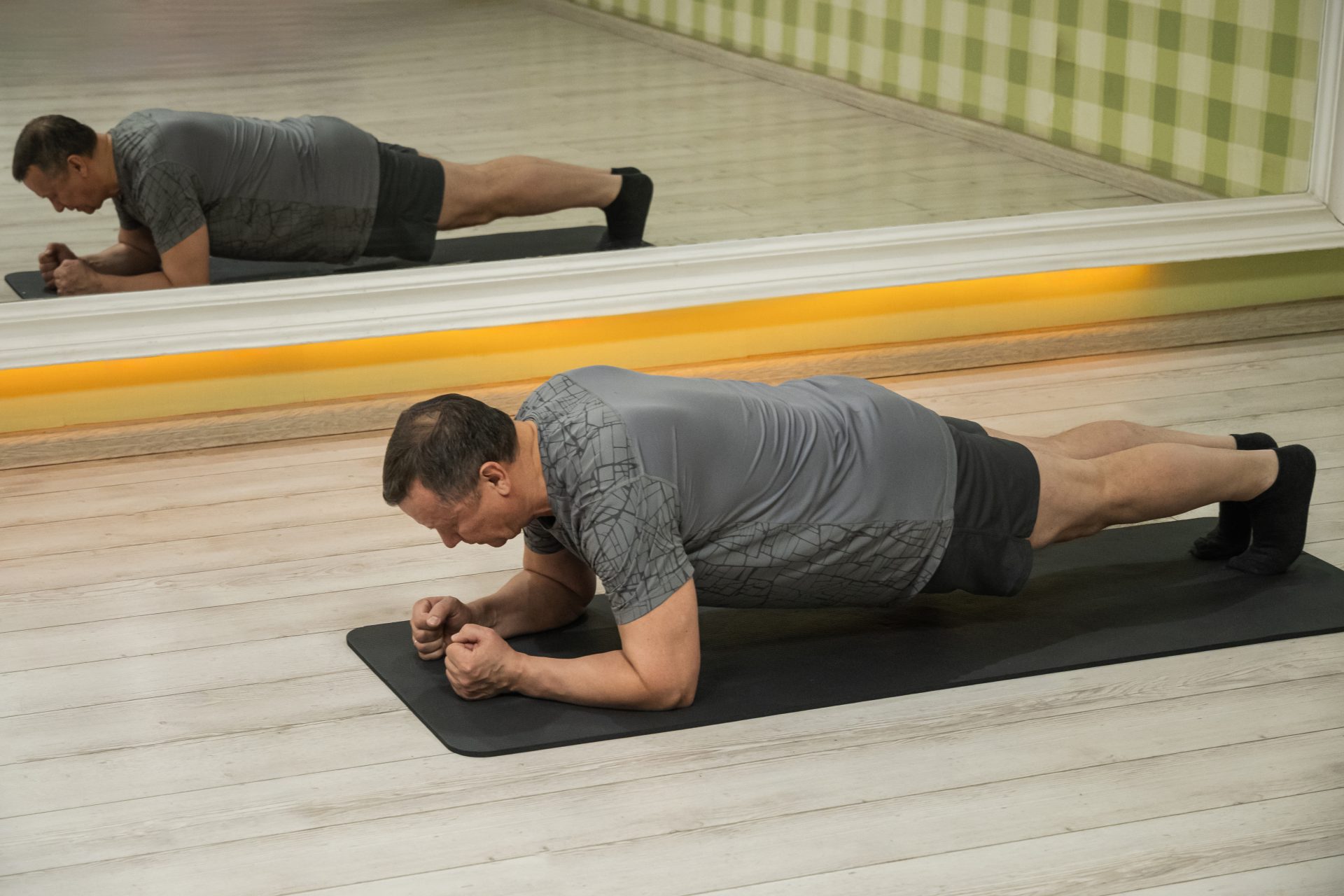
Core strength plank training is a progressive programme built around plank variations — the family of isometric and dynamic exercises that develop core stability through sustained muscular contraction against gravity and external forces. What makes a plank-specific core programme distinct from general ab training is its emphasis on total core stabilisation — training the transverse abdominis, obliques, spinal erectors, and shoulder girdle to work as an integrated unit, rather than isolating individual muscles through flexion exercises. The mechanism is anti-extension under progressive challenge. The plank trains the core to resist spinal extension (the natural tendency of the lower back to arch under load) — which is the primary function the core performs in real life and sport. Progressive plank training introduces this resistance challenge across multiple planes: the standard plank challenges sagittal extension; the side plank challenges frontal plane bending; the RKC plank and movement variations challenge the core under greater demand.
Start Your Free 14 Day Trial
Benefit 1: Deep Core Activation and Spinal Protection
Plank training specifically activates the transverse abdominis — the deepest core muscle and primary spinal stabiliser — at activation levels that conventional abdominal exercises cannot match.
Benefit 2: Improved Posture Through Total Core Endurance
The isometric demands of plank training develop the postural muscular endurance that sustains good spinal alignment throughout the day — a quality that no amount of crunching can produce.
Benefit 3: Shoulder Girdle Stability and Strength
The plank position requires the serratus anterior, lower trapezius, and rotator cuff to stabilise the shoulder blades actively — developing the scapular stability that overhead performance and shoulder health depends on.
Benefit 4: Better Performance in All Athletic Activities
Core stability — the ability to maintain spinal neutrality under load — is the foundation of all athletic power. A stronger plank directly improves performance in running, lifting, throwing, and sport through improved force transfer between the upper and lower body.
Protein — The Foundation of Core Strength Plank Training
Aim for 1.6–2.0g of protein per kg of bodyweight per day. Best sources include eggs, paneer, lentils (dal), chicken, Greek yoghurt, and whey protein. Distribute protein evenly across 3–4 meals rather than loading it all in one sitting. Adequate protein is non-negotiable — without it, training effort produces minimal adaptation regardless of programme quality.
Carbohydrates — Fuel for Core Strength Plank Performance
Complex carbohydrates (oats, brown rice, sweet potato, whole wheat roti) should form 40–50% of total calories. Consume a carbohydrate-containing meal 60–90 minutes before your core strength plank session to ensure glycogen availability. Post-session carbohydrates restore muscle glycogen within the critical 30-minute recovery window.
Anti-Inflammatory Foods for Recovery
Include turmeric (with black pepper for bioavailability), ginger, and omega-3 rich foods (flaxseeds, walnuts, fatty fish) daily. These directly reduce the systemic inflammation that accumulates with consistent training, speeding recovery between sessions.
Hydration — Often Underestimated
Aim for 35–40ml of water per kg of bodyweight daily. Add an additional 500ml for every 30 minutes of active training. Even mild dehydration (2% body weight) measurably reduces strength output and exercise capacity.
Before You Begin — What to Check
No medical clearance required for healthy individuals. Those with shoulder impingement, wrist pain, or lumbar disc conditions should consult a physiotherapist for modified entry positions (forearm plank, incline plank). Establish baseline: how long can you hold a perfect forearm plank with a neutral spine — hips level, no sag, no piking?
Your First 2 Weeks — Foundation Phase
Two sessions per week. Forearm plank from knees (20–30 seconds), side plank from knees (15–20 seconds each side), and the dead bug as active complement. Focus entirely on neutral spine throughout — hips level, lower back not arched, ribcage not flared. Form is everything in plank training.
Weeks 3–8 — Progressive Loading Phase
Three sessions per week. Progress to full forearm plank (toes on floor), side plank on feet, and introduce plank variations: shoulder tap plank (shifting weight side to side), plank hip dip (oblique activation). Increase duration by 5 seconds per week per variation.
Beyond 8 Weeks — Long-Term Maintenance
Introduce RKC plank (maximal isometric tension throughout — squeeze everything simultaneously), plank to pike, and loaded plank variations (weight plate on back, feet elevated). Measure progress through duration, variation complexity, and improvements in posture and back comfort in daily activities.

Forearm Plank (Standard Progression) — Transverse Abdominis, Rectus Abdominis, Obliques, Glutes, Shoulder Stabilisers
The standard forearm plank is the entry point to all plank training — it provides the foundational anti-extension stability training in a position most people can manage safely from day one. The key technique point: a straight line from head to heel, hips level (not sagging or piking), lower back in neutral (slight natural curve maintained). Beginner: perform from the knees; build to 30 seconds before progressing to the full plank.
Side Plank — Obliques (Lateral Core), Quadratus Lumborum, Hip Abductors
The side plank trains the lateral core — the obliques and quadratus lumborum — in the anti-lateral flexion pattern that most plank programmes neglect. This muscle group is critical for lateral spinal stability and for the hip abductor control that prevents the hip-drop pattern in running and single-leg activities. Beginner: perform from the knee (bottom knee bent, top leg straight); progress to full side plank as oblique endurance develops.
RKC Plank (Maximum Tension Variation) — Full Core — Maximal Isometric Activation
The RKC plank uses maximal intentional contraction of every body part simultaneously (squeeze the fists, drive the elbows toward the feet, squeeze the glutes, co-contract the core) — producing significantly greater muscle activation than a passive plank hold. Research shows it produces 30–50% greater transverse abdominis activation than the standard plank. Beginner: practise the cues separately before combining them; begin with 10-second maximum-tension holds.
Mistake 1: Allowing the Hips to Sag or Pike
Hip sag reduces core activation and increases lower back compressive stress; piking shifts load from the core to the shoulders. Both eliminate the training stimulus the plank is designed to provide.
Mistake 2: Holding the Plank Beyond Good Form
Holding a plank until form deteriorates (hips sagging, neck straining, breath-holding) trains faulty stabilisation patterns rather than producing useful core adaptation.
Mistake 3: Only Training the Standard Plank
The standard plank trains only the sagittal plane. Without side plank (frontal plane) and rotation challenges, the core’s lateral and rotational stability remains underdeveloped.
Mistake 4: Never Progressing the Plank Challenge
Performing the same 30-second plank for months produces a plateau in core adaptation. The plank, like every exercise, requires progressive challenge to continue producing results.
Complete Beginners Starting from Zero
No prior experience with core strength plank is required to start. Every movement is taught from its most foundational form, with modifications for those who cannot yet perform the standard version. Live instructor feedback prevents the form errors that cause beginners to plateau or get injured before results arrive.
Intermediate Trainees Who Have Hit a Plateau
If you have been exercising inconsistently or without structured progressive overload, core strength plank delivers the systematic load progression that general fitness classes do not. The programme targets the specific weaknesses and imbalances holding you back, producing results that months of unstructured training have failed to achieve.
Desk Workers and Sedentary Professionals
Extended sitting creates the exact muscle imbalances and weaknesses that core strength plank training corrects. No gym, no equipment, and no prior experience is required — the programme begins with bodyweight fundamentals and builds progressively from there. Habuild’s morning sessions fit into a working day without disruption.
Live Daily Sessions with Real-Time Instructor Feedback
Habuild’s live sessions — delivered daily by expert instructors — provide real-time form corrections for the specific technique errors that plank-based core strength training requires attention to. Unlike pre-recorded content, the live format means the instructor can see you and correct in the moment — the difference between building correct habits and reinforcing incorrect ones.
Condition-Specific Modifications in Every Session
Every exercise in the Habuild plank-based core strength programme is selected and modified with this specific goal in mind. Members are not attending a generic fitness class with a modification option bolted on — they are in a programme designed from the ground up for plank-based core strength outcomes.
Progressive Programming That Respects Your Recovery Timeline
The programme structure follows the physiological timeline of improvement — not an arbitrary 4-week or 8-week marketing format. Progression is earned through demonstrated capacity, not assumed by a calendar week.
Community of Members With the Same Goals


Practice Strong Everyday with Trishala Bothra, an IIT-B and London School of Business alumni
Trishala is focused on making movement feel lighter, more engaging, and something you actually look forward to.
In just 3 years, over 50,000 people began their strength journey, and 10,000+ join every week to keep getting stronger.