
Back pain weight training is a carefully structured resistance programme specifically designed to be performed safely alongside existing back pain — not instead of it.
What distinguishes back pain weight training from general strength training is its emphasis on the specific exercises that build the spinal stabilisers, posterior chain, and core musculature that reduce mechanical back pain, alongside the technique modifications, movement selections, and loading progressions that avoid aggravating sensitive spinal structures.
It is the opposite of rest — it is active, progressive intervention that addresses the muscular root causes of most chronic back pain.
The mechanism is structural support development.
Most chronic lower back pain is not caused by structural damage but by the muscular weakness, postural imbalance, and deconditioning that allow mechanical stress to fall on passive structures (discs, ligaments, facet joints) rather than being absorbed by the active musculature around them.
Back pain weight training progressively builds the spinal erectors, multifidi, glutes, and hamstrings that provide this active support — reducing the load on passive structures and gradually diminishing the pain they produce.
This is why exercise is consistently recommended over rest for most chronic back pain.
Benefit 1: Measurable Reduction in Chronic Back Pain
Research published in Spine journal found that specific lower back strengthening exercises reduced chronic lower back pain intensity by 58% on average — significantly more effective than rest, heat treatment, or passive physiotherapy alone. Stronger spinal stabilisers provide the active support that reduces disc compression and facet joint irritation with every movement of daily life.
Benefit 2: Improved Posture and Spinal Alignment
Weak posterior chain muscles — spinal erectors, glutes, and rhomboids — allow the forward-hunched posture that increases mechanical stress on the lumbar spine. Back pain weight training directly develops these postural muscles, producing the upright alignment that reduces pain by redistributing spinal load more evenly. Many practitioners notice meaningful postural improvement within 6–8 weeks.
Benefit 3: Greater Functional Capacity for Daily Activities
Carrying shopping, climbing stairs, picking up from the floor, and sustained standing all become easier and safer with a stronger back. The functional strength improvements from back pain weight training translate immediately into daily life — reducing the fear-avoidance cycle where pain leads to inactivity, which leads to greater weakness and more pain.
Benefit 4: Long-Term Prevention of Back Pain Recurrence
A structurally stronger back is more resilient to the postural demands and impact loads of daily life. Many practitioners find that consistent back pain weight training produces not just short-term pain relief but a lasting reduction in the frequency and severity of back pain episodes that previously disrupted their lives regularly.
Protein — The Foundation of Back Muscle Recovery
Aim for 1.6–2.0g of protein per kg of bodyweight daily. Best sources: eggs, paneer, dal, chicken, and Greek yoghurt. Protein is essential for the muscle protein synthesis that builds the stronger spinal stabilisers this programme targets. Distribute intake across 3–4 meals; post-training protein within 30–60 minutes supports optimal recovery.
Carbohydrates — Fuel for Training and Tissue Repair
Moderate carbohydrate intake from whole grains, vegetables, and legumes provides the energy that back training sessions require and the glycogen that supports training recovery. Anti-inflammatory carbohydrate sources — leafy greens, berries, sweet potato — also address the inflammatory component that contributes to chronic back pain.
Hydration and Micronutrients
Intervertebral discs are approximately 70–90% water — adequate hydration (2.5–3 litres daily) directly supports spinal disc health and function. Omega-3 fatty acids from flaxseeds and walnuts may help reduce systemic inflammation. Vitamin D and calcium support the bone density of the vertebrae that back training loads. Magnesium supports muscle recovery and may reduce the spasm that accompanies acute back pain.
Before You Begin — Setting Your Baseline
Consult your doctor or physiotherapist before beginning if you have: acute severe back pain, diagnosed disc herniation or prolapse, spinal stenosis, spondylolisthesis, or any neurological symptoms (numbness, weakness, or radiating leg pain). For chronic non-specific back pain, progressive strengthening is generally appropriate and recommended. Establish your baseline: pain level (0–10), daily activities most affected, and any movements that consistently worsen or relieve symptoms.
Week 1–2: Foundation Phase
Two sessions per week at the gentlest intensity. Begin with the safest foundational exercises: pelvic tilts, cat-cow mobilisation, dead bug, and bird-dog. Never train through sharp or radiating pain — mild muscular fatigue is acceptable; neurological symptoms or joint pain are not. Allow 48–72 hours between sessions. Do not attempt loaded exercises yet.
Week 3–8: Progressive Loading Phase
Three sessions per week where pain allows. Introduce glute bridge, Superman holds, and modified hip hinge patterns. Begin the core bracing technique before every movement. Add very light resistance — a resistance band or small bag — only after bodyweight movements are pain-free and consistent. Track pain levels before and after each session. Normal: mild muscle soreness. Warning sign: increased back pain, radiating symptoms, or pain that persists more than 48 hours.
Week 9+: Goal-Specific Advancement
Progress toward functional compound movements: Romanian Deadlift, farmer’s carry, and progressive loaded hinge patterns. These movements produce the strongest back and greatest real-world benefit. Introduce periodisation — varying intensity week by week. Continue monitoring symptom response and report improvements to your healthcare team, as medication adjustments may become appropriate.
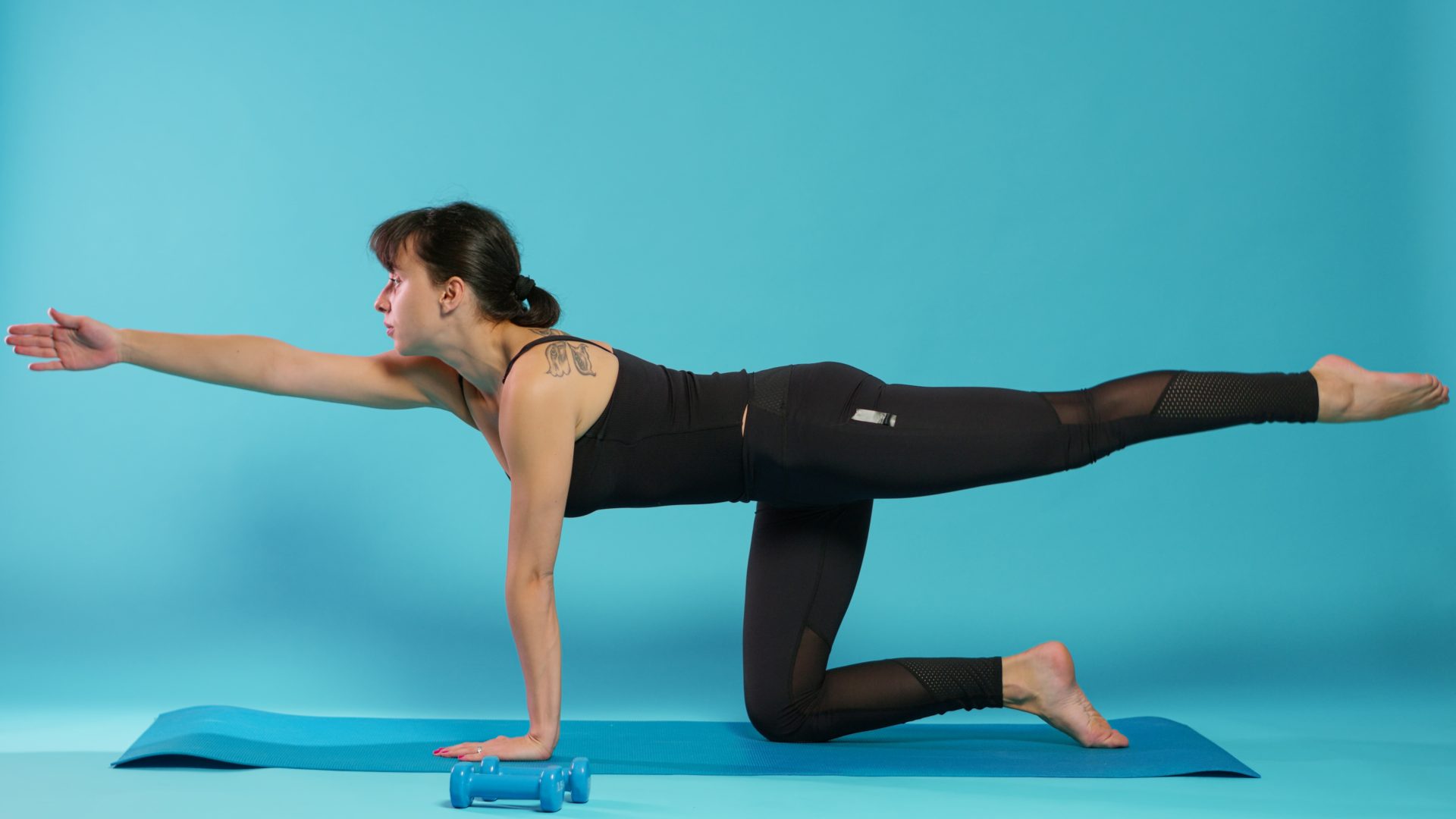
Bird-Dog — Spinal Stabilisers, Glutes, Core | 3 sets × 10 reps each side
The bird-dog trains the deep spinal stabilisers (multifidi) — the muscles that prevent individual vertebrae from shifting under load — through the contralateral limb extension pattern that directly develops spinal control. It loads the back without any spinal compression or shear, making it appropriate even in the presence of significant pain sensitivity. Beginner: arm only or leg only until the full extension can be performed without any back rotation or pelvic shifting.
Glute Bridge — Glutes, Hamstrings, Posterior Chain | 3 sets × 15 reps
The glute bridge strengthens the glutes and hamstrings that support the lumbar spine from below through hip extension — directly addressing the weak posterior chain that allows compensatory lower back loading. The floor-based supine position involves zero spinal compression, making it the safest loaded exercise for the most sensitive back pain presentations. Beginner: standard bilateral bridge with feet flat; progress to single-leg and weighted variations only as pain allows.
Romanian Deadlift — Hamstrings, Spinal Erectors, Glutes | 3 sets × 12 reps, slow eccentric
The Romanian Deadlift develops the complete posterior chain — the hamstrings, glutes, and spinal erectors that bear the load of every forward-bending and lifting activity in daily life. By progressively loading the hip hinge pattern with a neutral spine, it builds the structural capacity that allows pain-free lifting from the floor. Introduce only in weeks 4–6 after foundational exercises are established. Beginner: bodyweight hip hinge with hands sliding down the thighs; add load only after the neutral-spine pattern is completely established and pain-free.
Mistake 1: Training Through Sharp or Radiating Pain
The cardinal rule of back pain training: sharp pain or pain radiating into the leg during exercise is a stop signal — not a ‘push through it’ signal. These symptoms indicate that the current loading is aggravating sensitive structures rather than building resilience. Stop the exercise, choose a gentler modification, and consult your healthcare provider if radiating symptoms develop or worsen.
Mistake 2: Rounding the Lower Back Under Any Load
Lumbar flexion under load — the lower back rounding during exercises like rows or hip hinges — is the most common mechanism of disc injury in weight training. Maintaining neutral spine (preserving the natural lumbar curve) throughout every exercise is non-negotiable in back pain training. Reduce load immediately if neutral spine cannot be maintained through the full movement range.
Mistake 3: Returning to Heavy Loading Too Quickly When Pain Reduces
Pain reduction does not equal structural readiness for full training loads. Many practitioners reduce pain within 4–6 weeks and immediately attempt the heavy training that aggravated their back originally — producing relapse. Progress load by no more than 10% per week when pain has reduced. The progressive loading timeline exists for a reason.
Complete Beginners Starting from Zero
Back pain weight training is specifically accessible for those who have never exercised — because the foundational exercises (dead bug, bird-dog, glute bridge) require no equipment and begin at the gentlest possible intensity. The live instructor provides real-time form corrections from session one, ensuring the neutral spine technique that makes every exercise safe.
Those Who Have Been Told to Rest Their Back
Current clinical evidence strongly favours active intervention over rest for chronic back pain — staying still typically worsens the muscular deconditioning that perpetuates pain. A structured back pain weight training programme is the active approach that rest cannot provide.
Those Who Have Tried Back Exercises Before Without Lasting Relief
Most failed back pain exercise attempts involve either sporadic sessions without progressive overload, or generic exercises that do not target the specific stabilisers causing the pain. This programme addresses both — with built-in weekly progression and specific stabiliser emphasis.
Is Back Pain Weight Training Good for Beginners?
Yes — and it is specifically recommended. Beginning back strengthening before pain becomes chronic is significantly easier than rehabilitating it afterward. Every exercise in this programme starts at the safest available modification with full live instructor guidance.
Habuild is India’s First Habit Building Program for Yoga — and through its ‘Strong Everyday’ programme, it brings the same daily habit-building philosophy to back pain weight training. Consistency — showing up day after day — is the primary driver of back pain improvement that sporadic sessions cannot produce.
Goal-Specific Programming — Not a Generic Fitness Class
Every exercise selection, rep range, and progression in the back pain programme is chosen for its specific relevance to back pain management and safety. The programme opens with spinal stabiliser activation and progresses deliberately through the loading phases that are physiologically appropriate for back pain rehabilitation.
Live Daily Sessions with Real-Time Form Correction
Back pain training requires precise movement quality — small deviations from neutral spine can mean the difference between building resilience and aggravating pain. The live format allows the instructor to observe and correct in real time, from the very first session.
Progressive Overload Built into Every Session
Members do not need to design their own loading progression — it is built into the programme week by week. The gradual, deliberate increases ensure the back is consistently challenged without being overwhelmed.
Accountability, Streaks, and Community
I joined the Strength Session program to rebuild my yoga routine and bring back consistency after a long break.
I really enjoyed the Strength Session with Trishala — the timing fit perfectly into my routine.


Practice Strong Everyday with Trishala Bothra, an IIT-B and London School of Business alumni
Trishala is focused on making movement feel lighter, more engaging, and something you actually look forward to.
In just 3 years, over 50,000 people began their strength journey, and 10,000+ join every week to keep getting stronger.